
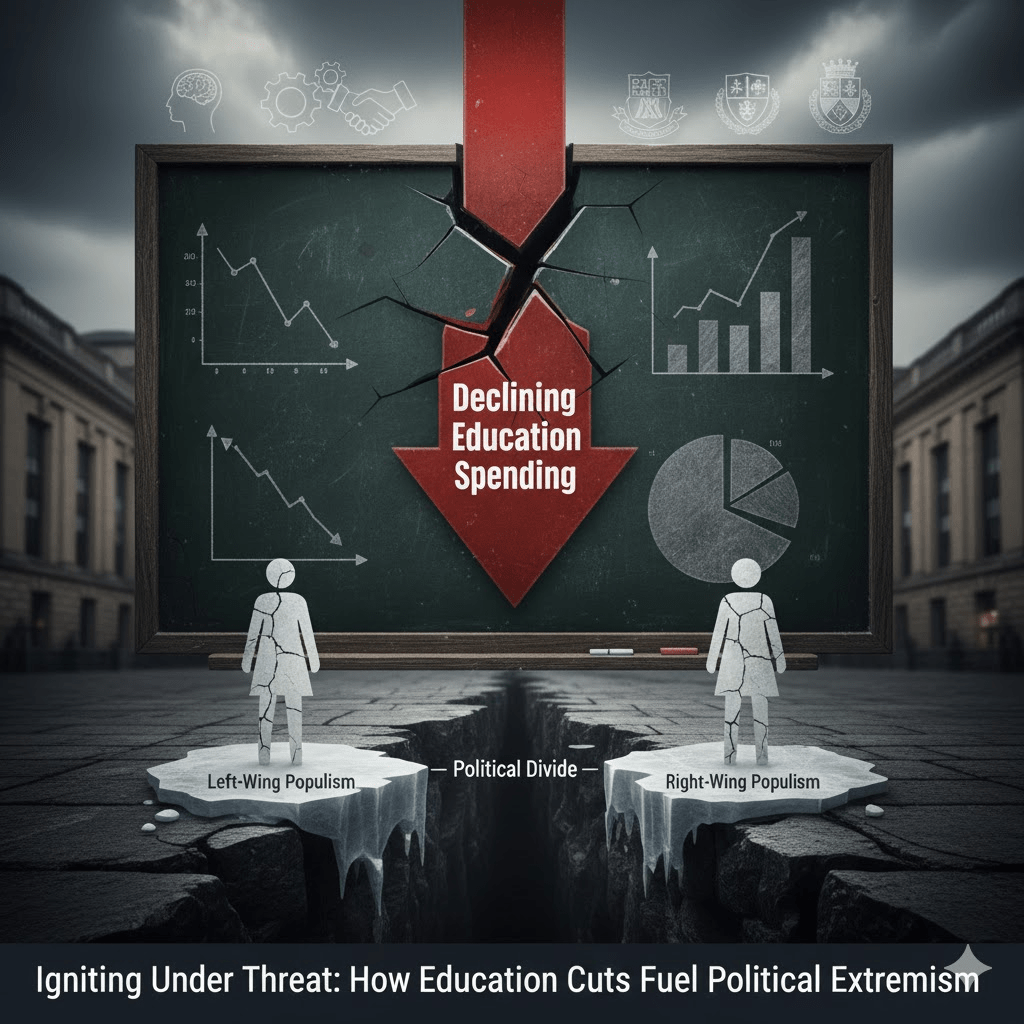
UK Education Spending: A Rollercoaster of Priorities
In our previous post, we explored the theoretical links between declining education investment and the rise of radical political attitudes. Now, let’s put theory to the test with concrete data from the UK and across Europe since 1946. We’ll uncover how shifts in public spending priorities, particularly on education, have coincided with profound changes in our political landscape, and critically, which political parties were at the helm during these pivotal moments.
Looking at the UK’s public education spending as a percentage of GDP reveals a telling pattern:
| Period | Trend in Education Spending (% of GDP) | Dominant Ruling Party Leaning | Key Policy Context | Political Aftermath |
| 1950s – Mid-1970s | Rapid Increase (Peaked approx 5.8% { of GDP} in 1975-76) | Mixed (Labour/Conservative) | Post-war consensus, welfare state expansion, significant investment in human capital. | Relatively stable, centrist politics. |
| Mid-1970s – Late 1990s | Decline/Stagnation (Fell to approx 3.9% { of GDP} by late 1990s) | Conservative (Right-Leaning) | Era of fiscal restraint, Thatcherite reforms, privatization, “load shedding” from the state. | Growing social inequality, rising disillusionment. |
| 2000 – 2010 | Rapid Increase (Peaked approx 5.5% { of GDP} in 2010) | Labour (Left-Leaning) | Significant re-investment in public services, “New Labour” focus on social mobility. | Initial period of relative political stability, though seeds of discontent were being sown. |
| Post-2010 | Significant Decline (Fell from approx 5.5% to approx 4.1$ by 2023) | Conservative/Coalition (Right-Leaning) | Austerity measures following the 2008 financial crisis, budget consolidation. | Dramatic rise in populism, Brexit, increased polarization. |
The Partisan Divide in Educational Investment:
The pattern is stark: periods of significant decline in education spending (as a proportion of national wealth) have predominantly occurred under Conservative (Right-leaning) governments. These declines were often driven by broader fiscal austerity agendas. Conversely, Labour (Left-leaning) governments have prioritized and accelerated investment in education.
Austerity and the Rise of Radicalism in Europe:
Beyond the UK, academic analysis across 166 European elections since 1980 paints a clear picture: austerity measures (which frequently include education cuts) are powerful catalysts for political instability and polarization.
- Increased Abstention: When governments cut public services, voters, particularly those most affected, feel their vote doesn’t matter. They disengage, leading to lower turnout.
- Surge for Non-Mainstream Parties: This disillusionment doesn’t just lead to apathy; it pushes voters towards radical, anti-establishment parties, both on the far-left and far-right. These parties offer clear, often simplistic, alternatives to the perceived failures of mainstream politics.
The Data Visualized:
Below, you’ll see a graph showing UK education spending as a percentage of GDP, highlighting the periods ruled by Left vs. Right-leaning governments. Overlayed are markers indicating significant shifts towards radical or populist political movements.
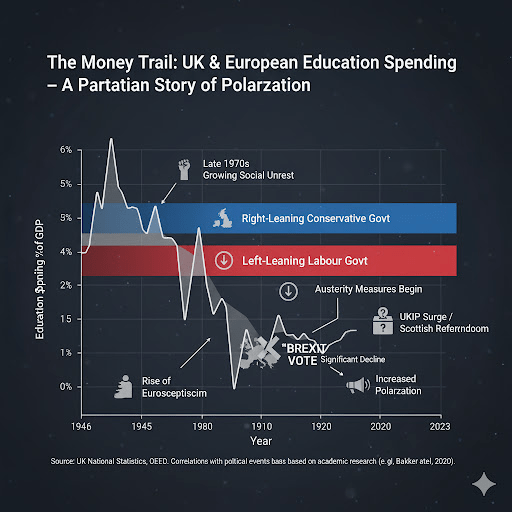
The graph starkly illustrates how the steepest declines in education spending correlate with the rise of significant populist and radical political shifts, especially in the post-2010 austerity era, which saw the Brexit vote and a dramatic increase in political polarization.
Coming Next:
In our final post, we’ll synthesize these findings and discuss the profound implications for the future of democracy in Europe. What can be done to reverse these trends, and what role must education play in building more resilient and cohesive societies?
First post – The Quiet Erosion
Second post – The Money Trail
Third Post – Beyond the Books

Discover more from Hysnaps Politics, Gaming, Music and Mental Health
Subscribe to get the latest posts sent to your email.


3 thoughts on “The Money Trail: UK & European Education Spending – A Partisan Story of Polarization”