

I will return to my on-going look at the UK national Debt and its democratic maturation. But recently I listened to Leon Trotsky’s “Fascism: What it is and how to fight it” -yep listened to, I’m a big fan of audible – and this made me wish to have a quick look at how relevant his writting was to the current political situation.
If you’ve ever read Leon Trotsky’s 1932 essay Fascism: What It Is and How to Fight It, or like me if you listened to it, you probably know that it’s not exactly light reading or easy listening. Trotsky wasn’t trying to be poetic — he was trying to warn the world that fascism doesn’t just happen. It grows. It builds. And it needs certain conditions before it can burst onto the political stage.
And here’s the surprising bit: when you look at late-20th-century and early-21st-century American politics, a lot of Trotsky’s checklist feels eerily familiar. Not identical — history never repeats cleanly — but familiar enough that it’s worth paying attention.
So let’s walk through Trotsky’s key steps in the rise of fascism, and see where modern America lines up… and where the comparison stops being useful.
1. Economic crisis that destabilises the middle class
Trotsky’s view: fascism feeds on a collapsing middle class — small businesses crushed, workers insecure, and people feeling abandoned.
Parallel in the U.S.
From the late 1970s onward, the American middle class didn’t collapse all at once, but it definitely eroded:
- Wages stagnated while productivity exploded: https://www.epi.org/productivity-pay-gap/
- Manufacturing jobs disappeared due to automation and offshoring
- The 2008 crash wiped out household wealth, especially among younger and minority workers: https://www.federalreserve.gov/econres/notes/feds-notes/wealth-inequality-and-the-racial-wealth-gap-20170927.html
That produced a huge pool of people who felt economically insecure, angry, and ignored — exactly the sort of constituency Trotsky argued fascists love to mobilise.
Where it diverges
The U.S. economy never fully “collapsed” in the way Weimar Germany’s did. The insecurity was real, but not existential. America remained a wealthy superpower with functioning institutions.
2. Political paralysis and declining faith in democracy
Trotsky’s view: fascism rises when parliamentary politics lose legitimacy — when people think “nothing ever changes” and the system stops working.
Parallel in the U.S.
By the 1990s and 2000s, the U.S. Congress was drifting into near-permanent gridlock. Public trust in government fell off a cliff:
https://www.pewresearch.org/politics/2023/09/19/public-trust-in-government-1958-2023/
Major legislation struggled to pass, and people on both the right and the left increasingly believed the system was rigged.
Enter the rhetoric of Trumpism:
- “Drain the swamp.”
- “The system is corrupt.”
- “Only I can fix it.”
This is straight out of Trotsky’s warning that fascists position themselves as anti-establishment saviours.
Where it diverges
The U.S. still has free elections, an independent judiciary, a functioning civil society, and a decentralised federal structure. Political decay? Yes. Complete systemic failure? No.
3. A mass movement driven by resentment, nostalgia, and cultural grievance
Trotsky’s view: fascism is not just a party — it’s a movement. It thrives on resentment and carries a promise to restore a “lost greatness.”
Parallel in the U.S.
“Make America Great Again” is, essentially, a nostalgia project. The emotional core of Trumpism lies in:
- demographic anxiety (e.g., fears of becoming a minority)
- cultural resentment
- distrust of media
- a feeling that elites look down on “ordinary Americans”
Research from PRRI and Pew tracks these trends clearly:
https://www.prri.org/research/
Trotsky would recognise this immediately — a mobilised base driven by grievance, feeling betrayed by traditional parties.
Where it diverges
Fascist movements historically relied on paramilitary formations (the Blackshirts, the Brownshirts).
Trumpism has seen sporadic militia activity (Proud Boys, Oathkeepers), but nothing on the scale of 1920s–30s Europe.
4. Big capital backing authoritarian populism (but not full fascism)
Trotsky’s view: fascism needs financial backing from sections of big business who fear social upheaval more than authoritarianism.
Parallel in the U.S.
Certain business sectors — fossil fuels, hedge fund donors, deregulation-friendly industries — supported Trump heavily:
https://www.opensecrets.org/overview/donors?cycle=2020&pac=true&type=C
But American corporate support is fragmented. Major companies fled after January 6. Wall Street shifted back to establishment candidates.
In Trotsky’s terms, capital flirted with authoritarian populism but never fully committed to fascism.
5. The attempted overturning of democratic outcomes
Trotsky’s view: fascism takes power by destroying democratic institutions outright.
Parallel in the U.S.
January 6, 2021, was an attempt to overturn an election. There’s no sugar-coating it.
Evidence:
U.S. House Select Committee Final Report: https://www.govinfo.gov/app/collection/january-6th-final-report
Militias, conspiracy movements, and extremist groups behaved exactly as Trotsky describes when a fascist leader attempts to use mass mobilisation to cling to power.
Where it diverges
Crucially, U.S. institutions held:
- courts rejected false claims
- state officials certified results
- the military refused involvement
- the transition happened
Trotsky would say this is the moment where America did not slip into fascism.
So did Trotsky “predict” Trump?
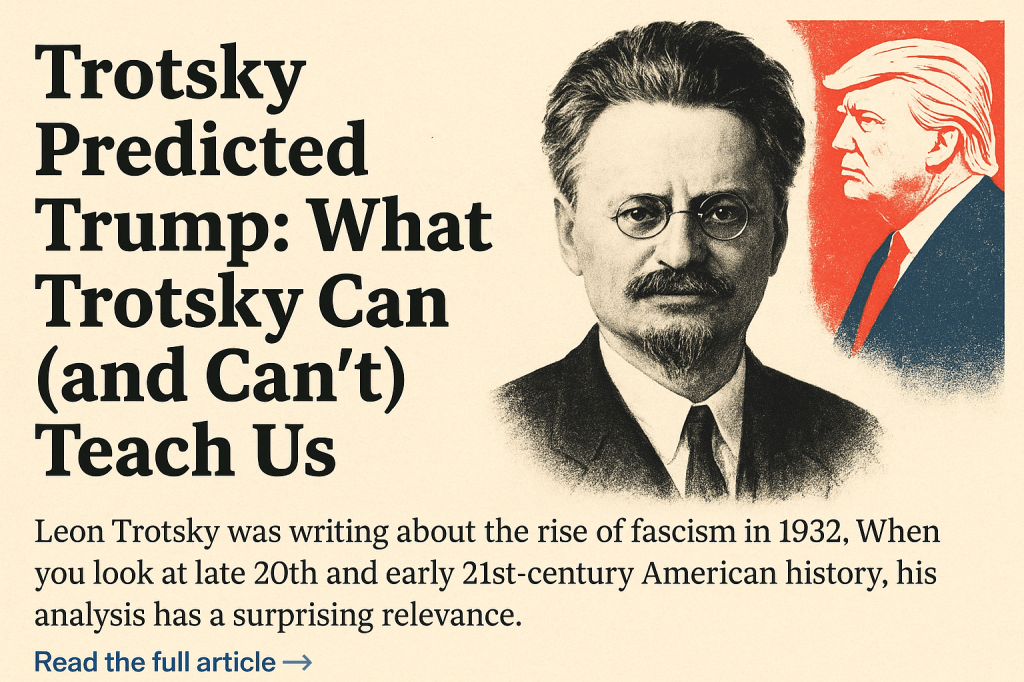
Not exactly — but Trotsky did give us a framework for understanding how unstable capitalism, political breakdown, and mass resentment can create a fertile environment for authoritarian populism.
Where Trotsky is useful:
- explaining the emotional engine of the movement
- understanding the role of economic insecurity
- showing how democratic institutions erode before authoritarianism rises
Where Trotsky breaks down:
- the U.S. has no single catastrophic crisis on the scale of the Great Depression
- American institutions are stronger and more decentralised
- Trumpism lacks a unified paramilitary force
- the ruling class never fully aligned behind authoritarianism
America flirted with the conditions Trotsky warned about — but didn’t fulfil them.
Final Thought
Trotsky would argue that the way to prevent fascism is not moral outrage, but material solutions — rebuilding economic security, reducing political alienation, and giving people a genuine stake in democracy.
You don’t have to be a Marxist to see that this remains very good advice.
In my next post I am going to repeat this but for the situation in the UK, and then I will, I promise, return to my previous topic.

Discover more from Hysnaps Politics, Gaming, Music and Mental Health
Subscribe to get the latest posts sent to your email.

