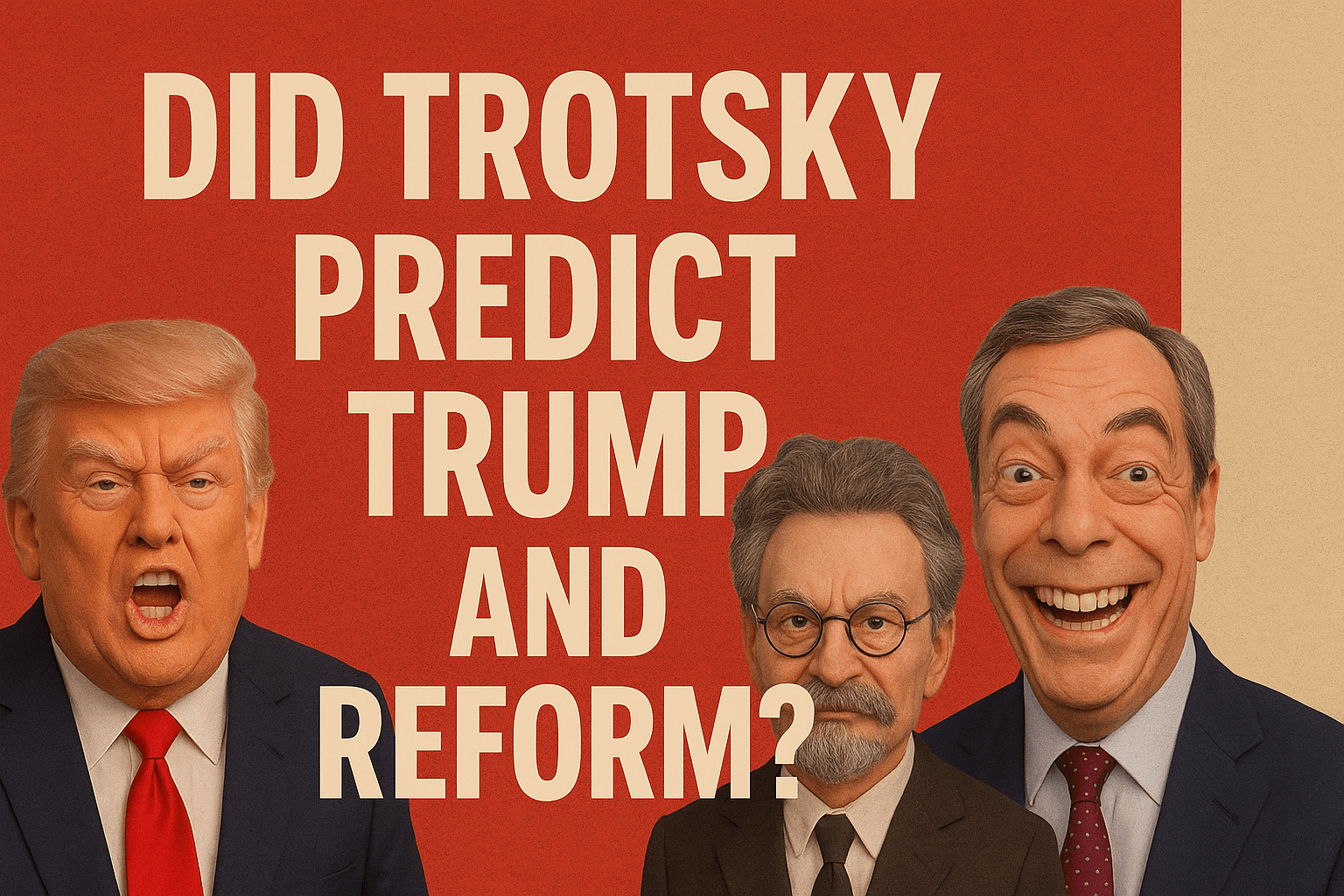
A conversational look at how Trotsky’s theory of fascism helps explain the UK’s political moment — and why it diverges from the US experience.
In the earlier US post (“Trotsky Predicted Trump”), we looked at how Leon Trotsky’s 1930s analysis of fascism eerily parallels some modern American dynamics. Trump’s political rise, MAGA identity politics, and the fusion of resentment, nationalism, and culture war do map — to a point — onto Trotsky’s warning that fascism emerges when a crisis-ridden ruling class mobilises mass discontent to preserve its power.
But what if we take that same Trotskyist lens and apply it to the UK?
Some similarities appear — stagnation, inequality, cultural resentments — but the outcomes are very different. And critically, Nigel Farage and Reform UK are not the British MAGA, despite common headlines claiming so. Trotsky’s framework helps explain exactly why.
Let’s walk through this in a clear, conversational way, linking back to the US comparison where helpful.
1. Inequality: Similar Pressures, Softer Politics
As discussed in the US post, American inequality has exploded since the 1970s and has fed a truly combustible political climate.
US:
- Inequality is extreme and rising
- Resentment fuels MAGA mobilisation
Sources: - https://wid.world/
- https://en.wikipedia.org/wiki/Income_inequality_in_the_United_States
UK:
- Inequality surged in the 1980s and stayed high, but didn’t escalate like in the US
- Political anger expresses as frustration, not insurrection
Sources: - https://www.ifs.org.uk/articles/uk-income-inequality-1961-2021
The Trotsky link:
He argued fascism grows from desperate small-business and working-class strata crushed between capital and labour.
The US fits this emotional profile far more sharply.
The UK — for now — does not.
2. Education: A Political Sorting System — But Not America-Level
In the US post, we noted that education has become a massive political predictor.
US:
Degree = Democrat
No degree = Republican/MAGA
Source: https://www.pewresearch.org/politics/2023/07/12/voters-in-2022/
UK:
The divide exists, but is milder.
Graduates → Labour/Lib Dem
Non-graduates → Conservative/Reform
Source: https://commonslibrary.parliament.uk/research-briefings/cbp-9186/
Trotsky stressed that the petty bourgeoisie becomes reactionary when it loses its social footing.
In the US, this group radicalised.
In the UK, it’s mostly disillusioned.
3. Class Identity: The UK Still Feels It — The US Thinks It’s Middle Class
This was a major difference in the US post.
US:
Class is aspirational. Everyone thinks they’re “middle class.”
Source: https://en.wikipedia.org/wiki/American_middle_class
UK:
Class is culturally embedded — accent, geography, opportunities.
Source: https://en.wikipedia.org/wiki/Social_class_in_the_United_Kingdom
This deeply affects how anger expresses itself.
The American system produces rage-driven “revolt against elites.”
The British system produces boredom, cynicism, and protest votes.
From Trotsky’s view, that’s the difference between a mass movement and a sigh.
4. Media: The UK Has Culture Wars — But Not a MAGA Machine
In the US post, we highlighted the way media ecosystems harden political identities.
US:
Fox News, talk radio, and social media create a 24/7 mobilisation engine.
Source: https://en.wikipedia.org/wiki/Mass_media_in_the_United_States
UK:
Partisan papers exist, but TV remains regulated and less inflammatory.
Source: https://en.wikipedia.org/wiki/Media_of_the_United_Kingdom
And trust in legacy news remains higher:
https://reutersinstitute.politics.ox.ac.uk/digital-news-report/2024
Without the same media megaphone, there is no UK equivalent of the MAGA identity factory.
5. Regional Identity: Divergent Structures
In the US post, geographic identity was a major factor (red states, blue states).
US:
Urban/rural divides map clearly onto ideological identities.
Source: https://en.wikipedia.org/wiki/Red_states_and_blue_states
UK:
Political geography is fragmentary:
- Scotland → SNP / independence
- Wales → Labour tradition
- England → Regions differ sharply
- Northern Ireland → Entirely separate system
Source: https://en.wikipedia.org/wiki/Politics_of_the_United_Kingdom
This prevents the formation of a single, unified nationalist movement of the US type.
Trotsky emphasises the need for a single national myth.
The UK currently has four competing ones.
6. Trust in Government: US Hostility vs UK Competence Fatigue
In the US post, distrust was a central driver.
US:
Distrust is ideological (“government is evil”).
Source: https://www.pewresearch.org/politics/2023/09/19/public-trust-in-government-1958-2023/
UK:
Distrust is pragmatic (“government is useless”).
Sources:
https://www.ipsos.com/en-uk/britain-and-public-trust-politics
https://www.instituteforgovernment.org.uk/publication/trust-government
Trotsky insisted that fascism emerges when the masses abandon faith in both the ruling class and parliamentary democracy.
The UK distrusts politicians — but not the concept of democracy itself.
7. Why Reform UK Isn’t Trumpism (Through Trotsky’s Lens)
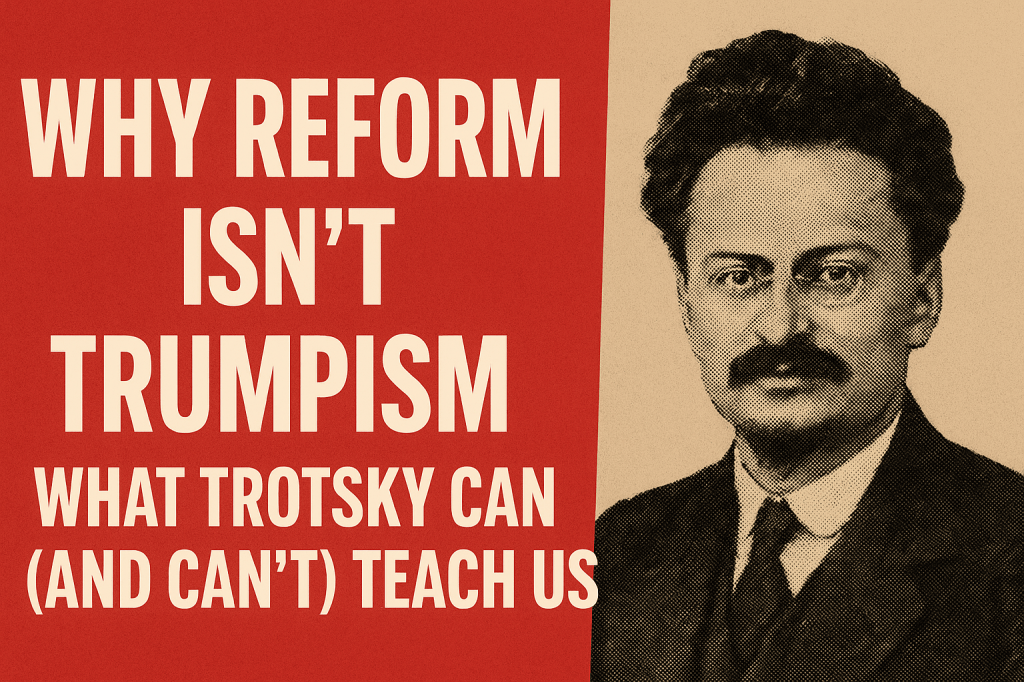
Here’s the key part — and where Trotsky helps the most.
Many UK commentators lazily describe Reform as “the British MAGA.”
But Trotsky’s framework shows that this analogy doesn’t hold.
(1) Trotsky says fascism requires a mass, mobilised petty-bourgeois movement.
MAGA has one.
Reform does not.
Reform’s support is older, less mobilised, more sceptical, and more dispersed.
(2) Trotsky says fascism requires a “party of civil war” — street force.
Reform has no militias, no insurrectionists, no paramilitaries.
(3) Trotsky says fascism claims to embody the entire nation.
Trump claims to speak for “real America.”
Farage speaks to particular grievances, not national identity.
(4) Trotsky says fascism thrives when conservative parties collapse.
In the US, the Republican Party was captured by its base.
In the UK, the Conservative Party is decaying — but remains structurally intact.
(5) Reform has no unified ideological worldview.
MAGA blends nationalism, Christian identity, conspiracy, and anti-state doctrine.
Reform blends immigration frustration, deregulation talk, and tabloid culture wars — but lacks coherence.
**Trotsky would not call Reform proto-fascist.
He would call it a brittle, protest-driven pressure party.**
Farage channels anger.
Trump channels identity.
Reform is not Trumpism because the UK is not the US — socially, ideologically, institutionally, or emotionally.
Conclusion: Similar Conditions, Different Destinies
Looking at the UK and US side-by-side through Trotsky shows:
| Theme | US (Trumpism) | UK (Reform) |
|---|---|---|
| Degree of resentment | explosive | weary, annoyed |
| Mass mobilisation | high | low |
| Paramilitary presence | present | absent |
| National myth | strong | fragmented |
| Media radicalisation | extreme | moderate |
| Trust collapse | deep | shallow |
| Political threat | system-level | electoral turbulence |
Reform is disruptive — not revolutionary.
Frustrated — not mobilised.
Populist — not fascist.
Trotsky reminds us that the conditions of crisis are present in both countries.
But the form that crisis takes is fundamentally different.
I hope you’ve enjoyed or at least found these 2 posts informative. I will return to my longer series regarding UK Debt, proberly, in my next post.

Discover more from Hysnaps Politics, Gaming, Music and Mental Health
Subscribe to get the latest posts sent to your email.

