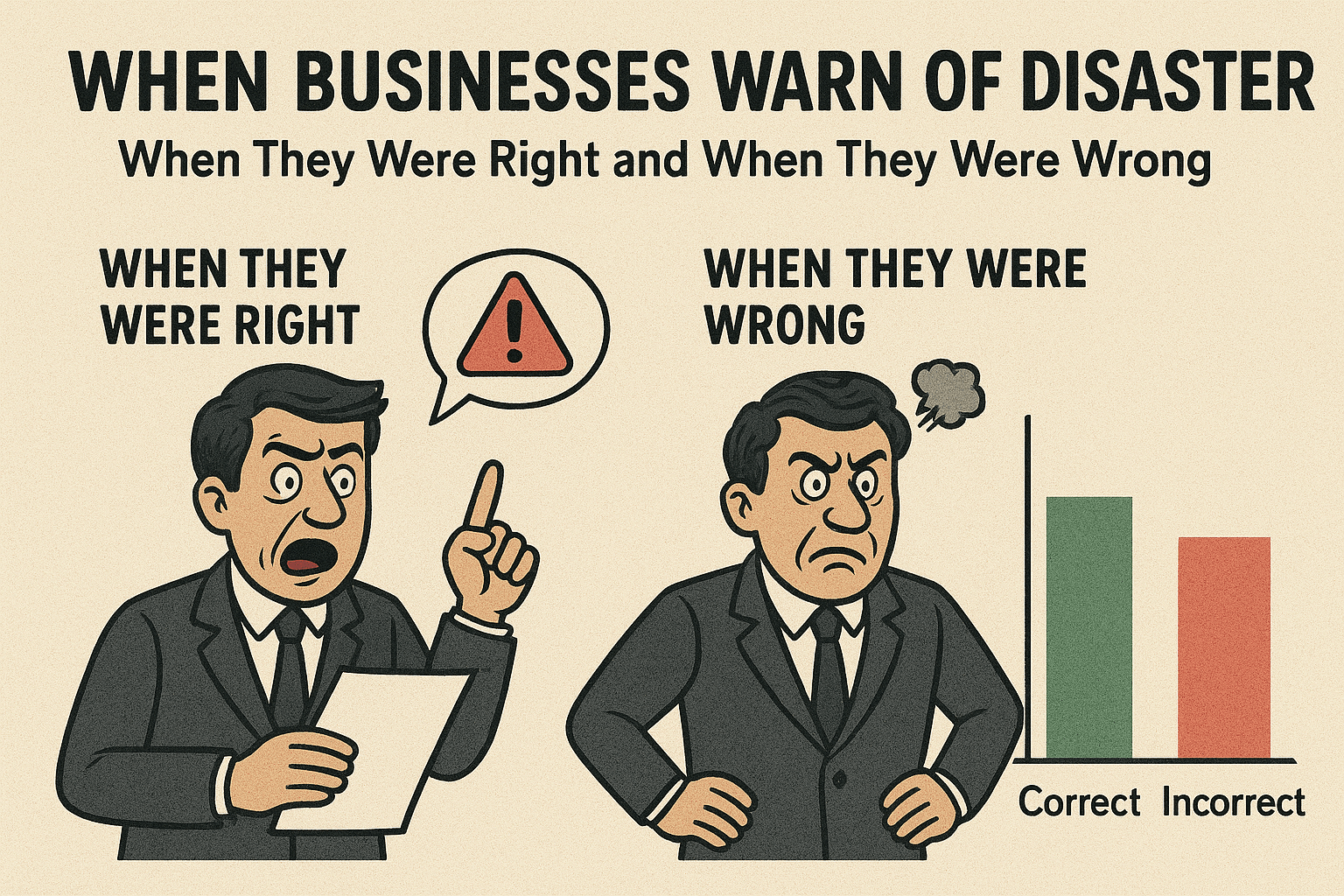
Lets have a look at how business reactions to government Budgets and economic decisions match up with reality — and which political parties were in power when those decisions were taken.
Businesses often issue strong warnings when governments introduce new Budgets, taxes or regulations. Some predictions prove accurate. Others fade quickly or are shown to be exaggerated.
I’m going to compare some major examples where businesses warned of economic damage, identifying when they were right, when they were wrong, and which political party was responsible for the Budget or policy.
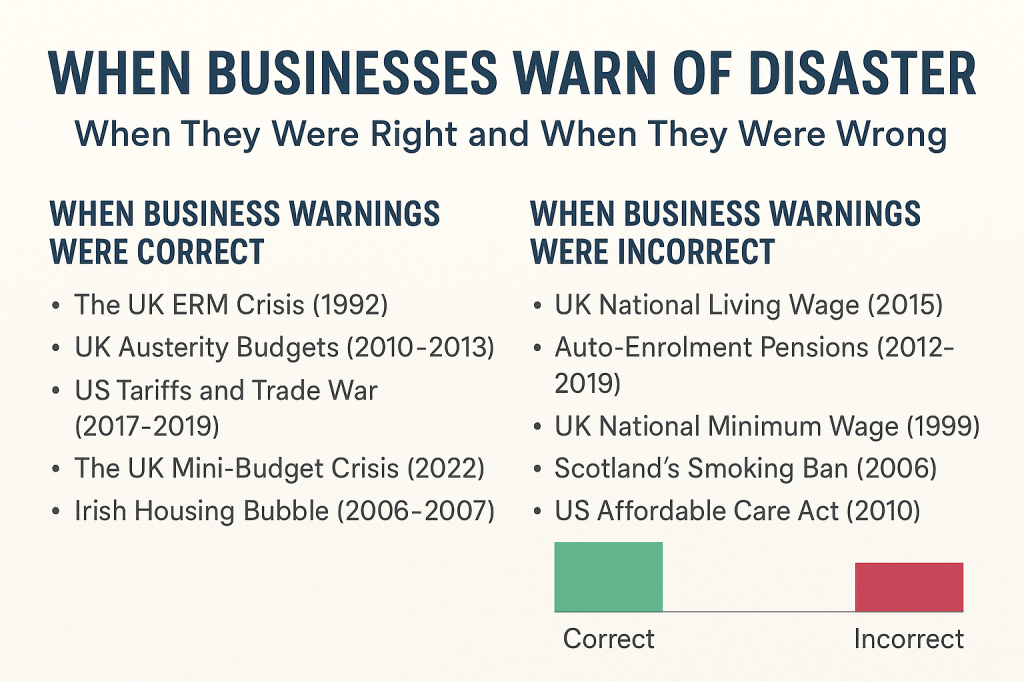
When Business Warnings Were Correct
1. The UK ERM Crisis (1992)
Party in power: Conservative (John Major)
During the UK’s struggle to keep the pound inside the European Exchange Rate Mechanism, business groups warned that interest rates of up to 15% were unsustainable and would damage investment and demand.
They were proven correct on “Black Wednesday”: the UK exited the ERM, markets were shaken, and the crisis deepened a recession.
References:
- https://en.wikipedia.org/wiki/Black_Wednesday
- Bank of England rates: https://www.bankofengland.co.uk/boeapps/database/Bank-Rate.asp
2. The UK Austerity Budgets (2010–2013)
Party in power: Conservative–Liberal Democrat Coalition (Cameron–Clegg)
Many businesses warned that rapid fiscal tightening after 2010 would depress demand and slow the recovery from the financial crisis.
Later analysis by the OBR and independent economists confirmed unusually slow growth, weak investment and stagnating productivity.
References:
- OBR Economic Outlook: https://obr.uk/overview/economic-and-fiscal-outlook/
- Productivity overview: https://en.wikipedia.org/wiki/Productivity_in_the_United_Kingdom
3. US Tariffs and the Trade War (2017–2019)
Party in power: Republican (Donald Trump)
Businesses warned that tariffs on Chinese imports would raise costs and invite retaliation.
These warnings proved correct: manufacturing supply chains were disrupted and agricultural exports fell sharply.
References:
- https://en.wikipedia.org/wiki/China%E2%80%93United_States_trade_war
- Brookings analysis: https://www.brookings.edu/articles/the-impacts-of-the-us-china-trade-war/
4. The UK Mini-Budget Crisis (2022)
Party in power: Conservative (Liz Truss)
The 2022 “Growth Plan” introduced large tax cuts without funding. Businesses warned of a market backlash.
Within days, gilt yields spiked, pension fund risks emerged, and the Budget was reversed.
References:
- https://en.wikipedia.org/wiki/2022_United_Kingdom_mini-budget
- FT market reaction: https://www.ft.com/content/bb114bc9-2cc4-4c08-8e3c-c73bf0169930
5. Irish Housing Bubble (2006–2007)
Party in power: Fianna Fáil–Progressive Democrats coalition
Construction groups and economists warned Ireland’s property market was dangerously overheated.
The market collapsed soon after, confirming the concerns.
References:
When Business Warnings Were Incorrect
1. UK National Living Wage (2015)
Party in power: Conservative (David Cameron)
Before its introduction, some groups predicted job losses and widespread business closures.
Instead, employment rose, inflation stayed low, and most sectors adapted successfully.
References:
- https://en.wikipedia.org/wiki/National_Living_Wage
- ONS employment data: https://www.ons.gov.uk/employmentandlabourmarket
2. Auto-Enrolment Pensions (2012–2019)
Party in power: Conservative–Liberal Democrat Coalition (2012 launch)
Businesses — especially SMEs — predicted heavy costs and hiring freezes.
In practice, compliance was manageable and participation exceeded 90%.
References:
3. UK National Minimum Wage (1999)
Party in power: Labour (Tony Blair)
Before the minimum wage, business groups warned of mass unemployment and inflation.
None of these predictions occurred. Employment rose and inflation stayed stable.
References:
4. Scotland’s Smoking Ban (2006)
Party in power: Labour–Liberal Democrat coalition (Holyrood)
Some hospitality groups warned pubs and restaurants would suffer severe losses.
Revenues stabilised and long-term impacts were limited.
References:
5. US Affordable Care Act (Obamacare, 2010)
Party in power: Democratic (Barack Obama)
Businesses predicted rising costs, layoffs and a major shift to part-time work.
Unemployment fell for many consecutive years after the law took effect.
References:
- https://en.wikipedia.org/wiki/Patient_Protection_and_Affordable_Care_Act
- US unemployment: https://www.bls.gov/charts/employment-situation/civilian-unemployment-rate.htm
Why Business Predictions Vary
1. Economic uncertainty
Most industries prefer stability, so any change — especially Budget-related — tends to generate worst-case scenario predictions.
2. Lobbying incentives
Businesses often highlight the most extreme impacts to influence policy decisions.
3. Short-term vs long-term effects
Some policies have initial adjustment costs but longer-term benefits (e.g., wage improvements boosting demand).
4. Genuine market risks
When the issue affects financial stability — currency crises, bond markets, pension funds — business warnings often prove accurate.
Conclusion
History shows that business reactions to Budgets and economic decisions are mixed.
Some warnings are justified, especially when market confidence or financial stability are at stake.
But many predictions — particularly around wages, regulation or public health — have not materialised and often reflect uncertainty or lobbying rather than economic fundamentals.
The political context matters too: every party, from Conservative to Labour to coalition governments, has experienced moments where business fears were either validated or disproved.
In the next post I am going to see if I can have a more comprehsive look at variation in Business Sentiment around Uk Budgets and actual economic performance.
You may be asking – “When are you returning to your posts on Government debt?”, well this is directly and indirectly related to those posts as getting an understanding of this issue will help untangle the issues of Government debt.
Discover more from Hysnaps Politics, Gaming, Music and Mental Health
Subscribe to get the latest posts sent to your email.


2 thoughts on “Business Budget Warnings: Whether they get it right or wrong”