I originally hoped to answer this question by running a proper statistical time-series analysis: budget-by-budget business sentiment compared with GDP, inflation, and investment outcomes from 1975 to 2025.
A lovely idea.
A nightmare in practice.
But here’s the catch: there is no single, unified public dataset that tracks business sentiment linked directly to each budget for the last 50 years. You would need to stitch together survey data from the CBI, British Chambers of Commerce, ONS, and HM Treasury, each with different methodologies, sample sizes, and publication frequencies.
In plain English:
It’s possible… but it’ll take a while.
(And yes — I’m still going down that rabbit hole.)
So while the full statistical model cooks away in the background, here’s what we can say by pulling together the existing research, surveys, and historical evidence — and relying on what businesses have always used alongside spreadsheets: their gut feeling.
Historical Observations in Business Gut feeling and Budgets
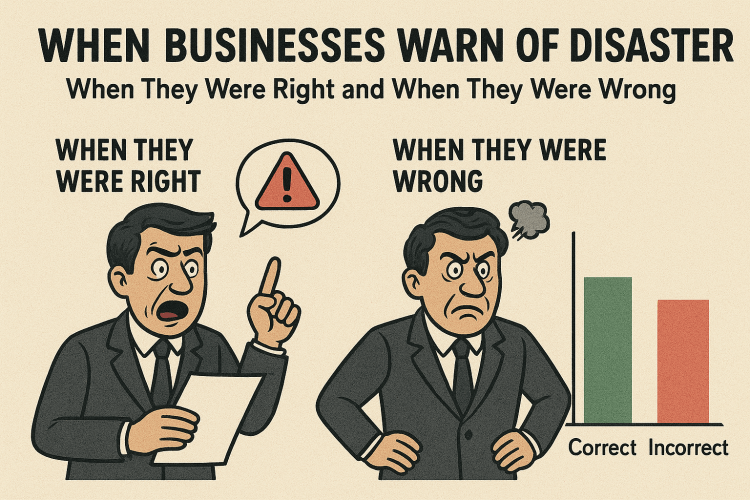
Based on 50 years of post-Budget reactions, business surveys, market responses, and government archives, several consistent themes emerge.
I.Gut Feeling Says: “Stability Matters More Than the Details”
If businesses could vote for one thing in every Budget, it would be predictability.
When it goes wrong
Budgets that surprise markets or abandon expected fiscal rules tend to crash confidence immediately — no matter how “pro-business” the individual measures look.
The best example is the 2022 Mini-Budget, which caused:
- a surge in gilt yields
- the pound crashing
- pension fund instability
- immediate business panic
Evidence:
- Bank of England review: https://www.bankofengland.co.uk/quarterly-bulletin/2023/2022-q4
- OBR assessment: https://obr.uk/box/the-september-2022-fiscal-event/
When it goes right
Budgets that reinforce long-term fiscal discipline, or clarify multi-year plans, often boost sentiment — even if taxes go up or spending tightens.
Businesses prefer a painful certainty to a pleasant surprise that spirals into chaos.
II. How Businesses’ Concerns Have Shifted Over Time
Businesses haven’t always worried about the same thing. Their gut feeling focus has evolved.
Late 1970s–1980s: Inflation, inflation, inflation
Budgets were judged almost entirely through the lens of inflation control.
1980s–1990s: Tax cuts and investment incentives
Corporate tax reductions and schemes like Enterprise Zones got positive reactions.
Evidence:
- HMRC historical rates: https://www.gov.uk/government/statistics/historical-tax-rates
- Enterprise Zones: https://publications.parliament.uk/pa/cm201011/cmselect/cmcomloc/1142/1142.pdf
2010s onward: Uncertainty and tax freezes bite hard
In the modern era, businesses constantly cite:
- frozen thresholds
- last-minute NI changes
- inconsistent Corporation Tax plans
This shows up across the BCC and CBI surveys:
III. When Global Events Drown Out Any Budget
Sometimes the world simply doesn’t care what’s in the Red Box.
Examples:
- 1973 & 1979 Oil Crises: inflation blew through everything
- 2008 Financial Crisis: budgets became footnotes to a global meltdown
- 2020 COVID: business confidence sank due to lockdowns and global trade collapse
- 2022 Ukraine energy shock: UK energy bills drove sentiment more than any fiscal measure
Supporting sources:
- IMF World Economic Outlook: https://www.imf.org/en/Publications/WEO
- ONS inflation series: https://www.ons.gov.uk/economy/inflationandpriceindices
In these periods, businesses didn’t react to the Budget — they reacted to reality.
IV. The Modern Importance of “Fiscal Headroom”
Since the OBR was created in 2010, a new driver of business gut instinct has appeared:
How close is the Chancellor to breaking their own rules?
If a Budget reveals more headroom than expected, confidence rises.
If it reveals less, businesses tense up.
What “OBR headroom” actually means:
https://obr.uk/fiscal-risks-and-sustainability/
Budget Case Studies: Sentiment vs. Economic Reality
These four budgets illustrate how gut feeling and outcomes often diverge.
| Budget Date | Context & Stance | Pre-Budget Sentiment | Sentiment After Budget | 12-Month Reality | Observation |
|---|---|---|---|---|---|
| June 1979 (Howe) | VAT rise from 8%→15%; spending cuts; shift from direct tax | Fragile / inflation-driven | Mixed/ Negative | 1980 recession; >20% inflation | Macro forces overwhelmed pro-enterprise tax changes |
| July 1997 (Brown) | Stability; fiscal rules; BoE independence | Optimistic | Positive | Strong, stable growth | Credibility mattered more than specific measures |
| March 2008 (Darling) | Downplaying early GFC risk | Deteriorating | Sharply Negative | Deep recession | Budget viewed as disconnected from reality |
| Sept 2022 (Kwarteng) | Unfunded tax cuts; no OBR forecast | Fragile | Catastrophic collapse | Market chaos, borrowing spike | Proof that credibility > tax cuts |
What We Learn From All of This
1. Credibility is worth more than any tax cut
Give businesses:
- stability
- predictability
- rules they trust
…and confidence rises.
Break these, and confidence collapses, regardless of headline measures.
2. Certainty beats generosity
Businesses prefer:
- five boring Budgets
over - one exciting Budget followed by a crisis.
3. Global shocks pick their own winners
Even the best-crafted Budget can’t defeat an oil shock or a global banking collapse.
So… Which Party Has Actually Been Better for Business?
The honest answer is: it depends on the metric, and luck plays a huge role.
1. Stock Market Returns
Winner: Conservatives (slightly)
- FTSE All-Share grows ~4.9%/yr under Conservatives vs ~3.9% under Labour
2. GDP Stability
Winner: Labour (historically)
Due to:
- the Great Moderation
- fewer recessions
- lucky timing
ONS GDP long-term series:
https://www.ons.gov.uk/economy/grossdomesticproductgdp/timeseries/abmi/pn2
3. Business Investment
Winner: Neither
The UK chronically under-invests.
OECD data:
https://data.oecd.org/gdp/gross-fixed-capital-formation.htm
Flatlining post-2016 reflects uncertainty more than ideology.
The Real Answer: The Best Budgets Are… Boring
Historically, the budgets that businesses like the most weren’t flashy, ideological, or full of surprises.
They were the calm, predictable, technocratic budgets that allowed companies to plan five or ten years ahead without worrying that everything might change next quarter.
Think:
- Ken Clarke (1993–1997)
- Gordon Brown (1997–2005)
Stability beats surprise.
Credibility beats politics.
And boring Budgets beat exciting ones almost every time.
So after all that in the words of Terry Pratchett –
‘They think they want good government and justice for all, Vimes, yet what is it they really crave, deep in their hearts? Only that things go on as normal and tomorrow is pretty much like today.’
Terry pratchett – Feet of clay
Now after this small diversion, I will get back to my main topic.
Discover more from Hysnaps Politics, Gaming, Music and Mental Health
Subscribe to get the latest posts sent to your email.

