
Over the last 27 days and 27 posts I have looked at a range of Social and Economic issues facing the UK, interspaced with some randomness, now is the time to pull all this together.
Because when you examine how political money, media power, and structural incentives shape British politics, the old saying becomes painfully relevant:
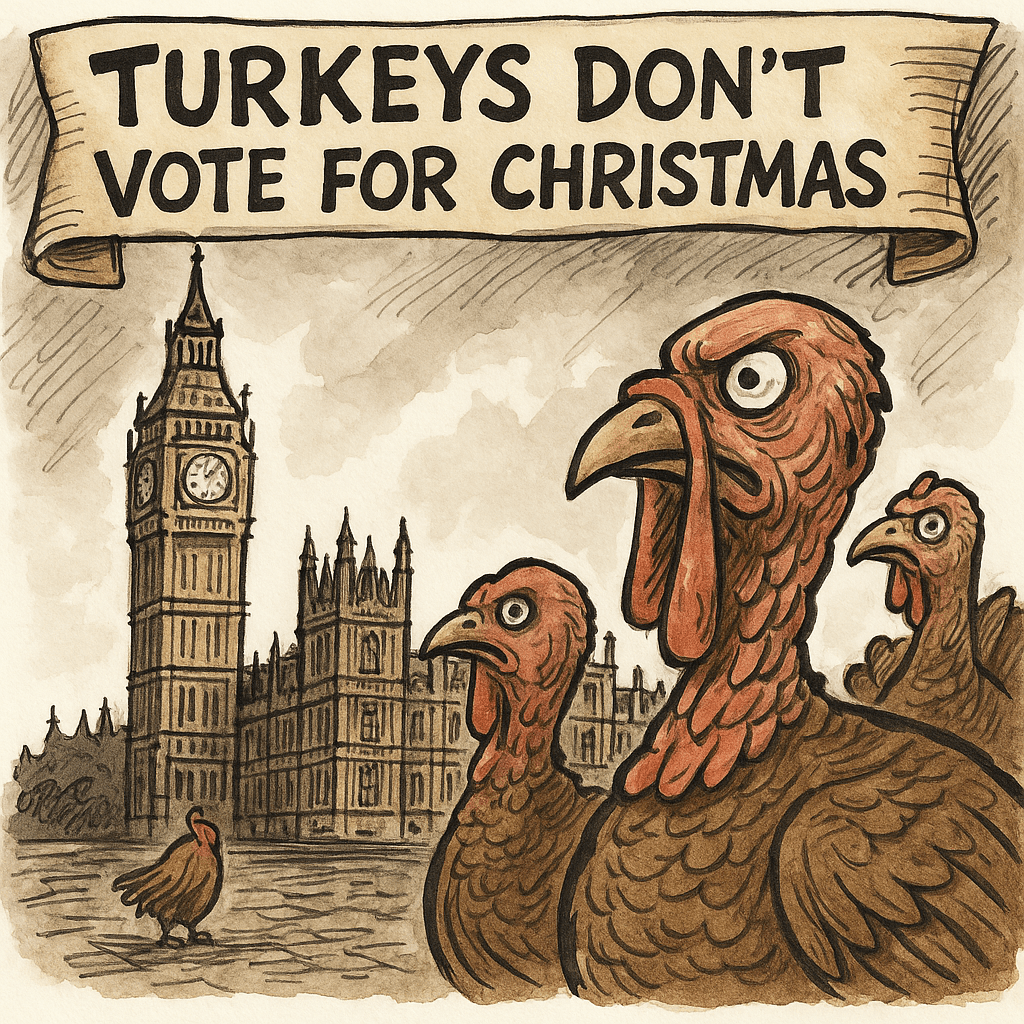
Turkeys don’t vote for Christmas.
And politicians don’t vote to limit the people who fund them.
There’s an old saying: “Turkeys don’t vote for Christmas.”
Yet every few years, we politely ask politicians to consider tightening the very donation rules that keep them in power — and then act surprised when nothing happens.
Because why would they?
The people who benefit most from the current system are the only people with the power to change it.
The more you look at the UK’s deepening crises — economic stagnation, political polarisation, crumbling public services, rising inequality, declining education funding, and the slow-motion disaster of social care — the clearer the common thread becomes:
A political system shaped by big money makes short-term decisions, avoids long-term responsibilities, and consistently chooses the interests of donors over the needs of voters.
So let’s have an honest, conversational look at why donation limits are no longer optional — and why the UK keeps walking into predictable disasters with its eyes wide open.
Manifestos Aren’t Binding — But Donor Expectations Are
Here’s a truth many people don’t realise:
UK party manifestos are not legally binding.
Parties can promise the earth at election time, and then never deliver it. There is no legal mechanism forcing them to do so.
Meanwhile, donors don’t rely on manifestos.
They get private access, private reassurances, and private influence.
The Electoral Commission has repeatedly documented how large donors gain heightened access to senior politicians, and how the UK permits some of the highest donation levels in the democratic world (source: Electoral Commission).
Voters get slogans.
Donors get outcomes.
Turkeys don’t vote for Christmas — and politicians don’t vote to limit the people who finance them.
The Consequences of a Donor-Shaped Democracy
The Brexit Fiasco — A Masterclass in Money, Misinformation and Short-Term Politics
Brexit wasn’t just a political event; it was a case study in what happens when:
- declining education funding
- stagnant wages
- widening inequality
- opaque political financing
- targeted misinformation
collide under a short-term political culture.
The Equality and Human Rights Commission and multiple academic analyses note how underinvestment in education weakens critical thinking and political literacy, making societies more vulnerable to simplistic narratives and misinformation.
The LSE Brexit Observatory has documented the role of opaque funding streams, data-driven targeting, and wealthy backers in shaping public debate.
The result?
The most economically damaging policy choice in modern UK history (source: Office for Budget Responsibility, OBR) — sold with lines that collapsed faster than wet cardboard.
And still, donors didn’t pay the price.
The public did.
Chronic Under-Investment — A System Designed to Avoid Long-Term Thinking
The UK has spent decades investing less than its peers.
Both OECD and OBR data show the UK consistently trailing other developed nations in public and private investment.
Why? Because our system rewards:
- quarterly business sentiment
- short-term shareholder dividends
- annual CEO bonus cycles
- five-year political horizons
- donor preferences for low taxation now, not prosperity later
This creates a country trying to run a 21st-century economy on 20th-century infrastructure, with 19th-century political incentives.
Nothing illustrates this better than the UK’s approach to demographics.
The Predictable Social Care Crisis — Emergency Repairs Instead of Maintenance
Every major UK institution — ONS, OBR, King’s Fund, Nuffield Trust — has warned for decades that the population is ageing, care needs are rising, and the current funding model is unsustainable.
This wasn’t a surprise.
It was forecast, charted, documented, and completely predictable.
Yet no government acted early. Why?
Because long-term preparation requires:
- honest tax conversations
- political courage
- investment today for savings tomorrow
- a willingness to ask the wealthy to contribute fairly
Donor-driven politics avoids all of these things.
So instead of gradual maintenance — the political equivalent of fixing the boiler before winter — the UK waited until the entire system failed and then performed emergency repairs at triple the cost.
Emergency fixes are noisy, chaotic, and expensive.
They also allow politicians to look busy without solving root causes.
Declining Education Funding — Fertile Ground for Division
Years of constrained investment in education have reduced:
- critical thinking
- civic understanding
- resilience against misinformation
- social mobility
IFS research has shown that further education and adult learning have been cut more deeply than almost any other public service.
The OECD notes that societies with lower educational investment experience greater political polarisation and susceptibility to populist narratives.
Underfunding education makes the electorate easier to divide — and easier to manipulate.
A well-educated public is hard to mislead.
A poorly educated public is a political strategist’s dream.
Inequality and Political Attitudes — The Perfect Environment for Bad Policy
Income inequality in the UK has been rising for decades (source: Resolution Foundation, OECD).
Research from the London School of Economics shows that as inequality rises:
- trust in institutions falls
- political divisions deepen
- voters become more responsive to fear-based messaging
- policy becomes reactive rather than strategic
Inequality doesn’t just harm people economically.
It harms democracy itself.
And who benefits from a divided public lacking trust in politics?
Not the majority.
Not the vulnerable.
Not future generations.
But the political and financial elites who thrive when scrutiny is weak and accountability is minimal.
The Sale of Nationalised Industries — When Christmas Became Commercialised
No discussion of donor influence and democratic distortion is complete without addressing the Great British Fire Sale — the privatisation of national utilities and infrastructure since the 1980s.
The pattern was simple:
- Public assets were systematically undervalued at IPO.
- Institutional investors made enormous first-day gains.
- Political parties received significant donations from beneficiaries of the process.
- The public now pays rent to private monopolies for infrastructure they used to own.
From British Telecom to British Gas, from electricity boards to rail and water, the evidence is remarkably consistent:
- IPOs were discounted far below market value.
- Long-term public revenue streams were sacrificed for short-term political wins.
- Donors gained financially — and politically.
- Citizens now pay some of the highest energy and water costs in Europe for worse service.
This was not an ideological project.
It was a transfer of wealth from the public to a donor-aligned class, packaged as “modernisation”.
It is the economic equivalent of:
Selling your house at a discount, then paying rent to live in it.
The turkeys did not vote for Christmas — the farmers staged an auction.
The Maintenance vs Emergency Repairs Problem
Imagine you own a house.
You know the roof will eventually leak — the survey told you as much.
You know the boiler is ageing.
You know the wiring is outdated.
A responsible homeowner performs regular maintenance:
- preventative fixes
- small repairs
- scheduled upgrades
The cost is predictable and manageable.
An irresponsible homeowner waits until:
- the ceiling collapses
- the boiler explodes
- the wiring catches fire
This is exponentially more expensive.
And this is how the UK governs itself.
Because donors prefer:
- lower taxes today
- smaller government today
- reduced public investment today
And so long-term planning becomes politically suicidal.
Turkeys don’t vote for Christmas.
Governments dependent on wealthy donors don’t vote for long-termism.
The Parent–Adult Child Analogy (Uncomfortably Accurate)
Picture a 30-year-old insisting they’re fully independent… while their parents quietly top up their rent every month.
They proclaim:
“I make my own decisions!”
But every substantial choice is pre-screened through:
“What will Mum and Dad say?”
That is the UK’s political system.
Publicly independent.
Privately dependent.
Parties insist they govern for everyone — yet never stop checking how donors will react.
Why Donation Limits Are the Foundation of a Healthy Democracy
✔ They break the short-term mindset
Long-term planning finally becomes possible.
✔ They reduce donor-amplified division
A more educated, less polarised electorate can emerge.
✔ They protect national decisions from manipulation
Brexit-scale disasters become less likely.
✔ They enable honest tax conversations
The real cost of civilisation can finally be addressed.
✔ They prevent cheque-book influence in marginal seats
Stopping wealthy actors from distorting outcomes under FPTP.
✔ They restore public trust
People participate more when democracy isn’t for sale.
The Problem With Sensible Politics: It Isn’t Sexy, and It Doesn’t Sell
Preventative investment never gets headlines. Disasters do.
And that, in a nutshell, is the flaw at the heart of modern British politics.
The kind of politics that actually works — the politics that prevents crises instead of reacting to them — is quiet, steady, detail-oriented and, frankly, boring. It is:
- future-proofing infrastructure
- reforming systems before they break
- investing early to save later
- analysing long-term risks
- coordinating between departments
- doing the small things consistently
It doesn’t produce dramatic front pages.
It doesn’t create viral clips.
It doesn’t offer governments a quick sugar rush of public approval.
But it does create a functioning country.
This is the kind of governance you see in nations with high public trust and strong economic performance. What they have in common is not charisma. It is competence.
Quiet Politics vs Media Politics
British politics has been trapped for decades in a cycle where:
- Leaders are incentivised to chase headlines
- Parties chase polling bumps
- Policy is shaped by donors demanding immediate returns
- Journalists chase drama over detail
Quiet, preventative politics simply cannot compete with the spectacle.
No politician gets applause for saying:
“We fixed a problem before it became a crisis.”
But they get endless attention for arriving in high-vis jackets after the crisis is already unavoidable.
This Is Exactly What Businesses Complain About
In my earlier post on Business Budget Forecasts, I highlighted a simple truth that business leaders repeat endlessly in surveys by the CBI, ONS, Resolution Foundation, Bank of England and BCC:
Businesses don’t need low taxes.
They need stability, predictability, and a government that doesn’t lurch from crisis to crisis.
Investment flourishes in environments where:
- policy doesn’t swing wildly every two years
- regulations are consistent
- long-term infrastructure plans exist
- public institutions aren’t starved, collapsing, or being restructured on a whim
- elections don’t feel like Russian roulette for the economy
This is why highly stable, consensus-driven countries — the Netherlands, Denmark, Sweden, Germany — get far more private investment per capita than the UK.
They have boring politics. And boring is good for prosperity.
Swing Politics Kills Investment
First-Past-the-Post amplifies volatility.
Small shifts in public mood cause massive shifts in policy direction.
This is deeply unattractive for investors evaluating 10–30 year horizons.
When a country’s politics swings between “slash everything” and “repair everything” every few years, businesses struggle to:
- plan capital expenditure
- predict demand
- hire long-term staff
- choose UK locations for head offices or research hubs
- commit to large-scale infrastructure partnerships
So what do they do?
They wait.
And waiting is just another word for declining national investment.
Boring Politics Rebuilds Nations
The irony is that the UK’s salvation is not found in revolution, nor in strongman theatrics, nor in the latest “bold new vision”.
It’s found in:
- dull, steady governance
- consistent frameworks
- long-termism
- adult-level communication with a well educated public
- well-planned investment
- boring competence
Countries do not rise through drama.
Countries rise through maintenance, predictability and trust.
A nation with boring politics is:
- safer
- wealthier
- healthier
- more cohesive
- more attractive to investors
And more importantly, it is less vulnerable to the manufactured crises, donor-driven distortions, and artificial panics that dominate British governance today.
Discover more from Hysnaps Politics, Gaming, Music and Mental Health
Subscribe to get the latest posts sent to your email.

