Nope – about the price of a white sliced loaf per voter per year
(Yes, the cost of democracy is literally equivalent to bread.)
People often assume politics is extravagantly expensive: parties splurging millions, donors buying influence, elections being giant money-burning exercises.
So here’s the real question:
What would it cost if the Government paid all legally allowed campaigning costs – national and local – instead of political parties and donors?
I’m going to calculate it at the absolute maximum legal spending, assuming:
- Every party spends the full amount allowed.
- Every candidate spends the full amount allowed.
- Every council seat, mayoralty and general election seat hits the upper legal cap.
- No corners cut. No discounts. No underspend. Just the maximum theoretical spend.
You might expect a jaw-dropping figure.
Instead, the answer looks like this:
Around £1.25 per adult, per year.
Or in everyday terms:
Roughly the cost of a single white sliced loaf.
Yes — the cost of democracy is literally equivalent to bread.
The General Election: the “big” spending event
Let’s start with Westminster elections.
Candidate spending limit
The Electoral Commission rule:
£11,390 + 8p or 12p per elector
(depending on whether it’s a borough or county constituency).
In a large seat of 80,000 electors, that gives a maximum of roughly:
£21,000 per candidate.
Party spending limit
If a party contests every seat in Great Britain:
£54,010 × 650 seats ≈ £35.1m. (it says 21k above, please explain – Cs)
Now push everything to the legal ceiling
Assume:
- 5 candidates per seat
- All candidates from nationwide parties
- Everyone spends the max
Per constituency:
- Candidate spend: 5 × £21k = £105k
- Party spend: 5 × £54k ≈ £270k
Total per seat ≈ £375k
Across 650 constituencies:
General Election maximum ≈ £243.75 million
Local Elections: smaller spends, more frequent ballots
Council elections
Candidate limit:
£806 + 7p per elector
Typical ward → £1,200–£2,000, so we model:
£1,500 per candidate average. (just go with the 2k max – Cs)
Across the UK:
- Roughly 6,700 seats up each year
- ~3 candidates per seat
- ≈ 20,000 candidates per year
Annual potential spend:
20,000 × £1,500 = £30 million per year
Most English councils elect 3 years out of 4, Scotland/Wales every 5 years, so across a five-year cycle, this comes to:
≈ £96 million (upper bound).
Mayors
Add in:
- London Mayor (high limit)
- Combined Authority Mayors
- London Assembly campaigns
Total:
≈ £2–3 million per cycle
Included in the £96m figure for simplicity. (breakdown please, otherwise could be misleading).
The big total: democracy, fully funded
Add everything over five years:
- General Election cap: ~£244 million
- Local Election caps: ~£96 million
Grand total (maximum theoretical)
≈ £340 million over 5 years
Now divide by the UK adult population (≈53 million):
£340m ÷ 53m ≈ £6.40 per adult per 5 years
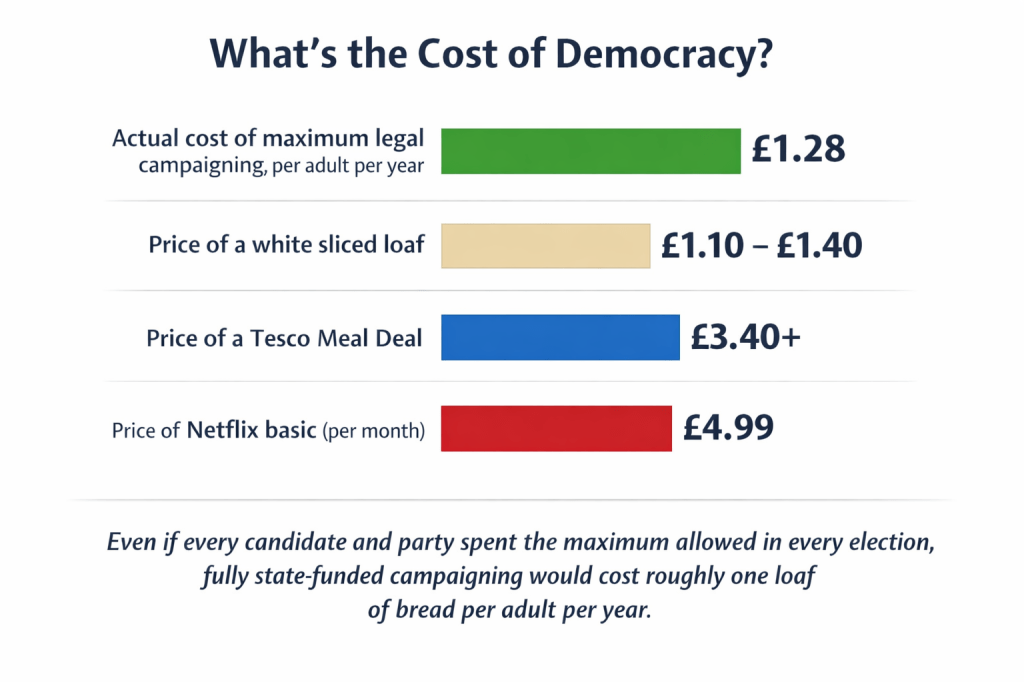
£6.40 / 5 ≈ £1.28 per adult per year
Which is…
About the cost of one white sliced loaf per voter per year.
So if we completely replaced private donations, big-money influence, and party fundraising with state-funded campaigning?
The total cost would be a loaf of bread per adult per year.
That’s it.
One loaf.
“The Cost of Democracy in Loaves”
Where this leads…
If democracy costs a loaf of bread per voter per year, then the next question is obvious:
So why do we rely so heavily on donations, wealthy backers, and private money?
Are parties overfunded by private donations compared to what they need to campaign fairly?
Or are we underfunding competitive politics in poorer areas where fundraising is impossible?
And:
What changes if donations dry up – or if the state replaces them?
Who gains? Who loses? What becomes fairer? What becomes harder?
That’s the direction of my next post — comparing:
- The maximum that campaigning actually needs, vs
- The real amounts being donated, and
- What that says about political influence, inequality, and reform.
Discover more from Hysnaps Politics, Gaming, Music and Mental Health
Subscribe to get the latest posts sent to your email.

