A Look at Donations, Dependence and Whether We’re Over-Funding or Under-Funding Democracy**
In my last post, I showed that if the Government paid all legally-permitted campaign spending — for every candidate, every party, every council election and every general election — the total cost would work out at roughly:
One white sliced loaf per adult, per year.
The literal bread required to fund democracy.
So now that we know the maximum democratic cost ceiling, it’s time to flip the question around:
How much money is actually flowing into British politics today?
Who is paying it?
And are we over-funding political parties through donations — or under-funding democracy itself?
To answer this, I used the enhanced dataset behind my donation-analysis Streamlit dashboard. This dataset cleans, merges, maps and deduplicates the Electoral Commission’s raw records, bringing together:
- MP-level donations
- Regulated entity donations
- Local party associations
- Company vs individual vs union donors
- Parent-party grouping (via
Party_Group) - All donations assigned to a precise received date
This post presents three charts:
- Donations by Party Over Time
- Donations by Donor Type in the Latest Reporting Cycle
- Donations Compared to the Maximum Public-Funding Requirement
Let’s look at each in turn.
1. Donations by Party Over Time: The Rise, the Plateau, and the Spikes
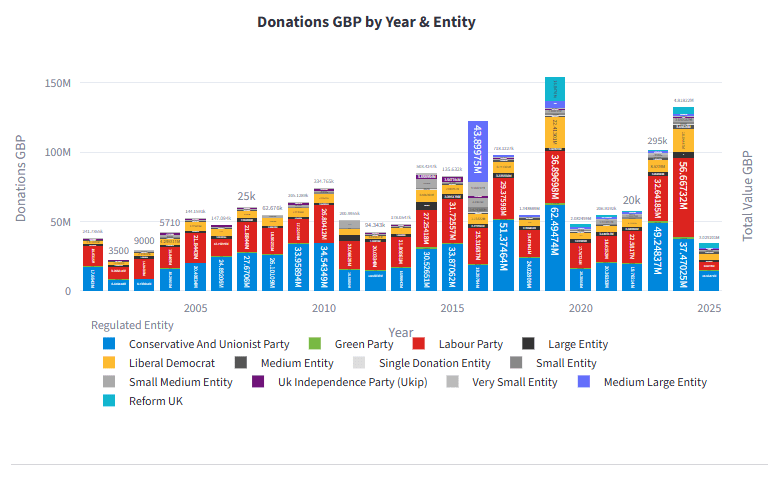
This chart tells a story familiar to anyone who follows British politics: donations rise and fall with political opportunity. (Click on image to go to interactive dashboard)
- Election years trigger sharp peaks.
- Governing parties consistently raise the most.
- Opposition parties surge when they look competitive.
- Minor parties remain structurally underfunded, regardless of public support.
The data also reflects a deeper truth:
Donations aren’t evenly spread; they follow power like iron filings to a magnet.
Over two decades, parties such as the Conservatives have received more than 40% of all political donations — a finding echoed by external research — while smaller challengers have struggled to scale up even when voter sentiment shifts.
In that context, the “one loaf of bread per year” price tag for clean, universal public funding begins to feel like a bargain.
2. Who Funds Whom? Donations by Donor Type
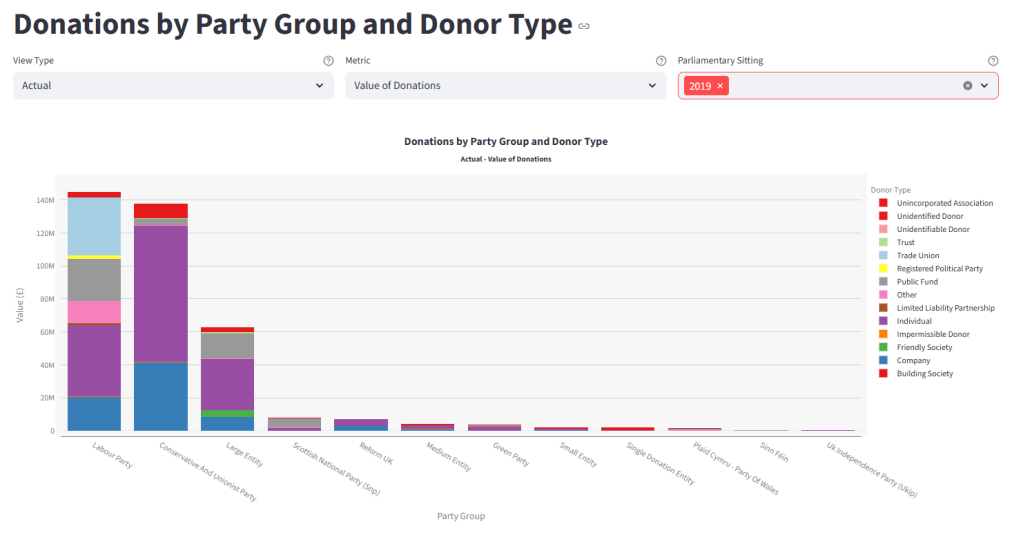
Using the data for all donations during the last parliament, this stacked bar chart breaks down UK political donations into:
- Companies
- Individuals
- Trade unions
- Unincorporated associations
- Other regulated donors
The pattern is unmistakable:
- Some parties are structurally dependent on corporate or high-net-worth donors.
- Others rely heavily on trade unions.
- A very small number rely on broad, low-value individual donors — the closest thing Britain has to grassroots financing.
And beneath it all remains the hard question:
Are we comfortable with parties being financially shaped by the interests of their largest backers?
If the answer is no, alternatives exist.
Public funding at the level of one loaf per adult per year could dramatically rebalance who politicians must listen to.
3. Donations vs. the Maximum Cost of Democracy
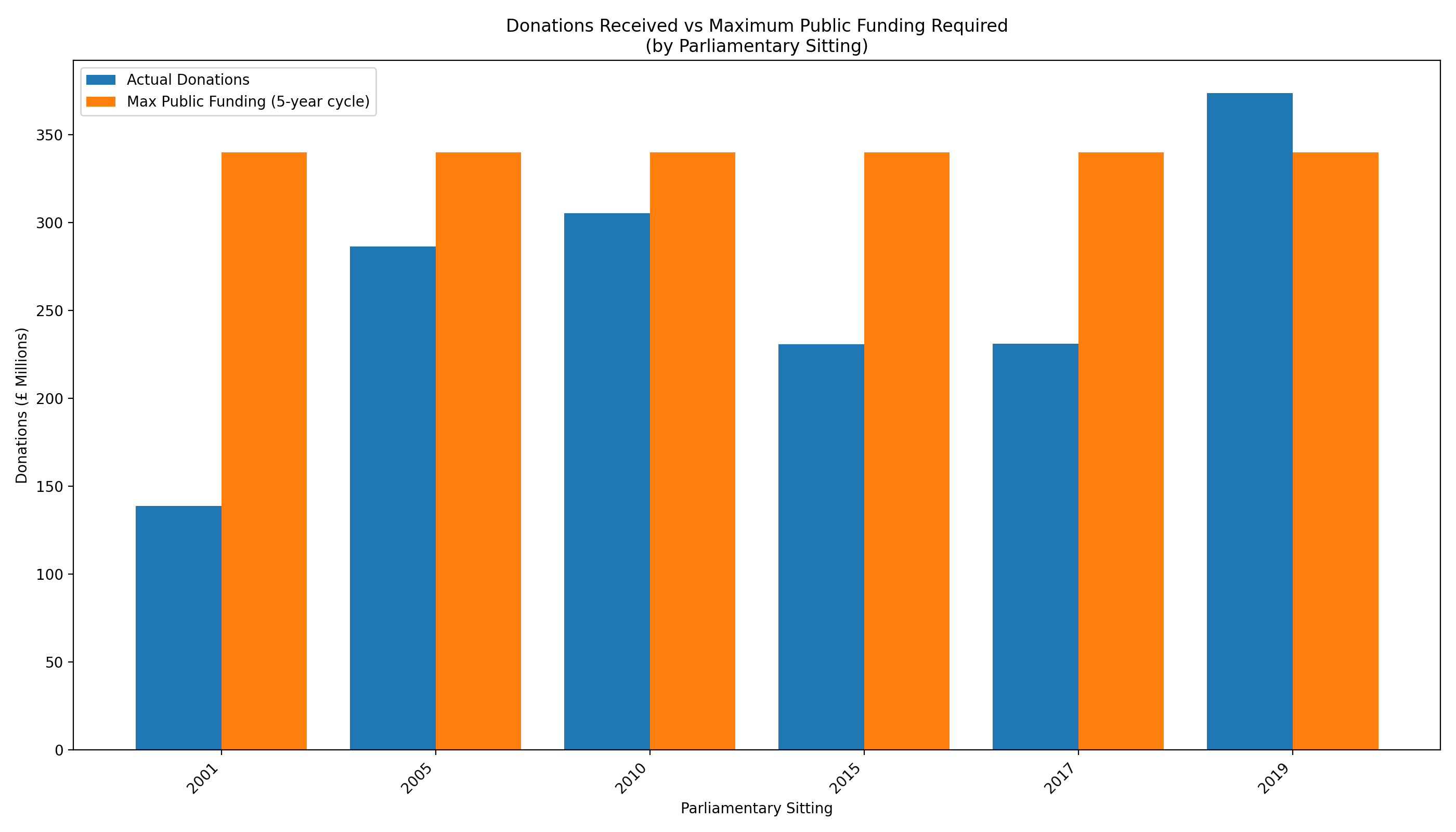
This chart compares:
- Actual donations received (summed within each reporting period)
vs - The maximum legal public-funding requirement (≈ £340 million per 5-year cycle)
The visual makes the conclusion obvious:
Britain raised more privately than it would cost to fund democracy publicly, during the 2019 parliamentary sitting.
Let me repeat that:
My estimate would provide more funds that parties are currently getting. It would actually better fund our political system.
That means the problem isn’t the cost of democracy.
It’s who currently pays that cost, and what they expect in return.
So… Are We Over-Funding or Under-Funding Democracy?
The answer is: Both. Simultaneously.
We over-fund political parties
…because a handful of wealthy donors can, and do, inject multi-million-pound sums into politics — far above what a fair, proportional public model would require.
We under-fund democratic competition
…because smaller parties, community challengers, independents and candidates in poorer regions cannot raise comparable funds.
The result?
Wealth, geography and organisational inheritance shape political opportunity more than voter sentiment does.
That is not a healthy democratic marketplace.
Where This Leads Next
Now that we’ve established:
- The true cost of democracy (a loaf per adult per year)
- The reality of donation dependence
- The gap between public need and private influence
…the next logical question is:
What happens if we shift the UK away from donation-driven politics and toward a system where democracy is funded like a public utility?
So over the last 25 years £1,6 Billion has been donated to UK Political Parties – and from my previous calculations the max Cost of funding it publicly would be £340 every 5 years or £1.7 billion.
Therefore, and lets be honest it wouldn’t happen, if we allowed private donors to still donate, but insisted it went into the central pot to be distributed, the fund from donors would cover all the cost.
Now wouldn’t it be nice to believe that donors would still donate to our democracy even if it didn’t buy influence.
In the next post, I’ll examine this further
The short version?
Democracy isn’t expensive.
Influence is.
And that, more than any loaf of bread, might be the price we finally choose to stop paying.
Discover more from Hysnaps Politics, Gaming, Music and Mental Health
Subscribe to get the latest posts sent to your email.

