
Over the last few posts, we’ve explored the UK’s relationship with political money — the loopholes, the influence, the quiet distortions. But now it’s time to go wider.
Because while Britain tiptoes around donation reform, other democracies have already decided that elections shouldn’t be decided by who can raise the most money from the wealthiest few. They’ve built systems that reduce private donor leverage, expand representation, and force parties back toward the electorate rather than the cheque book.
So in this post, I want to explore something simple but radical:
What would British politics look like if we stopped treating campaign finance as a free-for-all?
To answer that, we need to look at what other countries actually do — not the myths, not the fear stories, but the systems that already exist and work.
International Models of Public Campaign Funding
When you survey democracies across Europe, North America, and Oceania, a pattern emerges:
Britain is an outlier. Not because our politics is especially corrupt, but because we’ve built a system where private money quietly fills the gaps that public funding could otherwise cover.
Here are the main models we see elsewhere:
1. Flat Public Grants
Used in countries like Sweden and Austria. Parties receive annual grants based on vote share or representation. Private donations still exist, but they’re a topping, not the main course.
2. Matching Funds
Germany and Canada both use versions of this: small donations from ordinary people are matched by the state, making a £10 contribution just as important as a corporate £10,000 cheque.
3. Democracy Vouchers
Seattle’s experiment has drawn global attention. Every voter receives publicly funded “vouchers” they can give to candidates of their choice. This pulls the money supply away from corporate donors and toward actual voters.
4. Strict Caps on Donations and Spending
Most European countries enforce relatively low donation limits and spending caps that prevent perpetual arms races. Britain’s caps exist — but are too loose to shift the underlying incentives.
Taken together, these systems share one conclusion:
Democracy doesn’t collapse when you reduce the role of wealthy donors. It gets healthier.
How These Models Could Change British Politics
Let’s imagine introducing vouchers, matching funds, flat grants, or stronger caps in the UK.
1. Campaigns Would Become Less Dependent on Wealthy Donors
Right now, big donors don’t just give money — they buy time, access, and influence. If parties could rely on public funding and small-donor matching, those relationships become less vital.
2. Elections Could Become Cheaper, Fairer, and More Local
Matching funds and vouchers incentivise parties to actually speak to voters. It’s hard to overstate how much this shifts campaign strategy away from billionaire dinners and toward door-knocking.
3. New Parties and Independent Candidates Would Finally Have a Fighting Chance
Public funding systems level the playing field. No more situations where entering politics requires a war chest or a benefactor.
4. Internal Party Dynamics Would Shift
If money no longer flows through a handful of mega-donors or corporate networks, internal debate opens up. Candidate selection becomes less skewed toward those who can fundraise.
5. Policy Formation Would Be Cleaner
Even if no explicit quid pro quo exists, the gravitational pull of donor preferences is real. Public funding severs that gravitational line.
This isn’t utopian. It’s already the norm elsewhere.
What Happens to Donor Influence When It Loses Its Leverage?
Short answer:
It shrinks — fast.
Longer answer:
When donations stop being the core of campaign survival, donors can still express preferences, but they can’t shape the political weather. Meetings become less frequent. Policy asks carry less weight. Ministers and shadow ministers don’t need to “keep donors warm.”
Parties inevitably shift their attention to the only source that now matters: the electorate.
It doesn’t mean donors lose their voice. It just means their voice is no longer ten times louder than everyone else’s.
How Public Funding Interacts With Free Speech
This is one of the most misunderstood areas.
Public campaign funding does not restrict speech. No one stops individuals from:
- advocating for ideas
- publishing material
- volunteering
- donating (within limits)
What public funding does is prevent money from distorting whose speech is heard.
Right now, free speech in British politics is theoretically equal but practically hierarchical:
- a billionaire has more political “volume” than a nurse
- a hedge fund can shout louder than 10,000 ordinary voters
- a well-funded lobby group can saturate the airwaves while grassroots campaigns struggle to print leaflets
Public funding doesn’t silence anyone — it balances the megaphones.
Would Political Parties Even Accept Such a System?
If you ask them openly, many will squirm.
State funding is chronically unpopular with UK voters (thanks in part to decades of headlines about “taxpayer-funded politics”). Meanwhile, parties benefit handsomely from the status quo.
So why would they back reform?
Because other countries have made the same journey:
- Germany adopted matching funds to curb private influence.
- Canada banned corporate and union donations entirely.
- New Zealand cleaned up its donation rules after repeated scandals.
- Denmark switched its party funding model to increase transparency.
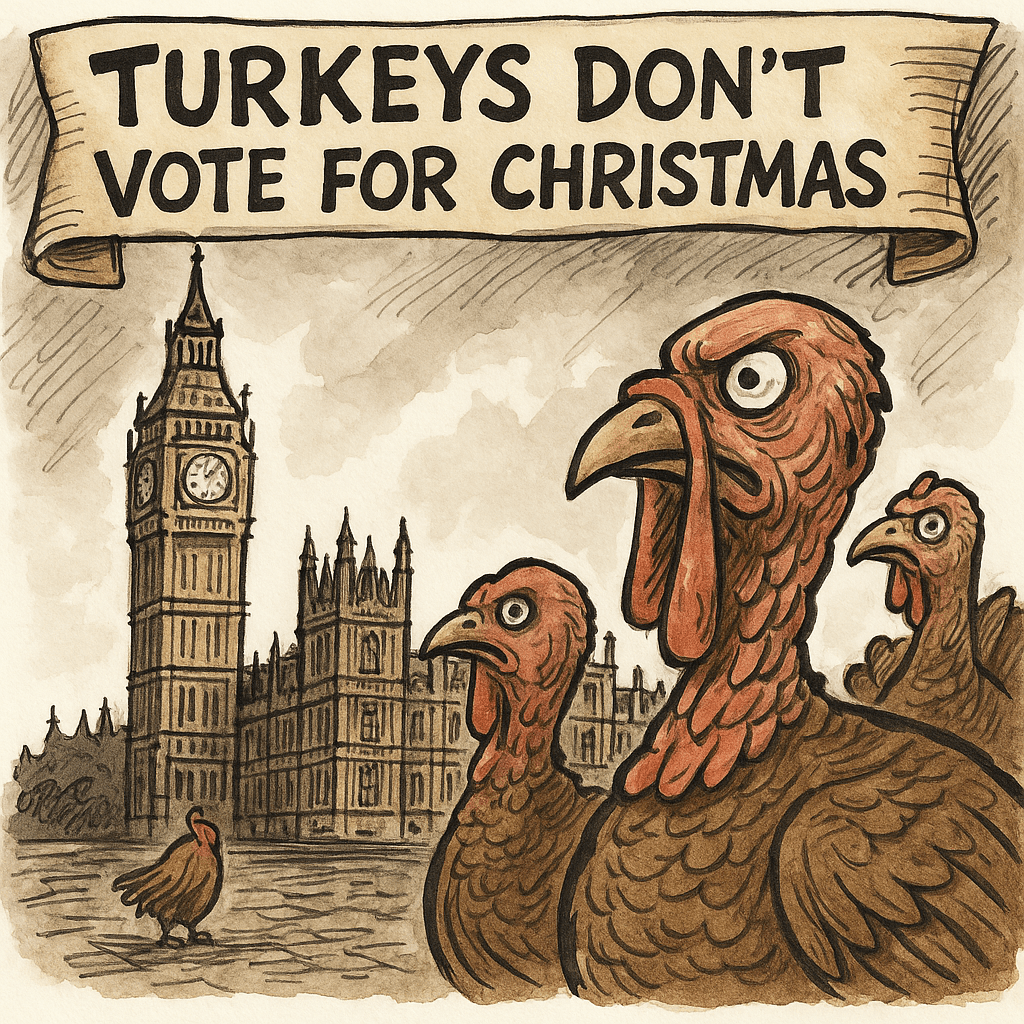
Parties rarely volunteer for reform – just as turkeys dont vote for Christmas — but they can be brought to it by scandal, public pressure, or cross-party deals.
The UK is not immune to any of these drivers.
And Why the “Loss of Deposits” Rule Still Matters
The deposit system — where candidates must pay £500 and lose it if they fail to reach 5% — is one of the quiet financial barriers that shapes our politics. Worth saying this was set in the 1980’s, today the same purchasing power would be nearer £2,500.
Deposits matter because they:
- limit who can stand
- reinforce two-party dominance
- punish new parties more than established ones
- disproportionately hit candidates from poorer backgrounds
- add up: a full national slate can cost smaller parties over £300,000
Even in a world with public campaign funding, the deposit rule would remain a gatekeeper.
If we’re going to discuss real democratisation, this rule must be part of the conversation. It was never meant to be a revenue stream or a barrier to entry, yet today it functions as both.
So Where Does This Leave the UK?
Other democracies have already shown that:
- public campaign funding works
- donor dominance is not inevitable
- fairer systems can exist without restricting free speech
- parties can survive and even thrive without billionaire patrons
The real question is not whether Britain could build a fairer, cleaner, more voter-centred campaign finance system.
It’s whether we’re finally ready to admit that the current one is failing us — and that alternatives already exist, waiting for us to grow the political courage to embrace them.
Because once you understand what other countries have built, our refusal to try starts to look less like caution… and more like complacency.

Discover more from Hysnaps Politics, Gaming, Music and Mental Health
Subscribe to get the latest posts sent to your email.

