So a slight change in my normal tone of voice for the bit – cos its important and I also don’t want to lead anyone a stray, so sorry its gonna get a bit dry – but there is a nice picture at the end.
How the Human Rights Act Has Limited (and Protected) Freedom of Speech in the UK
(What UK courts decided — and when Strasbourg stepped in)
Under the Human Rights Act 1998, UK courts apply Article 10 as domestic law. That means decisions about free speech are usually made in UK courts, interpreting UK statutes, long before the European Court of Human Rights (ECHR) becomes involved.
So let’s strip this back to speech only — words, expression, publication — and look at what these legal justifications have actually meant in practice.
National Security
How UK Law Interprets This (Human Rights Act)
Under UK law, national security is one of the strongest justifications for restricting freedom of speech. Where Parliament has clearly legislated—most notably through the Official Secrets Acts—UK courts have consistently upheld speech restrictions, even where the information is true, politically significant, or claimed to be in the public interest.
Restriction Upheld
R v Shayler (2002)
A former MI5 officer disclosed classified information and argued that publication was justified by public interest and freedom of expression. The House of Lords rejected this argument, holding that restrictions imposed by the Official Secrets Act were compatible with Article 10 as applied through the Human Rights Act.
Principle established:
Speech may be lawfully restricted even when true and politically relevant if Parliament has designated the subject matter as one of national security.
Restriction Rejected
In domestic UK case law, outright rejection of national-security-based speech restrictions is rare. Courts tend to defer heavily to the executive where secrecy and intelligence are invoked, provided the restriction is grounded in statute and applied proportionately.
ECHR Clarification
Observer and Guardian v UK (1991) – “Spycatcher”
The European Court of Human Rights accepted that initial publication bans could be justified on national security grounds. However, it ruled that once the information was already widely available internationally, continued restrictions in the UK were no longer necessary or proportionate.
Clarifying principle:
National security justifications weaken once secrecy no longer meaningfully exists.
Public Safety
How UK Law Interprets This (Human Rights Act)
Under UK law, public safety is used to justify restrictions on freedom of speech where expression is said to create a real risk of harm to people, panic, or serious disruption. Courts have stressed that this ground cannot be based on speculation alone, but it has nonetheless been applied preventively in certain contexts.
Restriction Upheld
UK courts accept in principle that speech may be restricted on public safety grounds where there is a clear and imminent risk of harm. This includes situations where expression is closely linked to dangerous conduct or where intervention is necessary to prevent immediate threats to physical safety.
While pure speech cases are less common under this heading than under “disorder or crime”, courts have recognised public safety as a legitimate aim capable of justifying speech restrictions under the Human Rights Act.
Principle established:
Public safety can justify restricting speech, but only where the risk is concrete, immediate, and evidenced.
Restriction Rejected
Redmond-Bate v DPP (1999)
Although often cited under disorder, this case is also relevant to public safety. The court ruled that speech cannot be restricted simply because it provokes a hostile reaction or creates a tense situation. The presence of risk does not automatically justify silencing the speaker.
Principle established:
Public safety concerns arising from audience reaction do not, by themselves, justify suppressing lawful speech.
ECHR Clarification
Steel and Others v UK (1998)
The European Court of Human Rights ruled that arrests and restrictions imposed on protestors were disproportionate where the risk to public safety was speculative rather than imminent.
Clarifying principle:
Public safety restrictions on speech must be based on a pressing social need, not precautionary anxiety or administrative convenience.
Prevention of Disorder or Crime
How UK Law Interprets This (Human Rights Act)
UK law draws a clear distinction between expressing extreme or offensive opinions, which is often lawful, and speech that actively encourages, supports, or legitimises criminal activity, which is not.
This ground is one of the most commonly relied upon in UK speech cases.
Restriction Upheld
R v Choudary (2016)
The defendant was convicted for inviting support for a proscribed terrorist organisation. The court held that speech which encouraged or legitimised serious criminal activity fell outside the protection of Article 10 under the Human Rights Act.
Principle established:
Speech loses protection when it moves from opinion into encouragement or endorsement of crime.
Restriction Rejected
Redmond-Bate v DPP (1999)
Street preachers were arrested after a hostile crowd reacted to their speech. The court ruled that the speech itself was lawful and that police had a duty to control the crowd rather than silence the speakers.
Principle established:
Offence, hostility, or disorder caused by listeners does not justify suppressing lawful speech.
ECHR Clarification
European Court of Human Rights case law consistently reinforces this distinction: states must tolerate provocative and unpopular speech unless it directly incites violence or criminal conduct.
Protection of Health or Morals
How UK Law Interprets This (Human Rights Act)
Under UK law, “health or morals” is one of the broadest and most subjective grounds for restricting freedom of speech. Courts have consistently accepted that Parliament has wide discretion to determine moral boundaries, particularly in relation to sexual material, obscenity, and extreme content.
Restriction Upheld
R v Peacock (2012)
The defendant was convicted for distributing extreme pornographic images. The court held that restricting this form of expression was compatible with Article 10 as applied through the Human Rights Act, justified by the protection of public morals.
Principle established:
Parliament is afforded wide latitude to restrict expression on moral grounds, even where no immediate harm can be demonstrated.
Restriction Rejected
UK courts are generally reluctant to reject moral-based speech restrictions outright where Parliament has legislated clearly. Successful challenges tend to focus on proportionality rather than denying the legitimacy of the moral aim itself.
ECHR Clarification
Handyside v UK (1976)
The European Court of Human Rights upheld the UK’s restriction on publishing The Little Red Schoolbook, but established a critical limiting principle:
“Freedom of expression applies not only to information or ideas that are favourably received, but also to those that offend, shock or disturb.”
Clarifying principle:
Moral offence alone is insufficient; restrictions must still be justified as necessary in a democratic society.
Protection of Reputation or the Rights of Others
How UK Law Interprets This (Human Rights Act)
This ground underpins defamation and harassment law. UK courts accept that speech may be restricted where it causes serious harm to individuals, but they also draw a clear distinction between protecting private reputation and suppressing criticism of public power.
Restriction Upheld
Lachaux v Independent Print Ltd (2019)
The Supreme Court clarified that claimants must show serious harm to reputation for defamation claims to succeed. Where that threshold is met, restricting publication is compatible with Article 10 under the Human Rights Act.
Principle established:
Speech that causes serious reputational harm may lawfully be restricted, even where it concerns matters of public interest.
Restriction Rejected
Derbyshire County Council v Times Newspapers (1993)
A local authority attempted to bring a defamation claim against a newspaper. The court ruled that public bodies cannot sue for libel, as this would unduly chill political speech and democratic scrutiny.
Principle established:
Speech criticising public authorities enjoys enhanced protection under UK law.
ECHR Clarification
The European Court of Human Rights has consistently reinforced that political speech and criticism of public institutions sit at the core of Article 10 protection, and that restrictions in this area require particularly strong justification.
To help clarify these points
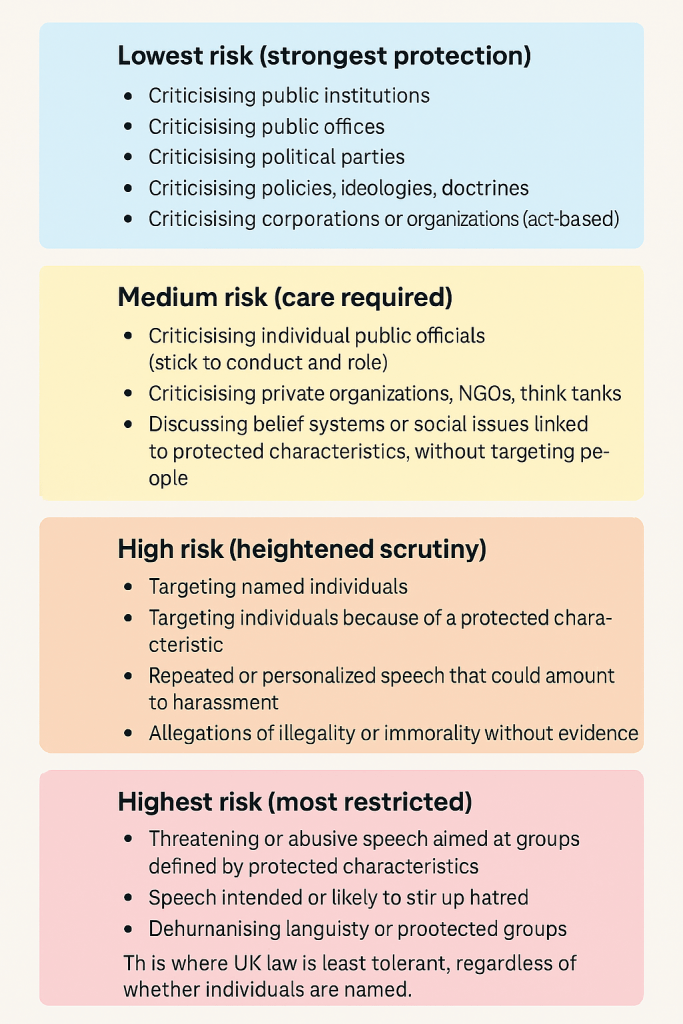
In the UK, you are broadly free to criticise public institutions — even harshly — and offence taken by others does not make that speech unlawful. Responsibility only shifts where speech crosses into incitement, harassment, or serious personal harm.
That protection is strongest when your criticism is directed at institutions, offices, political parties, or movements. Once criticism becomes focused on named individuals — even those in public office — greater care is required. Criticism of public officials is lawful when it relates to their actions or conduct in office, but becomes riskier when it strays into personal allegations, harassment, or unsubstantiated claims.
Criticism of private individuals, families, or non-public persons is more risky, as your criticisms have less protection under law. Corporations and private organisations sit somewhere in between: they can be criticised robustly, but allegations of illegality or dishonesty carry legal risk if not well supported.
Protected characteristics such as race, religion, sexuality, and disability attract particularly strong legal protection. Speech that targets individuals because of these characteristics — or that seeks to stir up hostility toward groups defined by them — is subject to far stricter limits than ordinary political criticism.
Criticism of institutions, policies, or belief systems remains protected, even where it is robust or unpopular. The legal risk increases when speech moves away from ideas and actions and toward people — especially where language is threatening, abusive, or directed at groups defined by protected characteristics.
A picture saves a thousand words
I think I understand – Ah but Context Matters!
It is also worth remembering, that so long as what you say stays legal, if it causes offence or unrest in the audience, that does not make it unlawful.
But it is not just the words you say that matter, speech can be come unlawful if it:
- is part of a course of conduct (harassment)
- is delivered in a way likely to incite violence
- targets protected groups in a threatening or abusive way
- creates a real and imminent risk rather than abstract offence
So legality is judged contextually, not just textually.
That means just because you didn’t explicitly say something illegal – the context in which you said it can make it illegal – BE WARNED.
Hello Me this is the Real Me
So enough dry legal speak – let me put it in my normal style-
In the UK, you are broadly free to criticise public institutions — even harshly — and the fact that someone takes offence doesn’t suddenly make what you said unlawful. People getting angry, upset, or uncomfortable is not, in itself, your problem. Responsibility only really shifts once speech crosses into things like incitement, harassment, or serious personal harm.
Feel reasonably free if your criticism is aimed upwards — at institutions, offices, political parties, movements, or systems. You can take a swing at a council, a police force, a government department, or a political party and UK law gives you a lot of breathing space to do that.
Things get a bit more delicate once you stop criticising structures and start criticising people.
You can criticise individual politicians — that’s part of democratic life — but this is safest when you stick to what they’ve done in their public role: their decisions, their voting record, their policies, their conduct in office. Once criticism drifts into personal allegations, repeated targeting, or claims you can’t back up, the legal ground gets noticeably softer under your feet.
Move further away from public life and the risk rises again.
Criticising private individuals, families, or people who aren’t public figures is far less protected. The law is much less interested in protecting your right to “say what you think” when the target isn’t exercising power or influencing public life.
Corporations and private organisations sit somewhere in the middle. You can criticise them — their behaviour, their lobbying, their impact, their profits — but once you start accusing them of illegality or dishonesty, you need evidence. Otherwise you’re likely to find yourself in legally risky territory very quickly.
There’s another important layer here too.
Characteristics like race, religion, sexuality, and disability attract particularly strong legal protection. Speech that targets people because of those characteristics — or that tries to whip up hostility towards groups defined by them — is treated far more seriously than ordinary political criticism. This is one of the areas where UK law is least tolerant, and deliberately so.
That doesn’t mean you can’t criticise ideas, policies, or belief systems. You absolutely can — even forcefully, even in ways that some people find uncomfortable. But the legal risk rises sharply when speech stops being about ideas or actions and starts being about people — especially where language becomes threatening, abusive, or dehumanising.
Put bluntly:
criticise power, systems, and ideas as hard as you like — just be much more careful when your words start landing on individuals or identity groups.
So what kind of free speech does the UK actually have?
Put plainly, Britain does not have foundational free speech – it has conditional tolerance, which has been built through precedent not proclamation.
This has produces a system where speech is often permitted, sometimes punished, frequently curbed/chilled and rarely clearly defined
Which brings us to the uncomfortable bit.
The British paradox
Britain talks about free speech as if it were ancient and secure.
In reality, it is historically narrow and originally protecting those in power, legal qualified through years of precedent and culturally enforced as much as it is legally regulated.
And because it was never clearly declared, it is constantly being re-negotiated — by courts, by regulators, by employers, by universities, and by public pressure.
This is not authoritarianism.
But it isn’t clarity either.
Where this leads next
In Part 4, we can now ask the harder question:
What happens to free speech when law is vague, culture is anxious, and enforcement quietly shifts away from the state?
That’s where:
- self-censorship
- institutional risk-aversion
- and informal punishment
start doing most of the work.
Discover more from Hysnaps Politics, Gaming, Music and Mental Health
Subscribe to get the latest posts sent to your email.

