Oops – Did we Lose the War on Drugs?
In Lets Rethink Policy-Making: Filthy Lucre – Whos Getting Rich?, we did something unfashionable, we stopped arguing about morality and added up the costs.
In Let’s Rethink Policy-Making: Filthy Lucre — Let’s Get Real, we went a step further and asked a deliberately uncomfortable question: what if, instead of pretending drugs would disappear, we tried to manage them — in broadly the way we already manage tobacco, alcohol, or pharmaceuticals?
This time, we’re stepping back again.
We’re going to look at what sticking with the approach adopted from the late 1960s onwards has actually cost the state — and, just as importantly, what we might have saved if moral panic hadn’t been allowed to drive policy design.
Not to relitigate the past.
Not to accuse anyone of bad faith.
But to ask whether “being tough” has turned out to be an especially expensive way of not solving the problem.
A quick word about data (and honesty)
If we’re going to do this properly, we need to be upfront about the limits.
We have reasonably solid estimates of drug use from the late 1960s. We then have much better, consistent survey data from the mid-1990s onwards. What we don’t have is a neat, continuous, substance-by-substance dataset covering the entire fifty-plus years in between.
So we can’t draw a single definitive curve and declare victory.
What we can do is look at:
- the shapes different stories imply
- how costs behave over time
- and whether the strategy we’ve pursued matches the outcomes we say we want
That’s not statistical trickery. It’s how policy thinking works when it’s being honest.
How behaviours tend to grow — and stabilise
When people talk about drugs, three very different growth stories tend to get mixed together.
The first is exponential growth — the idea that drug use spreads like an infection, accelerating unless it’s aggressively suppressed. This is the language often used in moral panics and zero-tolerance campaigns.
The second is linear growth — a steady, ever-worsening problem that just keeps rising over time.
The third looks more like a market pattern: rapid growth as a new behaviour or product appears, followed by slowing, stabilisation, and periodic rises and falls as conditions change.
Economics tends to expect the third pattern.
Moral arguments tend to assume the first.
Common sense suggests reality usually sits somewhere in between — shaped by availability, stress, opportunity, culture, and wider living conditions rather than law alone.
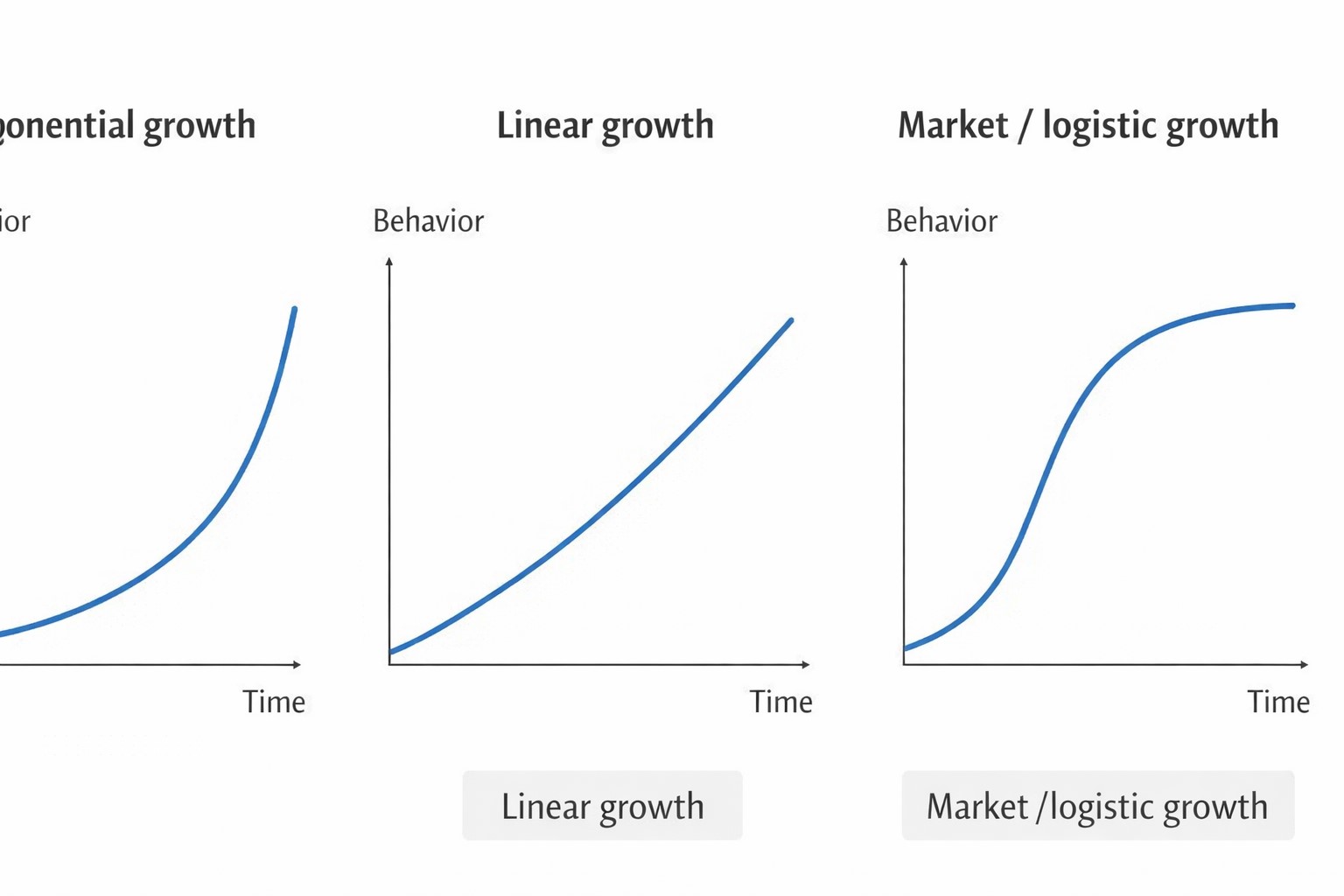
What matters here isn’t which curve feels most persuasive.
It’s that none of them describe a world in which tightening the law delivered the reduction it promised, and no clear evidence has emerged to suggest that it did.
If someone has solid evidence that I’ve missed, I’d genuinely like to see it — because after half a century, you’d expect success to leave a footprint.
Being honest about what regulation would do next
It’s also worth being upfront about what this implies going forward.
If a heavily restricted or criminalised market is brought into the open and regulated, a short-term increase in visible use is not just possible — it’s likely.
That doesn’t necessarily mean more people suddenly want the behaviour. It usually means:
- people are less afraid to admit it
- hidden use becomes visible
- reporting becomes more honest
- supply becomes more predictable
We’ve seen this pattern before with other behaviours — particularly where something moves from taboo or hidden into the open: an initial rise as the system adjusts, followed by normalisation, stabilisation, and — if regulation is well designed — a gradual reduction in harm.
Treating that early rise as a failure rather than a transition is one of the most common ways policy gets prematurely reversed.
We’ve seen this in the UK before. When day-rate fines were briefly introduced in the early 1990s — explicitly designed to make penalties proportionate to income — the policy wasn’t abandoned because it failed in principle. It was abandoned because a handful of highly publicised cases produced eye-catching headlines.
Those cases overwhelmingly involved wealthier offenders, who were far better placed to contest, publicise, and politicise their outcomes. The system was judged on the shock value of edge cases rather than on whether it improved fairness overall — and it was quietly dropped.
The lesson wasn’t that proportional penalties don’t work.
It was that we’re very bad at distinguishing transition effects from failure, especially when loud voices are involved.
What actually changed after the late 1960s?
From the late 1960s onwards, UK drug policy hardened significantly. Criminalisation became the primary tool. Enforcement expanded. Penalties increased. The expectation was clear: use would fall.
What we can observe instead is this:
- drug use did not disappear
- new substances entered the market
- patterns shifted rather than collapsed
- and costs grew steadily
By the mid-1990s, when modern survey data becomes available, around a third of adults report having used an illegal drug at some point in their lives — often briefly or experimentally. In any given year, roughly 1 in 10 adults report recent use.
More importantly, estimates of people experiencing serious or problematic drug use consistently sit at a few hundred per 100,000 adults — a small minority, but one that has proven stubbornly persistent.
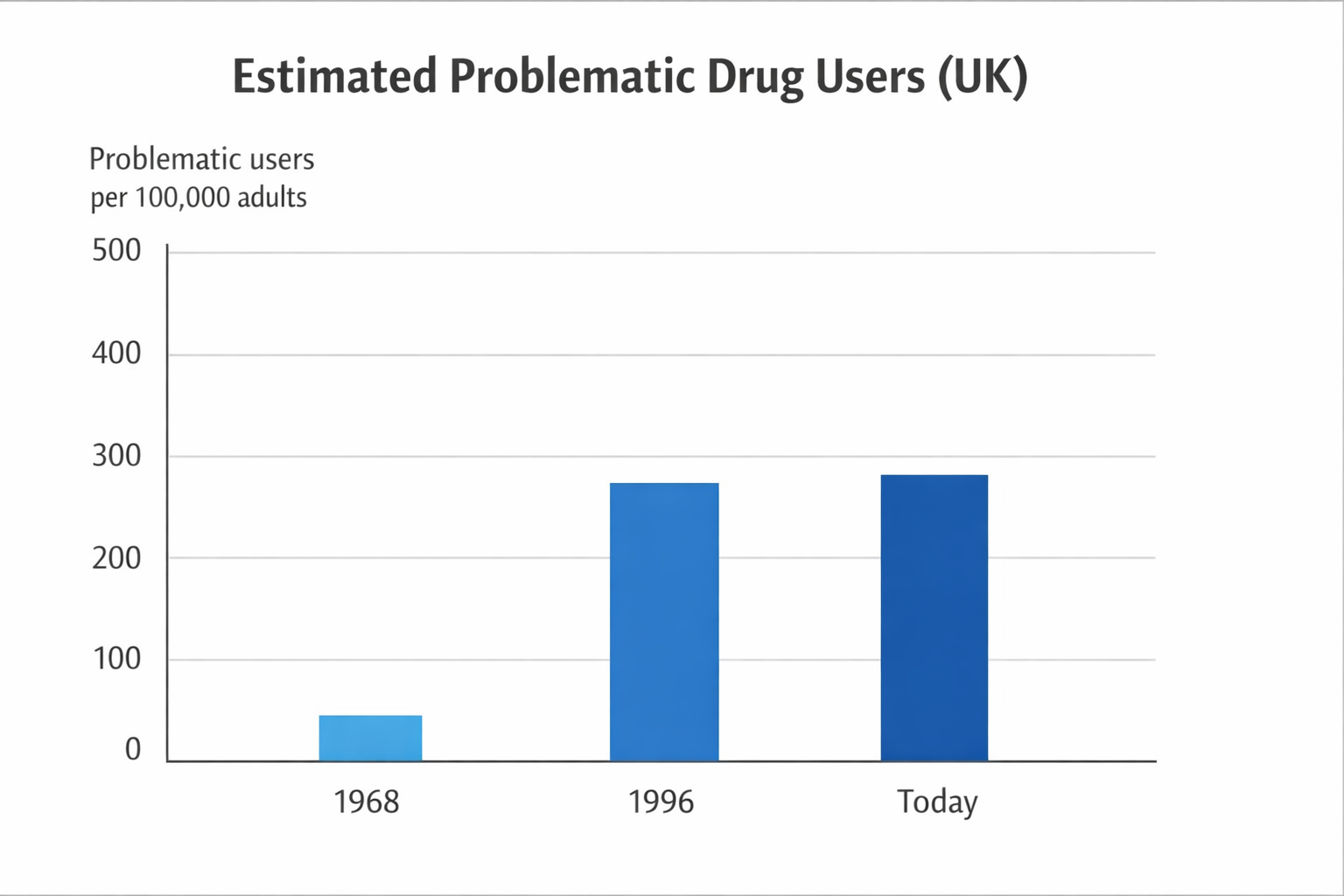
In practice, drug use and drug harm don’t scale together.
Use is relatively widespread. Severe harm is not. But the system we built assumed they moved in lockstep — and priced, enforced, and punished accordingly.
Looking at the figures in relative terms makes that assumption harder to sustain.
In the late 1960s, the number of known dependent users — even allowing for under-reporting — represented tens per million people. By the mid-1990s, estimates of serious or dependent use had risen to hundreds per 100,000 adults.
After decades of tightening laws and expanding enforcement, the most harmful forms of drug use had not vanished — and may even have increased modestly in relative terms.
That doesn’t prove a simple cause-and-effect relationship. But it does undermine the central promise of the strategy: that escalating punishment would steadily shrink the problem it was aimed at.
And what happened to the cost?
Here the picture becomes harder to ignore.
By the early 2000s, official estimates already placed the social and economic cost of illegal drugs in England in the tens of billions per year, with the vast majority driven by drug-related crime associated with a relatively small group of high-risk users.
Two decades later, the headline figure is still broadly the same: around £20bn a year, year after year.
That persistence is the point.
Even without perfect historical data back to the 1970s, we can say something robust: for at least twenty years, we have been spending very large sums annually trying to suppress a market that continued to exist — while criminal networks extracted their revenue regardless.
Even a deliberately conservative reading puts the cumulative public cost over that period into the hundreds of billions — plausibly £500bn to £1tn over the last fifty years.
Put another way, even if the state had chosen to cover the cost of supplying people with dependent or high-risk drug use — using the rough estimate from the previous post of around £3bn a year — the total bill over fifty years would have been in the region of £150bn.
That still implies a net saving of £350bn to £850bn, purely on cost grounds.
For context, that is equivalent to roughly 10–30% of current UK government debt, depending on how the assumptions are set. — money that could otherwise have gone into infrastructure, housing, healthcare, or simply not being borrowed in the first place.
That money didn’t buy elimination.
It didn’t buy control.
And it certainly didn’t starve the market.
Normalising for population and living standards
It’s tempting to say, “Well, the population grew.”
But that’s exactly why we normalise.
Viewed per head — or alongside broader measures of living standards and wellbeing — the story doesn’t suddenly improve. If anything, it becomes clearer that drug-related harm tracks stress, inequality, and declining opportunity far more closely than it tracks the severity of penalties.
Punishment doesn’t create stability.
It doesn’t create jobs.
It doesn’t reduce despair.
What it does do is reshape markets, often in ways that increase risk and cost at the margins.
So did we lose?
If the goal was to eliminate drug use, it’s hard to argue that we succeeded.
If the goal was to minimise harm at reasonable cost, the answer is… complicated.
What’s clear is that the approach we chose:
- didn’t remove demand
- didn’t collapse supply
- and didn’t stop criminal networks extracting value
What it did do was lock us into decades of spending — often justified by moral certainty rather than measurable improvement.
Which brings us back to the question this series keeps circling:
If a behaviour persists, is the measure of success how loudly we condemn it — or how intelligently we manage its consequences?
That’s where we’re heading next.
Further reading & supporting information
This post relies on order-of-magnitude reasoning, historical anchor points, and population-level trends rather than precise year-by-year accounting.
Drug use prevalence
- Crime Survey for England and Wales (CSEW)
- ONS statistical bulletins on drug misuse
Costs and harm
- UK Government / Carol Black Review of Drugs
- Home Office cost-of-crime modelling
Historical context
- Pre-1969 UK drug policy records and Hansard debates
- Estimates of registered dependent users prior to criminalisation
Policy transition effects
- UK day-rate fines trial (early 1990s) and subsequent abandonment
On uncertainty
Illegal markets are difficult to measure. The consistency across sources lies not in the decimals, but in the direction: persistent demand, persistent cost, and persistent criminal profit.
Discover more from Hysnaps Politics, Gaming, Music and Mental Health
Subscribe to get the latest posts sent to your email.


One thought on “Lets Rethink Policy-Making: Illegal Drugs – Cost of Losing the War.”