At this point, it’s probably worth stopping and taking stock.
We didn’t set out to have a conversation about drugs.
Or sex work.
Or migration.
Or punishment.
Those were just the places our journey took us.
What we’ve really been talking about is how policy behaves once it leaves the page.
A pattern that kept repeating
Across every example, the same structure kept showing up.
Not always in the same order.
Not always with the same language.
But recognisably the same.
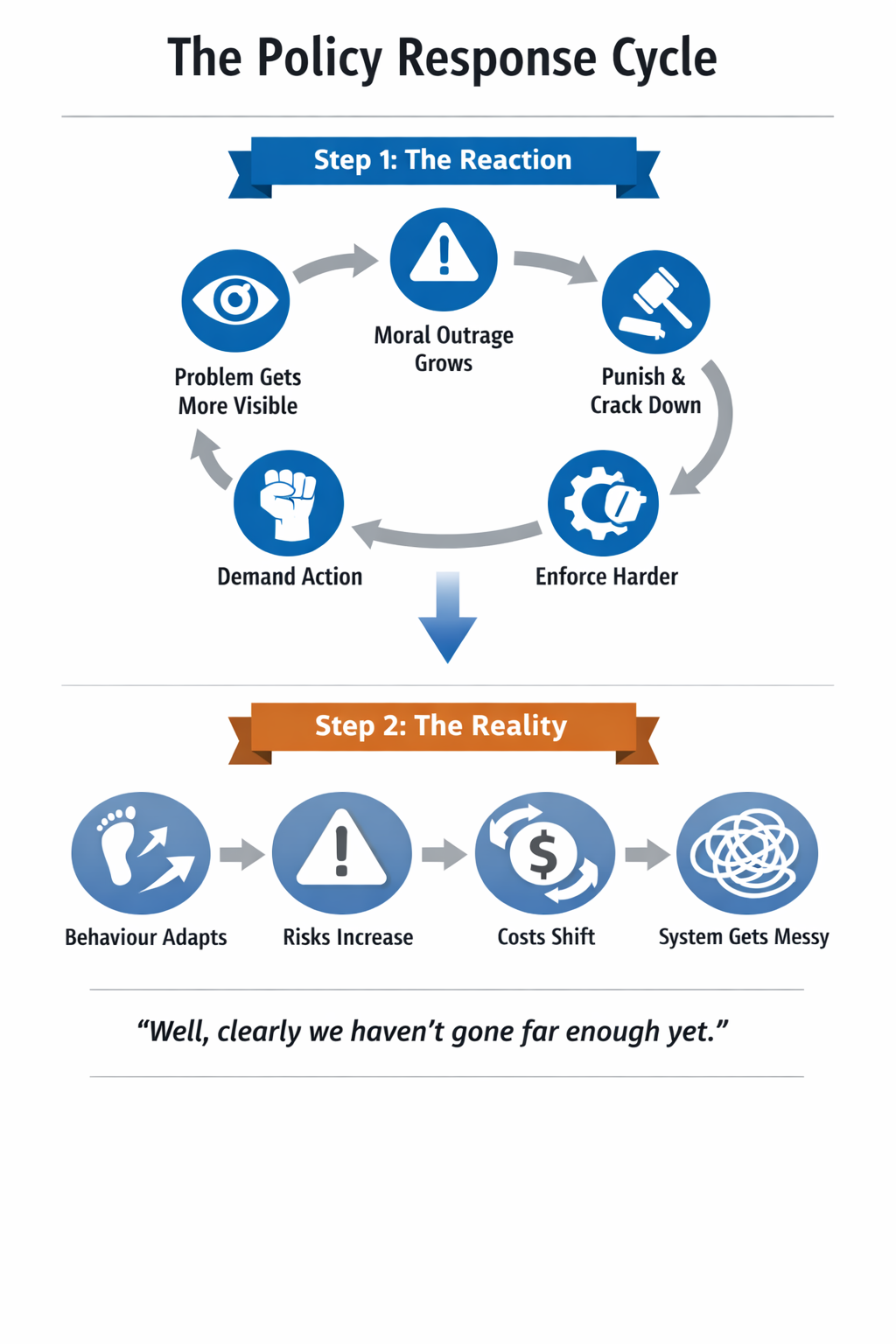
Something uncomfortable becomes more visible.
Concern grows.
That concern tightens into moral certainty.
Pressure builds to “do something”.
Punishment becomes the tool of choice.
And then…
Behaviour doesn’t disappear.
It adapts.
Risk concentrates.
Costs move elsewhere.
And the system gets more complex, not less.
At which point we usually say the same thing:
“Well, clearly we haven’t gone far enough yet.”
No villains required
One of the most uncomfortable realisations in all of this is that nobody has to be acting in bad faith for things to go wrong.
You can have:
- sincere concern
- decent intentions
- moral clarity
- a genuine desire to protect
…and still end up with outcomes that are:
- more harmful
- more expensive
- and harder to unwind
Because once policy becomes a system, it starts responding to incentives, not intentions.
That’s not a moral failing.
It’s just how systems work.
Morality wasn’t the problem
It’s important to say this clearly. Morality wasn’t the enemy in any of these examples.
In fact, morality is usually what starts the conversation:
- concern about harm
- concern about exploitation
- concern about safety
- concern about fairness
Those are good instincts. Necessary ones.
The problem begins when morality is asked to do something it can’t do on its own: to predict how millions of people will adapt once rules are enforced at scale.
That’s where evidence matters.
Not to replace values — but to stop values from blinding us to consequences.
What the evidence kept telling us
Across drugs, sex work, punishment, and migration, the evidence kept pointing in the same direction:
- persistent human behaviour doesn’t vanish under pressure
- enforcement reshapes markets more than it removes them
- risk migrates towards the least protected
- and costs rarely land where decisions are made
When visibility is mistaken for growth, urgency replaces curiosity.
When urgency replaces curiosity, feedback gets ignored.
And when feedback is ignored, systems drift into cycles that are very hard to stop.
None of this is particularly radical.
But it’s surprisingly easy to forget once moral certainty takes over.
The question we kept coming back to
By the end of each post, we found ourselves circling the same reframing.
Not:
“Is this behaviour right or wrong?”
But:
“What actually happens when we try to stop it this way?”
Who adapts?
Who pays?
Who becomes more vulnerable?
And which public services quietly absorb the consequences?
Once you start asking that question, a lot of familiar arguments begin to look… incomplete.
Why this matters beyond these examples
This wasn’t really a conversation about controversial topics.
It was a conversation about how systems behave under moral pressure.
Once you see the pattern, it becomes hard not to notice it elsewhere:
- in education policy
- in healthcare
- in fines and penalties
- in secrecy and transparency
- in financial regulation
- in public services more generally
Different surface issues.
Same underlying dynamics.
So what does “better” look like?
Not softer.
Not laxer.
Not indifferent.
Better usually looks like:
- clearer goals
- slower reactions
- fewer moral shortcuts
- more attention to incentives
- and a willingness to ask “what happens next?” before acting
It looks like designing for harm reduction, not moral purity.
For visibility, not fear.
For long-term cost, not short-term reassurance.
Which isn’t as emotionally satisfying.
But tends to work a lot better.
One last reframing
If there’s one idea worth carrying forward, it might be this:
Law doesn’t get to choose human behaviour.
It only gets to choose how expensive — and how harmful — managing it becomes.
Once you see policy through that lens, the conversation changes.
It stops being about winning arguments.
And starts being about designing systems we can actually live with.
Where this leaves us
This conversation wasn’t about answers.
It was about learning how to look.
How to slow down.
How to spot patterns.
How to separate intent from outcome.
And how to notice when morality and evidence have quietly drifted apart.
You don’t have to agree with every implication to recognise the structure.
And recognising structures is usually the first step toward changing them.
Discover more from Hysnaps Politics, Gaming, Music and Mental Health
Subscribe to get the latest posts sent to your email.

