Do we remember when this became untouchable?
Not a vote.
Not a speech.
Just a gradual shift in how we talked — and then how we thought. Somewhere along the line, Parliament stopped being described as something that evolves and started being treated as something that must be preserved exactly as it is.
Not the institution.
The habits.
Late nights.
Shouting across the floor.
Compressed sittings.
Rituals everyone understands but few can really justify.
None of that language is really about democracy.
It’s about tradition.
It’s about continuity.
It’s about “this is how it’s always been”.
And what’s odd is how natural that now sounds.
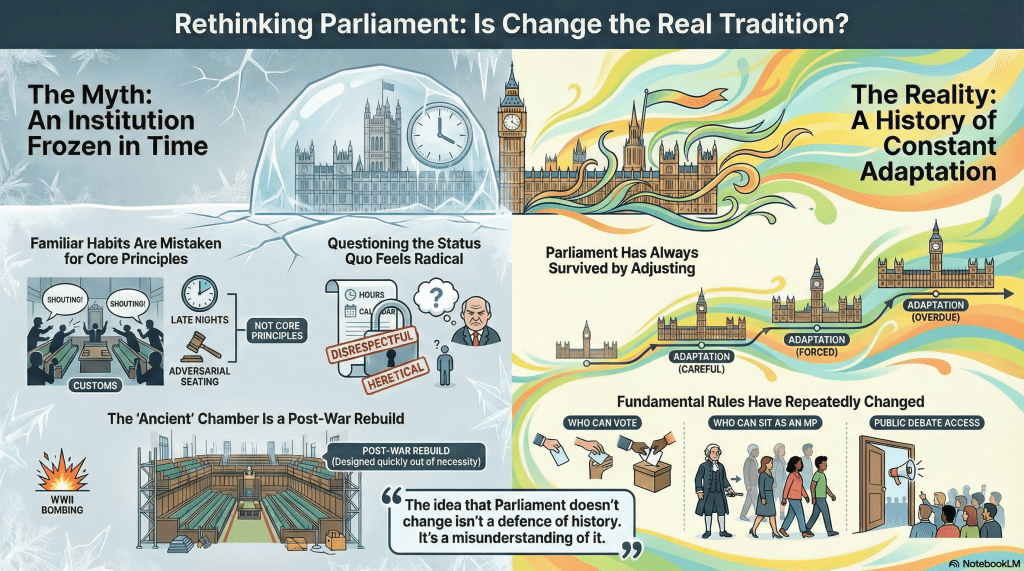
If someone suggests Parliament could work different hours, it feels radical.
If they question how the chamber is laid out, it feels disrespectful.
If they ask whether the calendar still makes sense, it sounds like heresy.
So when did change quietly slip into second place?
Ok… has Parliament really stayed the same?
We’ve been here before — just not in this context.
If you step back from the present moment, Parliament’s history is mostly a record of adaptation. Sometimes careful. Sometimes forced. Often overdue.
Who could vote changed.
Who could sit changed.
Whether MPs were paid changed.
Whether women were allowed into the chamber changed.
Even the idea that the public should hear debates at all is relatively recent.
None of that was obvious at the time.
None of it arrived without argument.
And yet now, all of it feels inevitable.
Which should make us pause.
What about the building itself?
This is where things often get muddled.
The Commons chamber is talked about as if it’s ancient — a physical embodiment of timeless constitutional wisdom.
It isn’t.
The current chamber is a post-war rebuild.
A response to bombing.
Designed under pressure.
Put together quickly because the country had other things to worry about.
That doesn’t make it wrong.
But it does mean it’s a product of circumstance, not scripture.
And once you notice that, a question starts to form.
So what are we actually protecting?
Because there’s a difference between:
protecting an institution
and
protecting the way it happened to work at a particular moment in time
One is stewardship.
The other is habit.
Late nights aren’t democracy.
Adversarial seating isn’t accountability.
Exhaustion isn’t seriousness.
They’re just things we’ve got used to.
And familiarity has a habit of dressing itself up as principle.
Why does change feel risky now?
Probably because “change” gets heard as “tear it all down”.
Which isn’t what anyone sensible is suggesting.
This isn’t about scrapping Parliament.
It’s about noticing that it has always survived by adjusting — often after periods where the old way of doing things stopped lining up with the job that needed doing.
The idea that Parliament doesn’t change isn’t a defence of history.
It’s a misunderstanding of it.
So where does that leave us?
Not with answers yet.
Just with a quieter realisation:
If Parliament has adapted repeatedly in the past, then the real question isn’t whether it can change.
It’s which changes strengthen it — and which ones we’ve been avoiding because they feel uncomfortable.
And to get any further than that, we probably need to be clear about something else first.
What Parliament is actually for.
Because a lot of the frustration aimed at it comes from expecting it to be something it never was.
And that’s where we go next.
This is the first post in a new series — Let’s Rethink Parliament.
There isn’t a fixed destination yet. The aim is to notice patterns as we go: how time is used, how incentives shape behaviour, how habits become untouchable — and what that does to outcomes across health, housing, education and beyond.
The direction will emerge as we proceed.



Discover more from Hysnaps Politics, Gaming, Music and Mental Health
Subscribe to get the latest posts sent to your email.

