Let’s Rethink Parliament: What Parliament Is Actually For
There’s a question that tends to surface whenever something goes wrong.
Housing stalls.
The NHS creaks.
Courts back up.
Schools struggle.
And sooner or later, the same thought appears:
Why doesn’t Parliament just fix this?
It’s an understandable reaction. Parliament is where the arguments happen. It’s where ministers stand at the despatch box. It’s where decisions feel like they’re being made. So when outcomes are bad, it’s natural for frustration to land there.
But this is where things start to blur.
Because Parliament isn’t actually designed to run the country in the way we often imagine.
So what is Parliament meant to do?
Parliament doesn’t manage hospitals. It doesn’t build homes. It doesn’t employ teachers or judges.
Those systems sit elsewhere, with their own structures and constraints.
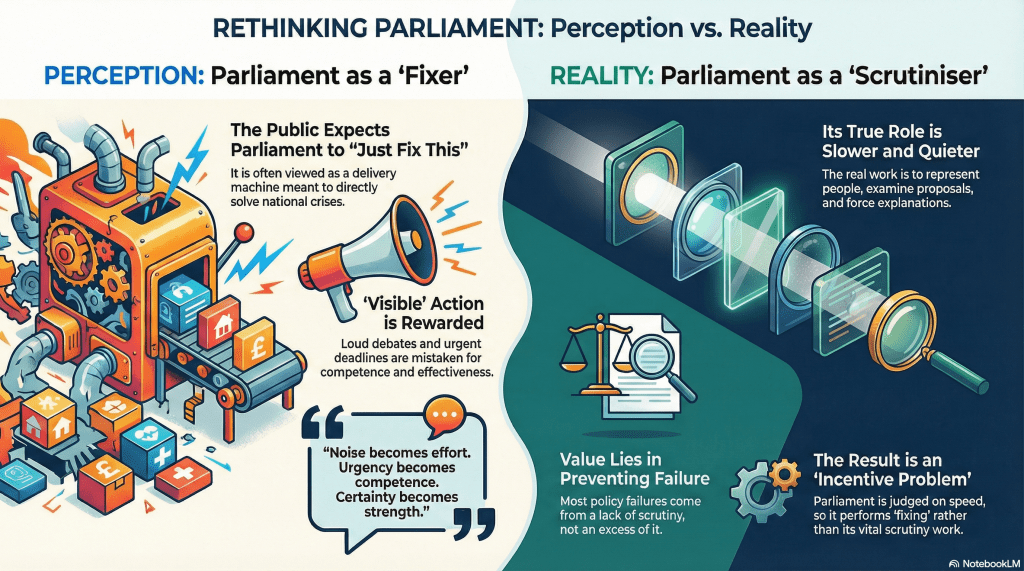
Parliament’s role is quieter. It represents people. It examines proposals. It slows things down. It forces explanations into the open.
None of that looks like delivery. And when it works well, it often looks like very little is happening at all.
Which makes it unsatisfying.
So when it looks like nothing is happening, that doesn’t mean they’re asleep?
There’s a familiar pattern here.
When Parliament is loud — trading blows across the chamber, issuing statements, setting deadlines — it feels active. It looks like effort. It reads as seriousness.
When it’s sitting in committee rooms, pulling apart draft legislation, listening to evidence, asking awkward questions, it can feel like stalling. Or worse, like nothing is happening at all.
So we start rewarding what we can see.
Noise becomes effort.
Urgency becomes competence.
Certainty becomes strength.
And the quieter work — the work Parliament is actually meant to do — begins to look expendable.
Isn’t scrutiny just getting in the way?
This is usually where the interruption comes.
At some point, surely decisions have to be made?
Of course they do. But here’s the part we tend to forget: most policy failures don’t come from too much scrutiny. They come from decisions taken quickly, under pressure, with uncomfortable details set aside because there “isn’t time”.
Bad policy rarely collapses immediately. It degrades. It reappears later as cost overruns, staff shortages, fragile systems, or the need for yet another reorganisation.
By then, Parliament is blamed again — this time for not spotting the problem earlier.
Which is awkward, because spotting problems early is exactly what scrutiny is meant to do.
Why Parliament drifts toward performance
When Parliament is judged as if it were a delivery machine, it starts borrowing the behaviours of delivery organisations.
Announcements.
Deadlines.
Signals of decisiveness.
Not because MPs are acting in bad faith, but because systems respond to what they’re rewarded for.
If the expectation is “fix this”, Parliament reaches for the tools that look like fixing — even when the real value lies somewhere slower and less visible.
That isn’t a moral failing. It’s an incentive problem.
A quiet mismatch
We want Parliament to think long-term, to prevent mistakes, to challenge assumptions early.
But we reward it for being fast, loud, and visible.
We complain about poor outcomes downstream, while steadily squeezing the space Parliament needs to do the upstream work that might have prevented them.
Once that mismatch becomes visible, a lot of behaviour that feels baffling starts to make uncomfortable sense.
Which leaves a practical question
If Parliament’s real work is slow, careful, and cumulative…
How much time does it actually have to do it?
Because scarcity changes behaviour everywhere.
And Parliament is no exception.
That’s where we go next.
This is the second post in a series — Let’s Rethink Parliament.
There isn’t a fixed destination yet. The aim is to notice patterns as we go: how time is used, how incentives shape behaviour, how habits become untouchable — and what that does to outcomes across health, housing, education and beyond.
The direction will emerge as we proceed.
Discover more from Hysnaps Politics, Gaming, Music and Mental Health
Subscribe to get the latest posts sent to your email.

