There’s a number that tends to surprise people.
Not because it’s hidden.
Just because we rarely stop to think about it.
Parliament doesn’t sit all year.
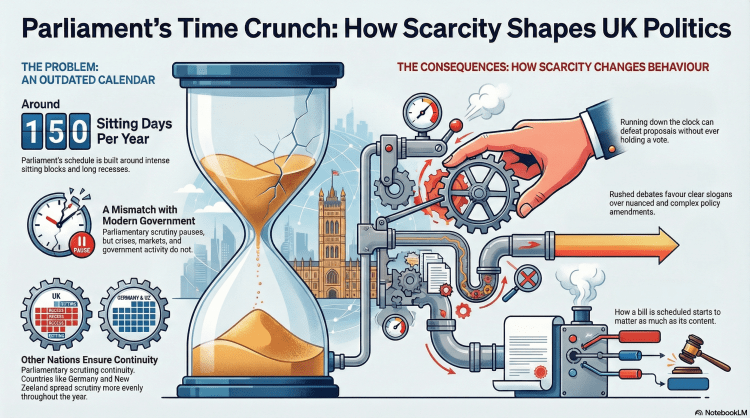
In a typical year, the House of Commons sits for around 150 days.
Sometimes a little more.
Sometimes a little less.
And once that number is on the table, a quiet question tends to follow.
Wait… only 150?
That reaction makes sense.
Politics feels constant.
The news cycle never stops.
Crises don’t politely wait for recess.
So it’s easy to assume Parliament is more or less always “on”.
But sitting days aren’t the same thing as visibility.
The calendar is built around:
- blocks of intense sitting
- long recesses
- an assumption that when Parliament isn’t sitting, things are calmer
That assumption hasn’t really held for a long time.
So what happens when Parliament isn’t sitting?
This is where things get a little hazy.
MPs don’t disappear.
Work continues — in constituencies, committees, meetings, correspondence.
But the central space — debates, votes, formal scrutiny in the chamber — slows or stops.
Which means that when something presses, there’s an obvious question.
And that’s where recall comes in
Parliament can be recalled.
And on the surface, that feels reassuring.
But recall isn’t part of the normal rhythm.
It’s an interruption.
Something exceptional.
Something reactive.
It exists because the calendar assumes long pauses — and reality doesn’t always cooperate.
Recalls happen when the gap between events and scrutiny becomes too uncomfortable to ignore.
What does that do to everything else?
Once time is finite, it starts to behave strangely.
When there are only so many days available:
- getting time matters more
- losing time feels costly
- delaying becomes leverage
Debates shorten.
Agendas crowd.
Procedural manoeuvres start to carry weight they wouldn’t otherwise have.
None of this requires bad intent.
It’s just what scarcity does.
Scarcity changes behaviour
There’s a more subtle effect here.
When time is limited, everything gets compressed.
Debates shorten.
Bills are rushed.
And suddenly, how something is scheduled starts to matter almost as much as what it says.
This is the bit that’s easy to miss if you’re not inside the system.
If Parliament only has a fixed number of sitting days, then time itself becomes a resource — and like any scarce resource, people start competing for it.
Getting a slot stops being administrative.
It becomes political.
If a bill is given plenty of time, it can be examined, amended, and reshaped.
If it’s squeezed into a narrow window, scrutiny becomes superficial — not because anyone wants that, but because there simply isn’t room to do more.
So decisions get made about time before decisions get made about policy.
Why delay becomes power
Once time is tight, delay takes on a new meaning.
Holding something up isn’t just obstruction — it’s leverage.
If there are only so many days available:
- delaying a bill can force concessions
- running down the clock can kill proposals without ever voting them down
- pushing something late in the session can make it effectively untouchable
None of this requires speeches or confrontation.
It’s procedural.
It’s quiet.
And it’s entirely legal.
But it only works because time is scarce.
Why talking something out starts to make sense
This is where things often look childish from the outside.
Long speeches.
Repetition.
Points that feel deliberately stretched.
It’s tempting to assume this is just bad behaviour.
But in a system where:
- there’s no guaranteed timetable for everything
- debate time is finite
- and running out the clock has real consequences
talking something out becomes a rational tactic.
Not a noble one.
Not a particularly dignified one.
But a predictable response to constraint.
Compression changes what survives
There’s another effect that matters even more.
When time is short, complexity loses.
Nuanced amendments struggle to get airtime.
Second-order effects get postponed.
“Well, we’ll fix that later” becomes the default.
Bills don’t just move faster — they move thinner.
And the things that survive best are:
- clear slogans
- simple binaries
- measures that fit into short exchanges
That doesn’t mean anyone set out to dumb things down.
It just means the system quietly selects for what fits the time available.
This isn’t about bad faith
None of this requires MPs to be cynical, lazy, or malicious.
It’s what happens in any system where:
- demand exceeds capacity
- time is rationed
- and visibility matters
Hospitals triage.
Courts backlog.
Planning systems queue.
Parliament does the same thing — just with arguments instead of patients or cases.
Scarcity doesn’t make people worse.
It makes certain behaviours rational.
And once those behaviours are rational, they become normal.
Which is why so much parliamentary conduct feels strange from the outside, but completely predictable once the time pressure is visible.
And that leads straight into the next problem.
If time is scarce, and the system rewards different ways of coping with that scarcity…
Is this unusual?
Most legislatures have calendars.
Most take breaks.
That part isn’t strange.
What’s unusual is how sharply parliamentary time is segmented — on or off — while the rest of government now operates on the assumption of continuity.
Because modern government doesn’t really pause.
International events don’t wait for recess.
Markets don’t wait.
Public services don’t wait.
And in many comparable countries, legislatures have quietly adapted to that reality — not by abolishing breaks, but by softening the stop–start nature of scrutiny.
How others handle continuity
Take Germany.
The Bundestag has recess periods, but the system is designed so that:
- committees continue working throughout the year
- scrutiny doesn’t rely on rare, dramatic recalls
- parliamentary time is spread more evenly across the calendar
The result isn’t constant intensity — it’s continuity. Fewer moments where everything has to be squeezed through at once.
Or New Zealand.
Parliament still recesses, but its sitting pattern is more regular and predictable. Committee work is central rather than secondary, and emergency scrutiny doesn’t require tearing up the calendar. Parliament can respond without needing to declare the moment exceptional.
In both cases, time pressure still exists — but it’s managed, rather than allowed to build silently and then release all at once.
Why this matters
In systems with more continuous rhythms, urgency doesn’t automatically translate into compression.
A problem emerging in July doesn’t have to wait until autumn to be examined properly.
A bill doesn’t need to be rushed because “there won’t be time later”.
Debate doesn’t have to do all its work in a narrow window.
The pressure is spread out.
Which means behaviour changes.
The UK’s particular mismatch
In the UK, the expectation has shifted — but the structure hasn’t.
Government activity now assumes:
- constant responsiveness
- rapid announcements
- ongoing management of risk
But parliamentary scrutiny still operates on a timetable built for an earlier era — one where long pauses were less disruptive.
So scrutiny gets interrupted just as complexity increases.
And when Parliament returns, it returns to:
- crowded agendas
- decisions already half-made
- pressure to “catch up”
That pressure doesn’t explode in a crisis.
It accumulates.
Pressure without a release valve
Because the system isn’t designed for continuity, pressure has nowhere to go.
It builds during recess.
It compresses on return.
It expresses itself through urgency, performance, and procedural manoeuvre.
Not because anyone planned it that way —
but because the structure quietly funnels behaviour in that direction.
The expectation of continuity now sits alongside a structure designed around interruption.
And that mismatch doesn’t fail loudly.
It distorts things slowly, and constantly.
And pressure shows up in behaviour
When Parliament returns after a break, the agenda is already full.
Things have happened in the meantime.
Statements have been made.
Decisions have edged forward.
So the choice quietly becomes:
slow things down and look obstructive
or
move quickly and look decisive
Neither option leaves much room for careful work.
So why does this matter?
Not to argue that MPs aren’t working.
Not to suggest Parliament should never pause.
Just to notice something simple.
When time itself is scarce:
- process becomes political
- visibility becomes currency
- performance starts to crowd out patience
And once that happens, behaviour starts to look odd — even when intentions aren’t.
Which brings us to the next question.
If Parliament has limited time, and unclear signals about what matters most…
how do MPs decide where to put their effort?
Because they don’t all respond to that pressure in the same way.
And the system quietly pretends they do.
That’s where we go next.
This is the third post in a series — Let’s Rethink Parliament.
There isn’t a fixed destination yet. The aim is to notice patterns as we go: how time is used, how incentives shape behaviour, how habits become untouchable — and what that does to outcomes across health, housing, education and beyond.
The direction will emerge as we proceed.



Discover more from Hysnaps Politics, Gaming, Music and Mental Health
Subscribe to get the latest posts sent to your email.

