There’s something we all recognise.
We don’t usually start with it, but it sits in the background of almost every conversation about politics.
Not all MPs work the same way.
There are MPs you recognise instantly — their faces are familiar, their voices easy to place. Others you only really encounter when something specific happens, when a local issue flares up or when they’re mentioned rather than seen.
And yet…
Formally, they’re all doing the same job.
Same title, same salary, same formal standing.
Which is fine, up to a point.
But it does make us pause.
So what is an MP actually meant to be doing?
This is where the edges blur.
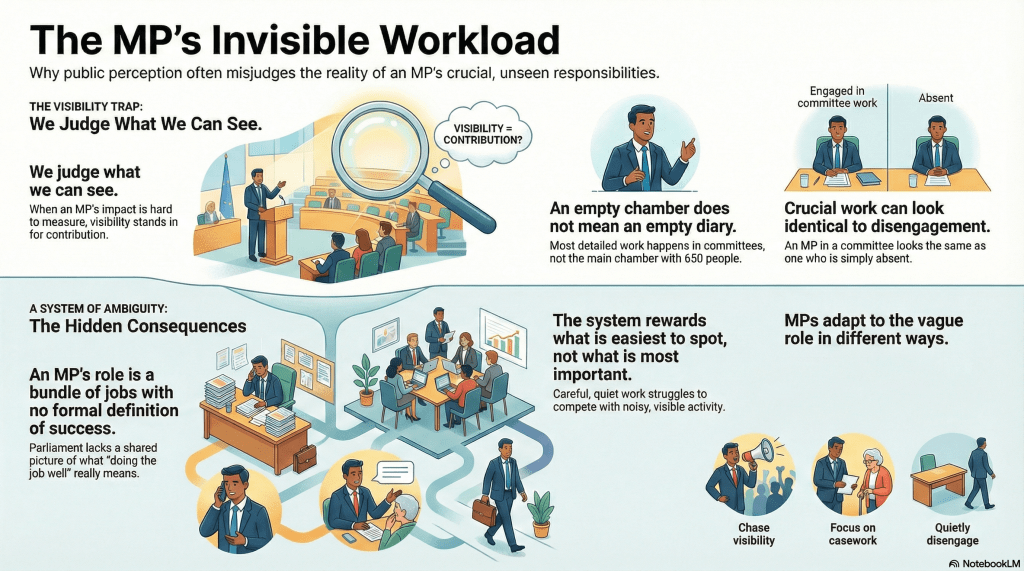
We talk about “being an MP” as if it’s a single, clearly bounded role, but in practice it’s a bundle of different responsibilities that don’t always sit neatly together.
Some of it is obvious and public. Some of it is quiet and technical. Some of it looks like politics, some like administration, and a surprising amount of it looks like listening, reading, and trying to untangle other people’s problems.
And none of that fits neatly into a checklist.
Which raises a slightly awkward thought.
If the role is that broad… how do we tell when it’s being done well?
And if we can’t answer that very clearly…
What do we end up using instead?
Usually, what we can see.
Who’s in the chamber, who’s speaking, who’s on the news, who looks busy.
That isn’t a moral judgement. It’s a human habit.
When outcomes are hard to pin down, visibility starts to stand in for contribution — not because it’s perfect, but because it’s available.
And once that happens, absence starts to carry meaning even when it probably shouldn’t.
Someone in a committee room can look missing. Someone deep in casework can look quiet. Someone doing slow, detailed legislative work can look inactive.
From the outside, those things blur.
So why does the chamber so often look half empty?
This is usually the moment frustration kicks in.
Why aren’t they there? Why does it look deserted?
Those reactions make sense, but they rest on an assumption — that the chamber is where most of the work should be happening.
It isn’t.
It can’t be.
Six hundred and fifty people can’t sensibly do detailed scrutiny together, which is why committees exist, evidence is taken elsewhere, and much of the careful work happens out of sight.
So an empty bench doesn’t automatically mean an empty diary.
But here’s the uncomfortable part.
From the outside, it’s hard to tell the difference between someone who’s working somewhere else and someone who’s simply not very engaged.
They look the same.
And the system doesn’t do much to help us tell them apart.
Same role. Same pay. Very different experiences.
This is where things get tricky.
Two MPs can hold the same position for the same length of time and have very different days — and very different impacts.
That isn’t shocking. It happens in most jobs.
What’s unusual is how little Parliament says about it.
There isn’t a shared picture of what “doing the job well” adds up to, how different kinds of work should balance against each other, or where the minimum line even sits.
So we muddle along with a quiet assumption that everyone is broadly pulling their weight in their own way.
Which is sometimes true, and sometimes… less so.
But the system doesn’t really separate the two.
So why hasn’t this ever been cleared up?
Partly because it’s uncomfortable.
Partly because it sounds like micromanagement.
Partly because nobody wants Parliament turned into a KPI factory.
And partly because it’s still leaning on an older idea: that MPs will regulate themselves through judgement, norms, and good faith.
That worked better when Parliament was smaller, slower, and less exposed. It’s harder to rely on now, when time is tight, pressure is constant, and attention never really switches off.
In that environment, vagueness doesn’t stay neutral for long.
How people respond to that vagueness
Given the same pressures, people adapt — but not in the same way.
Some lean into visibility. Some lean into committee work. Some lean into constituency cases. Some specialise quietly. Some drift, disengage, or burn out.
None of those responses are particularly surprising. They’re ways of navigating a role with fuzzy edges and competing demands.
The problem is that the system mostly treats them as equivalent.
So effort isn’t always easy to recognise, absence isn’t always easy to challenge, and contribution often gets judged later through impressions rather than outcomes.
Not because anyone designed it that way — just because nothing else filled the gap.
Why this starts to matter
This isn’t about accusing MPs of not working hard, and it isn’t about forcing everyone into the same mould.
It’s about noticing something subtle.
When a system isn’t very clear about what it values, it tends to reward whatever is easiest to spot.
And once that happens, behaviour gently shifts.
Being seen starts to matter. Noise travels further than patience. Careful work struggles to compete with visible activity.
Not because anyone is shallow, but because those are the signals in play.
Which leaves us with a loose end
Parliament depends on a lot of work that most of us never see.
But it doesn’t really know how to talk about that work, protect it, or separate it from disengagement, so everything flattens out.
And when everything flattens out, frustration grows — on all sides.
Which brings us to the next place to look.
If the chamber isn’t where most of the serious work is meant to happen… where is?
And what happens when that part of the system gets squeezed for time?
That’s where committees come in.
And that’s where we go next.
This is the forth post in a series — Let’s Rethink Parliament.
There isn’t a fixed destination yet. The aim is to notice patterns as we go: how time is used, how incentives shape behaviour, how habits become untouchable — and what that does to outcomes across health, housing, education and beyond.
The direction will emerge as we proceed.



Discover more from Hysnaps Politics, Gaming, Music and Mental Health
Subscribe to get the latest posts sent to your email.

