There’s a feeling a lot of us share, even if we don’t always articulate it.
We watch Parliament.
We hear it.
We see clips circulate.
And somewhere along the way, it starts to feel like being seen has become tangled up with doing the job.
Not because anyone decided that out loud.
Just because that’s how things slowly drift when visibility becomes constant.
Before we get into that, it’s worth remembering how different this all used to feel.
For most of Parliament’s history, what happened in the chamber was fleeting. You had to be there, or know someone who was — or read about it later through newspapers or Hansard, which preserved the words but not the moment itself.
Presence mattered.
But it wasn’t something most people could witness directly.
That distance did something important.
It meant that parliamentary work was largely judged after the fact.
By outcomes.
By decisions.
By what survived scrutiny over time.
And then, gradually, that distance disappeared.
What visibility was supposed to fix
When broadcasting and recording were introduced, the intention wasn’t sinister.
Quite the opposite.
The idea was transparency.
Accountability.
Letting people see how decisions were made, not just read about them later.
That made sense.
If Parliament was acting on our behalf, why shouldn’t we be able to watch it?
Why should it all feel hidden, clubby, or inaccessible?
So cameras arrived.
Radio coverage expanded.
Clips became shareable.
Parliament became something you could witness as it happened.
And at first glance, that feels like an unqualified good.
But changes like that rarely arrive alone.
They bring side effects with them — not because anyone wants them, but because systems respond to what’s visible.
When visibility becomes feedback
Here’s where things start to shift.
Once everything is visible, visibility itself starts to act like feedback.
You don’t just do the work.
You’re seen doing it.
And once that’s true, a subtle question creeps in:
What does “doing the job well” look like on camera?
That’s not a cynical question.
It’s a human one.
In any organisation, people respond to what’s noticed.
What’s commented on.
What’s praised or criticised.
Parliament is no different.
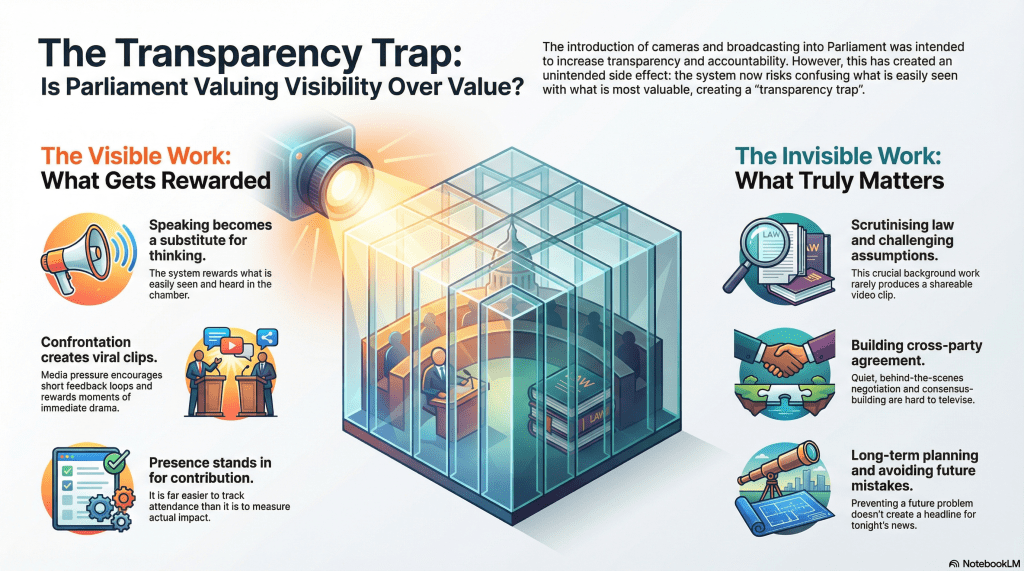
If speeches are clipped and shared, speeches start to matter more.
If moments of confrontation get replayed, confrontation becomes salient.
If silence looks like absence, quiet work starts to look like non-work.
None of that requires bad faith.
It doesn’t require anyone to be lazy or opportunistic.
It just requires a system where attention is unevenly distributed.
The problem with intangible work
A lot of parliamentary work is inherently hard to see.
Reading briefing papers.
Challenging assumptions in committee.
Building cross-party agreement behind the scenes.
Spotting unintended consequences before they harden into law.
None of that looks dramatic.
None of it produces a clip.
And when work is intangible, organisations face a choice.
They can design ways to recognise it.
Or they can default to whatever is easy to observe.
In modern workplaces, this is a familiar problem.
When output is hard to measure, managers fall back on presence.
Who’s visible.
Who’s active in meetings.
Who seems busy.
It feels like management.
But really, it’s a substitute for clearer expectations.
Parliament has quietly drifted into the same trap.
Presence starts standing in for contribution
Once visibility becomes the proxy, things start to blur.
Speaking becomes easier to spot than thinking.
Attendance becomes easier to track than impact.
Noise becomes easier to reward than restraint.
That doesn’t mean visible MPs aren’t working.
Many of them are working extremely hard.
But it does mean that visibility and value start to merge in the public imagination.
If someone isn’t seen, it becomes harder to explain what they’re doing.
If someone is constantly seen, it becomes easier to assume they’re effective.
The system doesn’t say this out loud.
It doesn’t need to.
The signals do the work quietly.
Media pressure and time horizons
There’s another layer to this, and it’s easy to miss because it feels normal now.
Media doesn’t just amplify visibility.
It compresses time.
A speech today is reacted to today.
A clip circulates within minutes.
A narrative hardens before the day is out.
That encourages short feedback loops.
What lands now?
What plays well now?
What survives the next news cycle?
Medium- and long-term thinking doesn’t vanish.
But it becomes harder to justify when the rewards are immediate and the costs are delayed.
Planning five or ten years ahead doesn’t produce a headline tonight.
Avoiding a future mistake doesn’t trend.
So attention drifts toward what registers quickly, even when everyone involved knows that the real work often doesn’t.
Again, this isn’t about blame.
It’s about incentives.
This isn’t unique to Parliament
If this feels familiar, that’s because it is.
We’ve seen the same pattern in offices debating remote work.
In healthcare, where activity targets crowd out outcomes.
In education, where measurable outputs replace deeper learning.
Whenever work becomes harder to define, systems cling to what they can see.
Parliament isn’t failing uniquely here.
It’s behaving exactly like other institutions under the same pressures.
The difference is that parliamentary decisions echo far beyond the building.
So what quietly changes?
Over time, a few things happen.
MPs adapt — differently.
Some lean into visibility.
Some focus on local or committee work.
Some do a mix of both.
The system, meanwhile, keeps pretending they’re all being judged by the same standards.
Which they aren’t.
And that gap — between what’s rewarded and what actually matters — is where frustration grows.
On the public side.
Inside Parliament too.
Because everyone can feel the mismatch, even if no one quite names it.
What we’re not saying
This isn’t an argument for secrecy.
Or for turning cameras off.
Or for nostalgia about a quieter past.
Transparency matters.
Visibility matters.
But visibility is not the same thing as work.
And presence is not the same thing as contribution.
Once those get confused, organisations drift.
Not dramatically.
Just steadily.
Which brings us to the next uncomfortable question.
If visibility has become a proxy for work…
and if different MPs respond to that pressure in different ways…
How does Parliament decide what it actually expects from the people inside it?
Because without that clarity, we keep circling the same frustration —
not because people aren’t trying,
but because the system can’t clearly say what “doing the job well” really means.
And that’s where we go next.
This is the fifth post in a series — Let’s Rethink Parliament.
There isn’t a fixed destination yet. The aim is to notice patterns as we go: how time is used, how incentives shape behaviour, how habits become untouchable — and what that does to outcomes across health, housing, education and beyond.
The direction will emerge as we proceed.
Discover more from Hysnaps Politics, Gaming, Music and Mental Health
Subscribe to get the latest posts sent to your email.

