There’s a phrase that comes up a lot when people talk about work.
“What does good actually look like?”
It sounds simple.
But it’s often the hardest question in the room.
Because once you ask it honestly, you realise how many systems never quite answered it — they just drifted into substitutes.
Parliament is no exception.
After talking about visibility, cameras, and the way presence slowly starts standing in for contribution, there’s a natural follow-on question that’s easy to dodge.
If visibility isn’t the same thing as work…
Then what is the work we’re actually trying to judge?
What do we think MPs are for?
We usually reach for instinctive answers.
Represent constituents.
Debate legislation.
Hold government to account.
All of those are true.
But they’re also broad — almost aspirational.
They don’t tell us how to recognise good performance.
They don’t help us distinguish between effort and impact.
And they don’t give MPs much guidance about where to put their time when everything feels urgent.
So instead, the system quietly falls back on what it can see.
Who spoke.
Who showed up.
Who made noise.
Not because those things are meaningless — but because they’re legible.
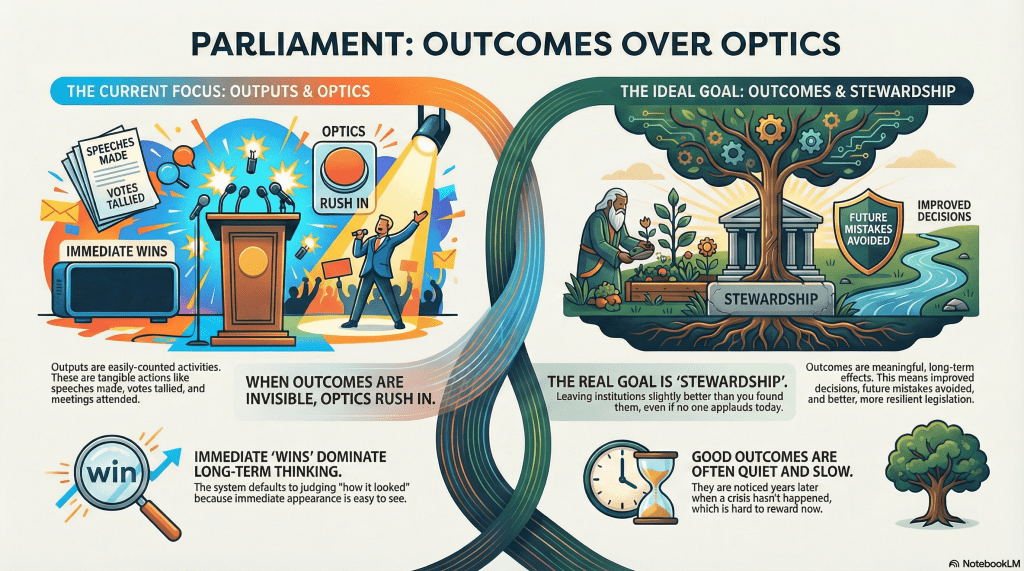
The difference between output and outcome
This is a distinction most workplaces eventually trip over.
Outputs are activities.
Meetings attended.
Emails sent.
Words spoken.
Outcomes are effects.
Decisions improved.
Mistakes avoided.
Capacity built for the future.
Outputs are easy to count.
Outcomes take time — and often only become visible after the moment has passed.
Parliament, especially in its public-facing moments, is heavily skewed toward outputs.
Speeches are recorded.
Votes are tallied.
Appearances are tracked.
But outcomes?
How do you show:
- a bad clause that never made it into law?
- a policy softened before it hardened?
- a future cost avoided because someone asked the right question early?
Those things rarely come with a timestamp.
When outcomes are invisible, optics rush in
Once outcomes are hard to see, something else fills the gap.
Optics.
How it looked.
How it landed.
How it played in the moment.
That doesn’t mean MPs stop caring about substance.
But it does mean substance has to compete with appearance — and appearance often wins the tie-breaker because it pays off immediately.
A careful intervention in committee might matter more in the long run.
A sharp exchange in the chamber matters more now.
And when time, attention, and media pressure are all compressed, “now” starts to dominate.
Why this doesn’t feel like anyone’s fault
This is the part that’s easy to miss if we frame things as character flaws.
No one sat down and decided Parliament should reward optics over outcomes.
No one voted for performance to crowd out patience.
It happened the way these things usually do.
Gradually.
Reasonably.
Through adaptation.
When scrutiny time is limited, visibility feels safer.
When attention is scarce, clarity beats nuance.
When feedback is instant, long-term payoffs feel abstract.
The system doesn’t say “ignore outcomes”.
It just doesn’t make room for them.
What good outcomes would actually look like
This is where it’s tempting to reach for metrics.
Targets.
Dashboards.
But that’s not what this is about.
Good parliamentary outcomes are often quiet.
Legislation that survives contact with reality.
Policies that don’t need constant patching.
Decisions that age better than expected.
They show up as:
- fewer emergency fixes
- less reform churn
- fewer “how did no one spot this?” moments
You don’t notice them on the day.
You notice them five or ten years later, when something hasn’t gone wrong.
Which is awkward in a system geared toward immediate judgment.
Stewardship doesn’t trend
There’s a word that fits here, even if it sounds a bit unfashionable.
Stewardship.
Looking after institutions so they’re still functional tomorrow.
Resisting the urge to overcorrect.
Leaving things slightly better than you found them, even if no one applauds.
Stewardship is slow.
It’s cumulative.
And it doesn’t lend itself to clips.
Which makes it easy to undervalue — especially in a culture that increasingly asks, “what did you do today?”
So what happens when outcomes stay undefined?
If a system can’t clearly say what success looks like, people improvise.
Some optimise for visibility.
Some retreat into specialist work.
Some focus locally.
Some burn out trying to do everything.
From the outside, this looks like inconsistency.
From the inside, it feels like guesswork.
And the system quietly pretends all these approaches are equivalent — because it doesn’t have a better language.
Which brings us to the next uncomfortable step.
If we can’t clearly articulate outcomes…
and if optics keep filling the gap…
How does Parliament decide what effort it actually values?
And what does that do to who thrives inside the system — and who quietly opts out?
That’s where we go next.
This is the sixth post in a series — Let’s Rethink Parliament.
There isn’t a fixed destination yet. The aim is to notice patterns as we go: how time is used, how incentives shape behaviour, how habits become untouchable — and what that does to outcomes across health, housing, education and beyond.
The direction will emerge as we proceed.
Discover more from Hysnaps Politics, Gaming, Music and Mental Health
Subscribe to get the latest posts sent to your email.

