

There’s a quiet assumption that sits behind a lot of frustration with Parliament.
That the real work is meant to happen in the chamber.
That debates are where scrutiny lives.
That if something wasn’t argued out across the floor, it probably wasn’t examined properly.
But that isn’t actually how Parliament is supposed to work.
And once you notice that, a lot of things start to look slightly different.
So where is the detailed work meant to happen?
Not in the shouting matches.
Not in the clipped exchanges.
Not even, most of the time, in the moments that get replayed.
The system already has a place for slow, detailed, unglamorous work.
Committees.
They’re not new.
They’re not marginal.
And they weren’t designed as an afterthought.
They exist because Parliament has always known something important:
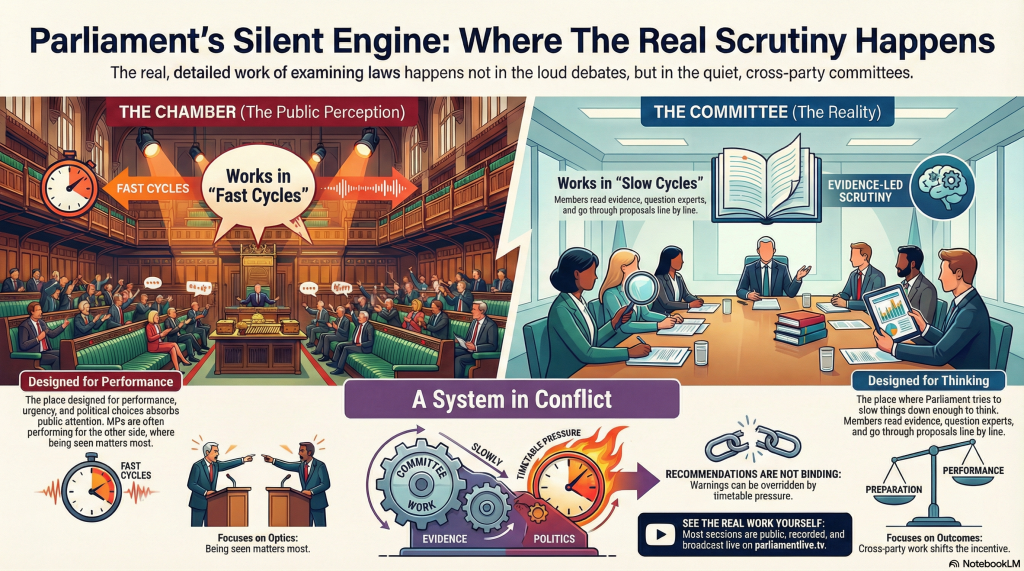
You can’t examine complex policy properly in a crowded room, on a clock, with everyone watching.
None of this is hidden.
You can see which select committees are currently running, what they’re examining, and who sits on them on Parliament’s own site — not as an archive, but as live, ongoing work.
Most sessions are public. Many are recorded. Some are broadcast live.
What committees quietly do
Most committees don’t look dramatic from the outside.
They read evidence.
They question witnesses.
They go line by line through proposals.
They sit with awkward details long after the headlines have moved on.
Crucially, they’re usually cross-party.
Which changes the dynamic straight away.
You’re no longer performing for the other side.
You’re working with people you disagree with, trying to understand how something will actually behave once it leaves the page.
That doesn’t remove politics.
But it does shift the incentives.
Being seen matters less.
Being prepared matters more.
This is where scrutiny was meant to live
There’s a common misconception that committees are secondary.
That they’re where MPs are sent when they’re not “important enough” for the main event.
In reality, it’s almost the reverse.
Committees are where Parliament tries to slow things down enough to think.
They’re where:
- experts are questioned without soundbites in mind
- unintended consequences get surfaced early
- trade-offs are acknowledged rather than flattened
Or at least, that’s the design.
When it works, it works quietly.
Which may be part of the problem.
Committees don’t just talk.
They produce formal reports — sometimes dozens a year — setting out findings, recommendations, and evidence trails that remain publicly available long after the news cycle has moved on.
Why this work doesn’t travel well
Committee work doesn’t clip neatly.
It’s discursive.
It’s technical.
It often ends in “it depends”.
That makes it harder to translate into the kind of visibility we talked about earlier.
So from the outside, it can look like very little is happening.
Inside the system, though, this is where many MPs will tell you the job actually feels real.
Where their questions land.
Where their preparation shows.
Where outcomes — not optics — still have a fighting chance.
If you want to see this work happening in real time, you can.
Committee evidence sessions are regularly broadcast — not as highlights, but in full — and they often look very different from the chamber debates most people recognise.
If committees exist, why doesn’t this feel like the centre of gravity?
That’s the uncomfortable bit.
Committees are designed for seriousness.
But they’re embedded in a wider system that runs on urgency.
Their recommendations aren’t binding.
Their timelines can be squeezed.
Their work can be overtaken by events — or by the legislative clock.
So while committees can do deep scrutiny, they’re often doing it under quiet pressure.
Not because anyone doubts their value.
But because time elsewhere is scarce.
Which leads to a strange inversion.
The place designed for thinking gets less time.
The place designed for performance absorbs more attention.
Committees also operate on their own calendars — scheduling evidence sessions, private deliberations, and report publication over weeks or months rather than news cycles.
This wasn’t meant to be a loophole
Committees weren’t created so that detail could be bypassed later.
They exist precisely because Parliament has long understood that:
- complexity needs space
- disagreement needs structure
- good law takes iteration
The shouting chamber was never meant to do all the work.
It was meant to surface political choices after serious examination had already happened.
When that order reverses, things start to fray.
So what’s going wrong?
Not because committees are weak.
Not because MPs don’t care.
But because the system keeps asking committees to do slow work inside fast cycles.
They’re meant to absorb complexity.
But they’re fed it late.
They’re meant to reduce risk.
But their warnings can be overridden by timetable pressure.
And when that happens repeatedly, learning gets lost.
Which brings us to the next step.
If committees are where Parliament’s best instincts live…
what happens when they’re rushed, sidelined, or quietly ignored?
That’s where we go next.
Appendix: Seeing Committee Work for Yourself (Optional Reading)
If you want to see where much of Parliament’s detailed work actually happens, it’s all publicly available.
You don’t need special access.
You don’t need insider knowledge.
It’s just not where attention usually lands.
Current committees and live inquiries
The full list of active Commons, Lords, and Joint Committees — including what they’re currently examining — is published by UK Parliament here:
https://committees.parliament.uk/
This includes:
- ongoing inquiries
- committee membership
- published calls for evidence
Watching committee sessions
Many committee evidence sessions are broadcast live and remain available to watch later.
You can view them in full (not as highlights) via Parliament’s live streaming service:
https://parliamentlive.tv/Commons
Committee sessions tend to look very different from the chamber:
slower, more technical, and far less performative.
Committee reports and historic outputs
Committees publish formal reports setting out findings, recommendations, and evidence trails — along with government responses.
Those reports are archived and searchable here:
https://committees.parliament.uk/publications/
Some quietly shape policy.
Some are acknowledged and then ignored.
Either way, the record remains.
Committee calendars
Committees operate on their own schedules, often planned weeks or months in advance.
Upcoming evidence sessions and meetings are listed here:
https://committees.parliament.uk/calendar/
It’s a useful reminder that parliamentary scrutiny doesn’t only happen in bursts — even if that’s how it often appears from the outside.
This is the seventh post in a series — Let’s Rethink Parliament.
There isn’t a fixed destination yet. The aim is to notice patterns as we go: how time is used, how incentives shape behaviour, how habits become untouchable — and what that does to outcomes across health, housing, education and beyond.
The direction will emerge as we proceed.



Discover more from Hysnaps Politics, Gaming, Music and Mental Health
Subscribe to get the latest posts sent to your email.

