
Let’s Rethink Parliament: When Committees Are Undermined
Up to this point, something reassuring has been sitting in the background.
That Parliament already knows how to do serious work.
That committees exist precisely because complexity needs time, structure, and space.
That scrutiny wasn’t meant to be a shouting match.
So the obvious question, once you’ve noticed that, is a slightly awkward one.
If committees are designed to do the careful thinking…
why does it so often feel as though that thinking arrives too late — or doesn’t land at all?
This isn’t a question about intent.
It’s about pressure.
It’s not that committees don’t work
This is worth saying clearly before anything else.
Most of the time, committees do exactly what they’re supposed to do.
They gather evidence.
They test assumptions.
They surface risks that aren’t obvious in the headline version of a policy.
When people talk about Parliament “missing things”, they’re often talking about issues that were raised — just not acted on.
So the problem isn’t that committees are asleep.
It’s that they’re operating inside a system that doesn’t always wait for them.
Timing is where things start to slip
One of the quiet ways committees get undermined is simply by when they’re involved.
Sometimes scrutiny happens early, when things are still fluid.
But often it happens late, when:
- political commitments have already been made
- public expectations have been set
- reversing course would look like weakness
At that point, even good scrutiny becomes awkward.
Not because it’s wrong.
But because acting on it would mean slowing down — or admitting that earlier certainty was premature.
So recommendations land politely… and then drift.
When urgency outruns examination
There’s a familiar rhythm here.
A problem emerges.
There’s pressure to respond.
A bill is introduced quickly.
Committees start working — but the legislative clock is already running.
Evidence arrives while timetables are fixed.
Concerns are raised while decisions are half-locked in.
Amendments are suggested when there’s limited appetite to reopen fundamentals.
None of this requires anyone to say “ignore the committee”.
It happens because urgency is contagious.
Once speed becomes the priority, everything else has to negotiate for space.
Executive control of time matters more than it sounds
There’s another structural detail that tends to stay in the background.
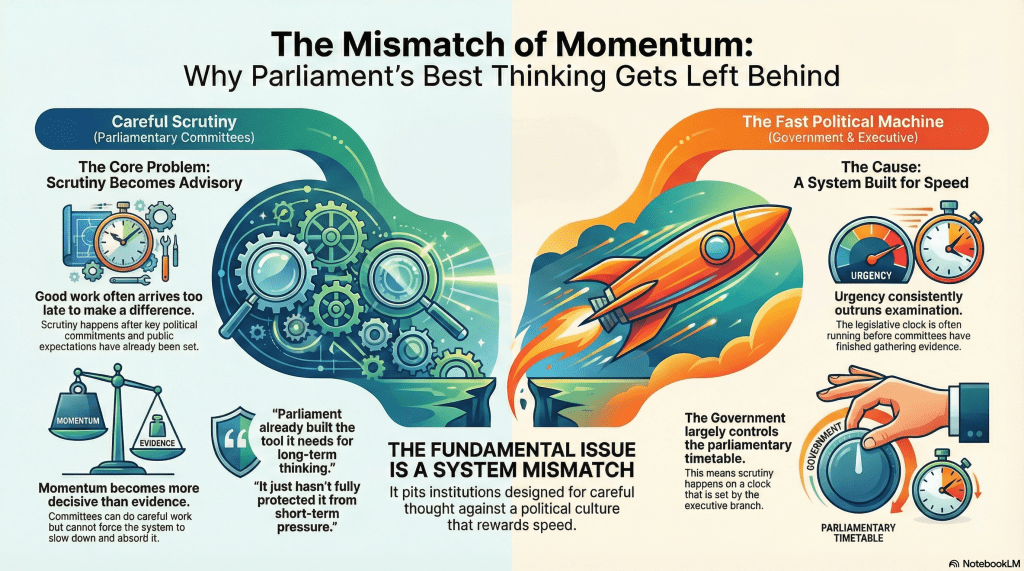
In practice, the government largely controls the parliamentary timetable.
What gets time.
When it gets it.
How much room there is for iteration.
That doesn’t mean scrutiny is forbidden.
But it does mean scrutiny happens on a clock set elsewhere.
So committees can do careful work…
but they can’t force the system to slow down and absorb it.
Which quietly flips the relationship.
Scrutiny becomes advisory.
Momentum becomes decisive.
When learning turns into churn
Over time, this produces a familiar pattern.
Issues are flagged.
They’re partially addressed.
They resurface later — often in crisis form.
At that point, the response isn’t “we should listen more carefully next time”.
It’s often structural reform.
Reorganisation.
A new framework.
Which feels active.
But also resets institutional memory.
Committees, meanwhile, end up re-learning the same lessons — because the system keeps moving faster than its own capacity to remember.
This isn’t sabotage — it’s mismatch
It’s tempting to describe this as committees being “ignored”.
But that’s slightly too strong — and a bit misleading.
What’s really happening is a mismatch between:
- institutions designed for careful scrutiny
- and a political environment that rewards speed and decisiveness
Committees ask, “What happens if…?”
The wider system keeps asking, “Can we move on?”
Neither question is unreasonable.
But when one consistently outruns the other, the balance tips.
Why this matters more than it looks
When committees are sidelined, it’s not just a procedural loss.
It changes behaviour.
MPs learn — quietly — that deep scrutiny doesn’t always travel.
That raising awkward questions late in the process carries risk.
That the safest place to intervene is often earlier, louder, and more visible.
Which nudges behaviour back toward the chamber.
Back toward optics.
Back toward performance.
Exactly the opposite of what committees were meant to encourage.
The irony sitting underneath all this
Parliament already built the tool it needs for long-term thinking.
It just hasn’t fully protected it from short-term pressure.
So instead of committees anchoring the system,
they end up orbiting it — influential, respected, but not always decisive.
And that brings us to the next step.
If committees are where Parliament’s best thinking can happen…
what would it take to make their work harder to bypass — without turning them into an unelected veto?
That’s the question waiting for us next.
Appendix: Seeing Committee Work for Yourself (Optional Reading)
If you want to see where much of Parliament’s detailed work actually happens, it’s all publicly available.
You don’t need special access.
You don’t need insider knowledge.
It’s just not where attention usually lands.
Current committees and live inquiries
The full list of active Commons, Lords, and Joint Committees — including what they’re currently examining — is published by UK Parliament here:
https://committees.parliament.uk/
This includes:
- ongoing inquiries
- committee membership
- published calls for evidence
Watching committee sessions
Many committee evidence sessions are broadcast live and remain available to watch later.
You can view them in full (not as highlights) via Parliament’s live streaming service:
https://parliamentlive.tv/Commons
Committee sessions tend to look very different from the chamber:
slower, more technical, and far less performative.
Committee reports and historic outputs
Committees publish formal reports setting out findings, recommendations, and evidence trails — along with government responses.
Those reports are archived and searchable here:
https://committees.parliament.uk/publications/
Some quietly shape policy.
Some are acknowledged and then ignored.
Either way, the record remains.
Committee calendars
Committees operate on their own schedules, often planned weeks or months in advance.
Upcoming evidence sessions and meetings are listed here:
https://committees.parliament.uk/calendar/
It’s a useful reminder that parliamentary scrutiny doesn’t only happen in bursts — even if that’s how it often appears from the outside.
This is the eighth post in a series — Let’s Rethink Parliament.
There isn’t a fixed destination yet. The aim is to notice patterns as we go: how time is used, how incentives shape behaviour, how habits become untouchable — and what that does to outcomes across health, housing, education and beyond.
The direction will emerge as we proceed.



Discover more from Hysnaps Politics, Gaming, Music and Mental Health
Subscribe to get the latest posts sent to your email.

