
There’s a strange thing about Parliament that most of us only really notice when we stop and think about it.
No one ever seems quite sure when the working day actually starts.
Or when it’s meant to end.
We talk about Parliament as if it operates like any other workplace — demanding, high-pressure, responsible for serious outcomes.
But when you look at the rhythm of the day itself, it doesn’t feel designed in quite that way.
It feels… inherited.
When does the day begin?
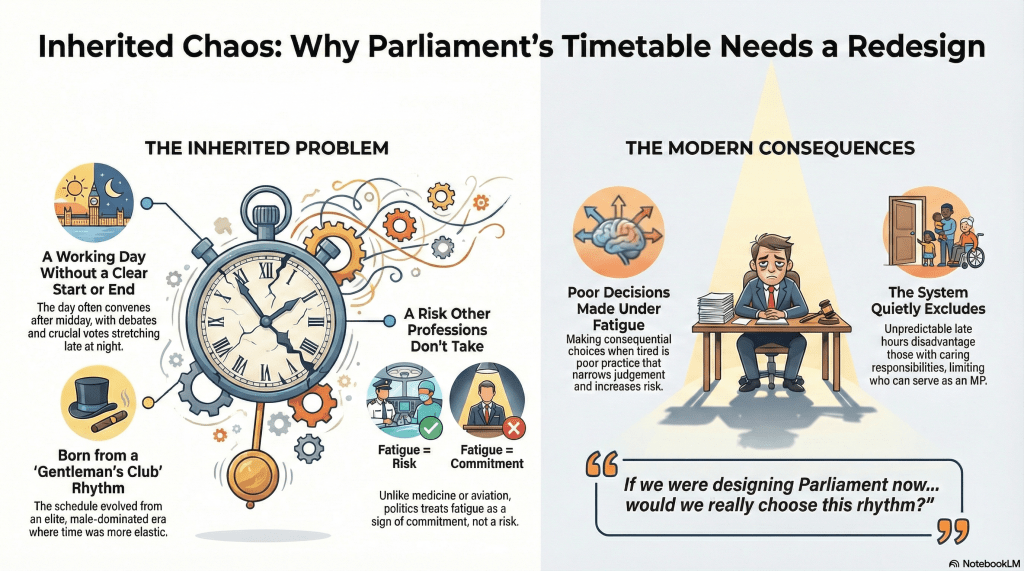
Many parliamentary days don’t properly get going until late morning or early afternoon.
That isn’t laziness.
It isn’t indulgence.
It’s just how the timetable evolved — layered on top of travel, meetings, committees, party activity, and centuries of habit.
But it does raise a quiet question.
If this were a new institution we were designing today —
with the responsibility to make national decisions —
would we choose a working day that only reliably convenes after midday?
Probably not.
And when does it end?
This is where things get even stranger.
Votes late at night.
Debates stretching into the small hours.
Important decisions taken when the room is tired and half-empty.
We’ve normalised this.
There’s even a kind of pride attached to it — a sense that exhaustion signals seriousness, commitment, sacrifice.
But step back for a moment.
In almost any other context, making consequential decisions at midnight would be treated as poor practice.
Risky.
Avoidable.
Fatigue doesn’t sharpen judgment.
It narrows it.
So why do we accept it here?
The gentleman’s club rhythm
Part of the answer is historical.
UK Parliament wasn’t designed around modern working assumptions.
It evolved from a social, elite, male-dominated environment where time was elastic and domestic life was handled elsewhere.
That doesn’t make it malicious.
It just makes it dated.
As the role of MPs professionalised, the rhythm didn’t fully follow.
Layers were added.
Responsibilities expanded.
But the core timetable never really got rebuilt.
So instead of a designed working day, we have an accretion of expectations.
Why this matters more than it sounds
Working patterns shape behaviour.
If decisions happen late, the people who can stay late gain influence.
If unpredictability is normal, those with caring responsibilities are quietly disadvantaged.
If exhaustion is expected, only certain kinds of people thrive.
None of this needs to be intentional to be real.
The system doesn’t say “this role isn’t for you”.
It just makes some lives much harder to fit into it.
This isn’t about comfort
It’s tempting to hear this as a complaint about hours.
About ease.
About making things nicer.
That misses the point.
This is about decision quality.
About who gets heard.
About whether Parliament is set up to do careful work — or just to endure it.
If scrutiny already struggles for time, pushing it into the late hours doesn’t help.
If outcomes matter, taking decisions when people are depleted is a strange way to pursue them.
Other systems learned this the hard way
In medicine, aviation, engineering — fatigue is treated as a risk factor.
Shifts are structured.
Rest is planned.
Overlap is designed in.
Not because people are weak.
But because systems that ignore human limits fail more often.
Politics tends to pretend it’s different.
As if determination can substitute for structure.
The question we rarely ask
So here’s the question that tends to sit unspoken.
If we were designing Parliament now —
with everything we know about work, fatigue, inclusion, and decision-making —
would we really choose this rhythm?
Or would we design something more deliberate?
Predictable hours.
Clear expectations.
A working day that supports scrutiny rather than squeezing it to the edges.
This isn’t about copying another country.
Or imposing a rigid template.
It’s just about noticing that the current pattern wasn’t chosen — it was inherited.
And inherited systems rarely optimise themselves
Once you see that, it becomes harder to unsee.
Late nights stop looking heroic.
They start looking like a workaround.
And that leads naturally to the next step.
If the working day itself was never properly designed…
what kind of people does it quietly select for?
And who does it push away — before the debate even starts?
That’s where we go next.
This is the ninth post in a series — Let’s Rethink Parliament.
There isn’t a fixed destination yet. The aim is to notice patterns as we go: how time is used, how incentives shape behaviour, how habits become untouchable — and what that does to outcomes across health, housing, education and beyond.
The direction will emerge as we proceed.



Discover more from Hysnaps Politics, Gaming, Music and Mental Health
Subscribe to get the latest posts sent to your email.

