There’s a question that tends to sit just offstage in discussions about Parliament.
Not about rules.
Not about reform.
Not even about behaviour.
It’s simpler than that.
Who does this system actually work for?
Not in theory.
In practice.
Nobody sets out to design a filter
It’s important to start here.
No one sat down and said Parliament should favour a particular type of person.
No one drew up a list of traits they wanted to exclude.
But systems don’t need intention to filter.
They filter by what they make easy — and what they make hard.
Working patterns.
Expectations.
Unspoken norms.
Over time, those things do the selecting.
What the job quietly asks of you
If you step back and look at the role as it’s actually lived, a few things stand out.
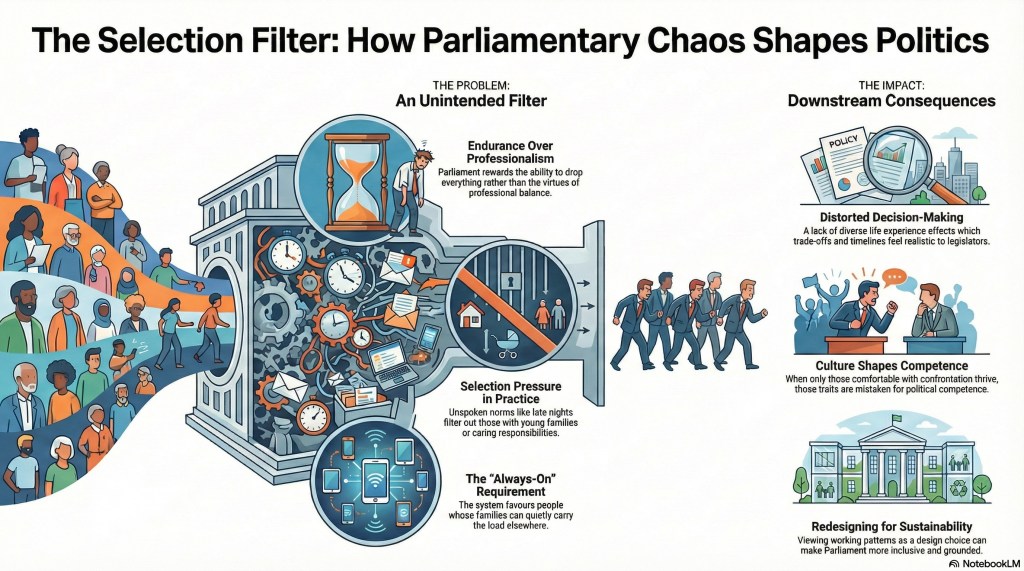
Unpredictable hours.
Late nights.
Long stretches away from home.
Constant switching between visibility and availability.
None of these are written into a job description.
But they’re baked into the rhythm.
And that rhythm favours people who can absorb disruption.
People without caring responsibilities.
People with flexible personal lives.
People whose partners or families can quietly carry the load elsewhere.
That doesn’t make those people less committed.
But it does narrow the field.
Who finds it harder to stay
Once you notice that, another pattern becomes visible.
People with young families.
People caring for relatives.
People who need predictability to function well.
None of these make someone a worse representative.
Often the opposite.
But they make an unpredictable, late-night, always-on environment much harder to sustain.
So some people never stand.
Some leave earlier than planned.
Some decide it’s simply not compatible with the rest of their life.
Not because they lack motivation.
But because the cost is too high.
Professionalism versus endurance
There’s an odd inversion here.
We often talk about wanting Parliament to be more professional.
More representative.
More grounded in real-world experience.
But the system still rewards endurance more than balance.
Being able to stay late.
Being able to drop everything.
Being able to treat personal life as secondary.
Those aren’t professional virtues in most fields.
They’re warning signs.
Yet in politics, they’re often framed as dedication.
The type of confidence this produces
Over time, this shapes the culture.
If the people who thrive are those comfortable with confrontation, unpredictability, and constant exposure, then those traits start to look like competence.
If quieter, more methodical people struggle to fit, their absence is rarely remarked on.
The system doesn’t say it prefers one over the other.
It just behaves as if it does.
And behaviour teaches faster than rules.
Representation without conspiracy
This isn’t an argument that Parliament is full of the “wrong” people.
Or that those who succeed are somehow illegitimate.
It’s an argument about selection pressure.
When a system rewards certain ways of living and working, it will tend to reproduce them.
That’s true in companies.
In professions.
In institutions.
UK Parliament isn’t exempt from that logic.
Why this matters downstream
Who ends up in Parliament affects more than atmosphere.
It affects:
- which problems feel intuitive
- which trade-offs feel acceptable
- which timelines feel realistic
If long-term planning is hard for people whose own lives are lived in constant disruption, that’s not a moral failing.
It’s a structural one.
The quiet contradiction
We often say we want Parliament to look more like the country.
But we’ve built a working environment that makes many ordinary lives hard to accommodate.
That contradiction doesn’t announce itself.
It just persists.
And over time, it shapes who feels they belong.
Which leaves us with a question
If the working patterns of Parliament quietly select for certain kinds of people…
And if those patterns weren’t deliberately designed in the first place…
What would happen if we treated them as something we could redesign?
Not to make the job easier.
But to make it more sustainable.
More inclusive.
More aligned with the decisions it’s meant to make.
That’s the question we carry forward.
This is the tenth post in a series — Let’s Rethink Parliament.
There isn’t a fixed destination yet. The aim is to notice patterns as we go: how time is used, how incentives shape behaviour, how habits become untouchable — and what that does to outcomes across health, housing, education and beyond.
The direction will emerge as we proceed.


Discover more from Hysnaps Politics, Gaming, Music and Mental Health
Subscribe to get the latest posts sent to your email.

