
There’s a question that tends to come up whenever people are unhappy with politics.
Why do we keep ending up with this sort of politician?
It’s usually asked with frustration.
Sometimes with anger.
Often with a vague sense that “something has gone wrong”.
But there’s another way of coming at it — one that feels less satisfying in the moment, but more useful.
Instead of asking who ends up in Parliament, we might ask:
What kind of person does this system quietly make it easiest to become an MP?
Selection doesn’t start at the ballot box
We often talk about elections as the great filter.
Who stands.
Who wins.
Who loses.
But by the time someone’s name is on a ballot paper, a lot of filtering has already happened.
Long before parties select candidates.
Long before voters make a choice.
People have already decided whether this is a life they can realistically take on.
And that decision is shaped less by ideology than by logistics.
The unspoken requirements
If you look at the job as it’s actually lived, not how it’s described, certain expectations quietly emerge.
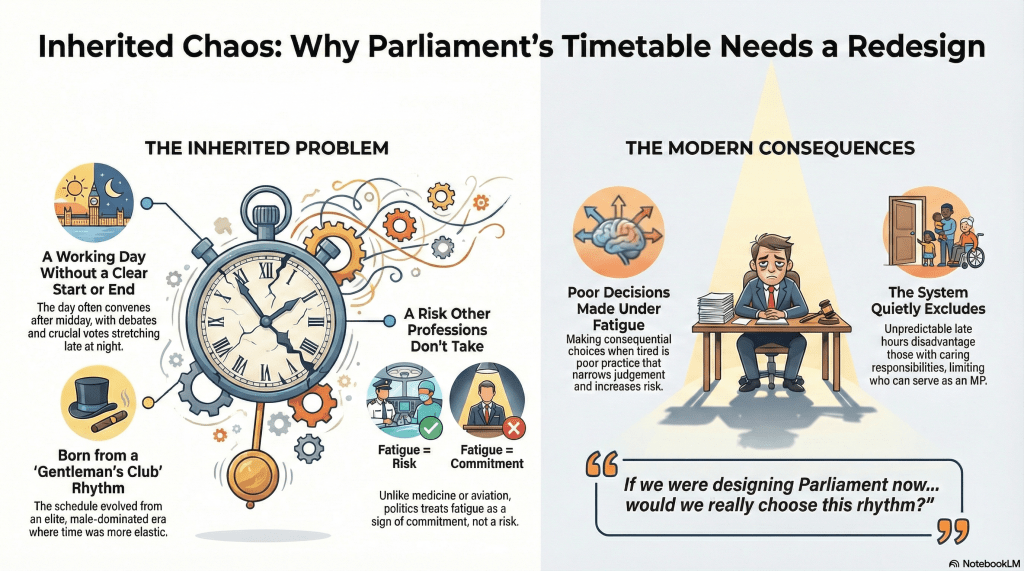
Unpredictable hours.
Frequent late nights.
Long stretches away from home.
A constant need to be available — sometimes at very short notice.
None of this is written down.
But it’s widely understood.
And it immediately narrows the field.
Not by talent.
Not by motivation.
But by circumstance.
Who finds it easier to say yes
Some people can absorb that disruption more easily than others.
People without caring responsibilities.
People with partners who can take on more at home.
People whose lives are already structured around flexibility.
That doesn’t make them less representative.
It doesn’t make them bad actors.
But it does mean the system is gently leaning in their direction.
Not by preference.
By design — or rather, by lack of design.
And who quietly opts out
Others look at the same reality and make a different call.
People with young children.
People caring for parents or relatives.
People whose professional lives depend on predictability.
People who value being present at home as much as being present at work.
None of those things make someone less capable of public service.
Often they bring exactly the experience we say we want more of.
But the cost of participation is higher.
So some never stand.
Some step back earlier than they expected.
Some decide they’ll engage in other ways instead.
Not because they don’t care.
But because the system asks too much in the wrong places.
Availability bias in action
There’s a subtle effect here that’s easy to miss.
When availability becomes the quiet prerequisite, it starts to look like commitment.
Those who can always stay late appear dedicated.
Those who can always attend appear serious.
Those who can always respond appear engaged.
Meanwhile, people who need boundaries — for reasons entirely unrelated to effort — risk being read as less committed.
Not explicitly.
Just through accumulated assumptions.
Over time, that shapes who gets encouraged.
Who gets promoted.
Who is seen as “a good fit”.
Why professionalism alone doesn’t fix this
We often talk about wanting more professionals in politics.
People with experience.
People who’ve run organisations.
People who understand complex systems.
But most professional environments have moved in the opposite direction to Parliament.
Predictable hours.
Clear expectations.
Some separation between work and life.
As long as parliamentary life remains unusually disruptive, it will continue to repel many of the people we say we’d like to attract.
Not because they wouldn’t cope.
But because they wouldn’t choose to.
Incentives don’t judge — they select
None of this requires a conspiracy.
Or gatekeeping.
Or ill intent.
It’s just how incentives work.
Systems don’t argue with you.
They don’t persuade you.
They quietly reward some choices and penalise others.
And over time, people adapt — or step aside.
The uncomfortable implication
If we’re unhappy with the kind of politics we keep getting…
If we find ourselves frustrated by tone, behaviour, or short-termism…
It’s worth sitting with an awkward possibility.
Maybe the system is doing exactly what it’s set up to do.
And maybe the question isn’t why these people,
but why this environment keeps selecting them.
Carrying this forward
This isn’t about blaming MPs.
Or dismissing those who’ve made it work.
It’s about recognising that representation starts long before election day.
If you don’t like the people a system attracts,
you don’t start by criticising the people.
You start by looking at what the system quietly rewards.
And that leads us to the next step.
If incentives shape who enters Parliament…
what else do they shape once people are inside?
That’s where the conversation goes next.
This is the eleventh post in a series — Let’s Rethink Parliament.
There isn’t a fixed destination yet. The aim is to notice patterns as we go: how time is used, how incentives shape behaviour, how habits become untouchable — and what that does to outcomes across health, housing, education and beyond.
The direction will emerge as we proceed.


Discover more from Hysnaps Politics, Gaming, Music and Mental Health
Subscribe to get the latest posts sent to your email.

