There’s something we rarely stop to notice, mostly because it’s always been there.
You become aware of it before anything formally begins — before the first question, before a vote, before anyone has really had a chance to shape the moment themselves.
The room has already spoken.
You walk into the Commons chamber and the message is immediate.
Government on one side. Opposition facing them. Everyone else lined up behind their own team.
You don’t need a rulebook to understand what’s expected.
The layout already tells you who you’re meant to be arguing with.
And that isn’t accidental.
Are we overthinking the furniture?
This is usually where the objections surface.
That it’s just a room. That it’s tradition. That no one is being forced to behave in any particular way.
And taken literally, that’s all true.
But we already accept this idea everywhere else in life. Classrooms don’t look like courtrooms by accident. Boardrooms aren’t laid out like lecture theatres without reason. Even cafés nudge behaviour through lighting, noise, and how tables are arranged.
Rooms don’t dictate behaviour — but they invite it.
And the Commons chamber invites confrontation.
What the chamber quietly encourages
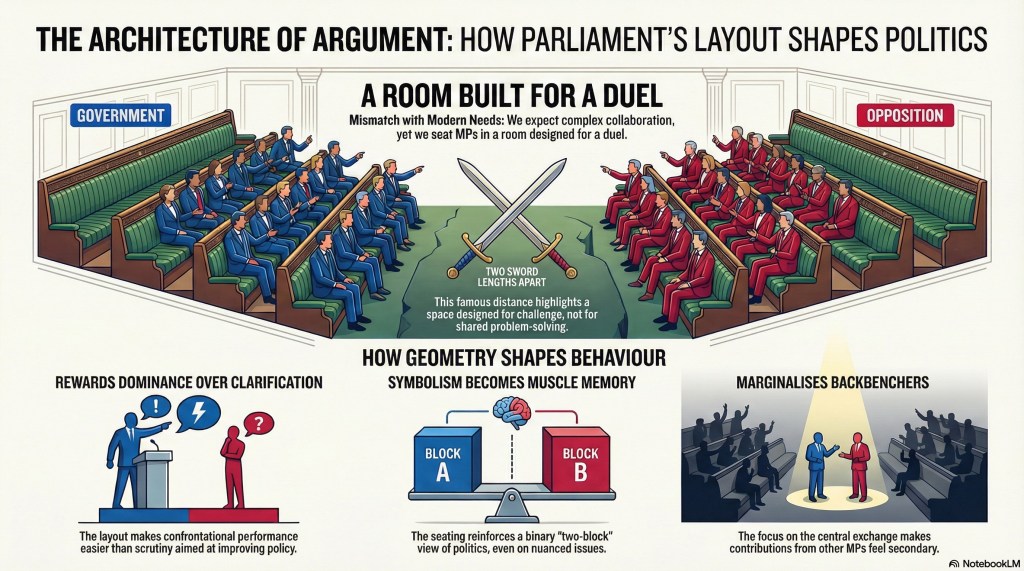
The benches face each other at close quarters.
The distance between the front rows is famously said to be two sword lengths apart.
That detail gets repeated so often it’s almost a joke. But jokes tend to survive because they’re pointing at something real.
This is a space designed for challenge, for opposition, for visible contest. Not for tentative agreement. Not for shared problem-solving. Not for working something out collectively in real time.
When someone stands to speak, they aren’t stepping into neutral space. They’re stepping into a position that already carries expectation — of resistance, of defence, of point-scoring.
Over time, that matters.
But Parliament has always argued, hasn’t it?
Yes. And no one here is pretending disagreement is new — or undesirable.
Disagreement is essential. Democracy depends on friction — on people being willing to say “I don’t agree” and to push back when something doesn’t sit right.
The question isn’t whether Parliament should argue.
It’s what kind of argument the space rewards.
There’s a difference between disagreement aimed at clarification and disagreement aimed at dominance. Between scrutiny that tries to improve something and performance that tries to land a blow.
The current chamber doesn’t force the latter — but it certainly makes it easier.
When symbolism turns into habit
What begins as symbolism has a habit of becoming muscle memory.
If you sit every day facing the same opponents, if your allies are always physically behind you, if speaking means turning toward one side rather than addressing the room as a whole — politics slowly starts to feel like a contest between two blocks, even when the issue itself isn’t binary.
Nuance struggles to find a physical home.
Cross-party agreement becomes something that has to work against the geometry of the space. Compromise starts to look awkward, even suspect, when the audience is arranged as rival camps.
None of this requires bad intent.
It simply trains people, over time, to behave predictably.
What happens to the rest of the room?
There’s another, quieter effect that’s easy to miss.
Most MPs don’t experience the chamber from that central, confrontational position. Most aren’t on the front benches, and most don’t spend their time facing the opposition head-on.
They sit behind it all — listening, reacting, and often waiting for a moment to contribute that may or may not come.
Because the focal point of the room is the exchange across the centre, everything else becomes secondary — literally and figuratively.
Contribution ends up being associated with visibility at the front, rather than the quieter work spread across the chamber.
Not because anyone set out to sideline those voices — but because that’s what the layout quietly produces.
Is this really about architecture?
Not in the abstract sense.
This isn’t about materials, or aesthetics, or heritage versus modernity. It’s about whether the environment matches what we now expect Parliament to do.
We ask MPs to work together across party lines on problems that are complex, long-term, and rarely reducible to simple choices. We talk a lot about evidence-led policymaking, careful scrutiny, and thinking beyond the next headline.
And then we seat people in a room built to stage a duel.
That mismatch doesn’t break the system.
It just nudges it — day after day — in a particular direction.
And the nudges add up
Individually, none of this feels decisive.
No one walks into the chamber thinking, “Right, I will now behave differently because of the benches.”
But over years — over whole careers — the space normalises certain behaviours and quietly marginalises others.
Fast, decisive moments start to crowd out slower thinking. Clear sides feel easier than messy agreement. And visible performance begins to edge ahead of quieter process.
Not because people are shallow.
But because the room keeps whispering the same cues.
So what are we actually noticing?
Not that Parliament is theatrical.
Not that disagreement is bad.
Not that tradition is worthless.
Just this:
If we want different behaviour, it’s worth asking whether the space itself is helping — or quietly pulling the other way.
Because long before anyone speaks, the room has already framed the conversation.
Which leaves us with an uncomfortable question to sit with:
If we changed nothing else — no rules, no powers, no people — how much difference would it make if the room stopped telling MPs who they’re meant to be fighting?
That isn’t a call to tear anything down.
It’s simply noticing that behaviour doesn’t emerge in a vacuum.
And spaces, like systems, always leave fingerprints.
This is the twelfth post in a series — Let’s Rethink Parliament.
There isn’t a fixed destination yet. The aim is to notice patterns as we go: how time is used, how incentives shape behaviour, how habits become untouchable — and what that does to outcomes across health, housing, education and beyond.
The direction will emerge as we proceed.

Discover more from Hysnaps Politics, Gaming, Music and Mental Health
Subscribe to get the latest posts sent to your email.

