
Once we start noticing how much the room shapes behaviour, an awkward question follows almost immediately.
Do we actually have to move Parliament to change this?
Because the moment anyone mentions a new building, the conversation tends to derail. Costs. Heritage. Symbolism. Headlines about “vanity projects”. The substance gets buried under the reaction.
So it’s probably worth pausing and asking something quieter first.
What could change without leaving the Palace at all?
Are we stuck with this layout?
It’s easy to assume the chamber is fixed — that the benches, the divisions, the sightlines are somehow immutable.
But they aren’t.
The Commons chamber we know today isn’t medieval. It was rebuilt after the war, under pressure, with compromises, and with a particular idea of how politics should work at the time.
That means two things can be true at once:
The building is historically significant.
And the way we use the space has already changed before.
So the question becomes less “can this ever change?” and more “what kind of change would actually matter?”
What if the centre mattered more than the sides?
One small but telling detail is where speaking happens.
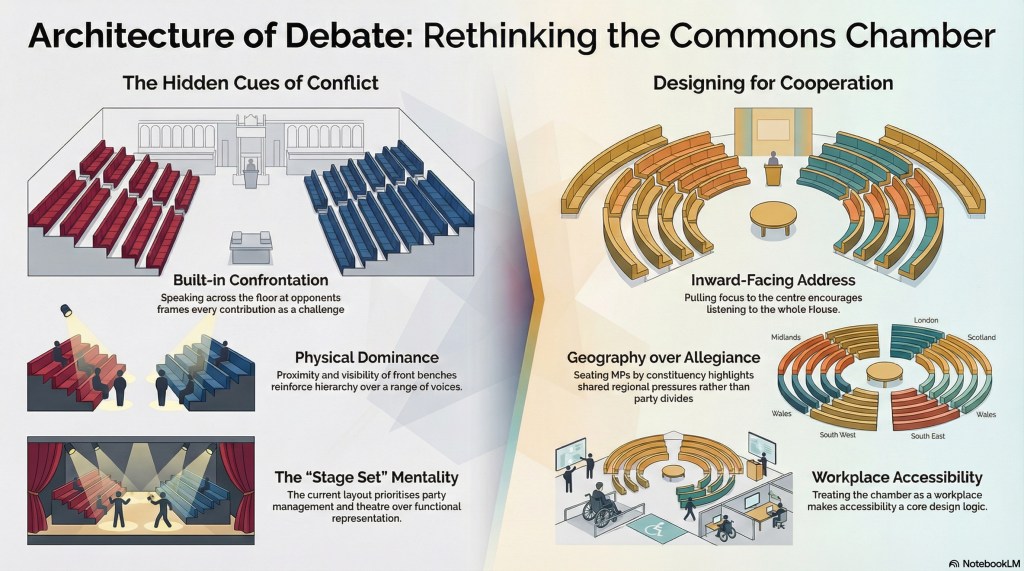
Right now, the act of speaking reinforces the divide. You rise from your side, face the other side, and deliver your argument at them. Even when the content is careful or conciliatory, the posture is confrontational.
It quietly frames every contribution as a challenge.
So imagine a small shift.
Not a redesign. Not new walls. Just a change in emphasis.
What if the speaking position pulled attention inward, rather than across?
What if addressing the House meant addressing the whole room, not just the opposing bench?
That alone wouldn’t make Parliament consensual — but it might make listening feel more natural than performance.
Seating sends signals too
The current arrangement sorts people first by party, then by seniority, then by visibility.
That makes sense for party management. It makes less sense for representation.
So here’s another gentle question to sit with.
What if MPs were seated by constituency instead?
Not perfectly. Not rigidly. Just as a guiding principle.
You’d still see party clusters — of course you would. Politics doesn’t dissolve because of furniture. But you’d also see geography intrude on allegiance. Regional proximity. Shared local pressures.
The visual story would shift slightly — from “two teams facing off” to “a country represented in a room”.
That’s not nothing.
What about the front benches?
The front benches are powerful because they’re physically dominant.
They’re closer to the action. More visible. More audible. More likely to be clipped and replayed.
That prominence reinforces hierarchy and narrows the range of voices that feel consequential in the moment.
So what happens if we soften that dominance rather than abolish it?
Side-by-side positioning rather than opposing trenches.
Less physical separation from the rest of the chamber.
A sense that leadership is part of the room, not elevated above it.
Again — not revolutionary. Just less theatrical.
But doesn’t this disadvantage some MPs?
This is where the conversation has to slow down and be careful.
Any physical change has to work for everyone — including MPs with mobility needs, hearing differences, or accessibility requirements. The current setup already creates challenges here, and any adjustment would need to improve things, not worsen them.
That’s not an argument against change.
It’s an argument for treating the chamber as a working environment, not a stage set.
If Parliament is meant to be a modern workplace, accessibility shouldn’t be an afterthought — it should be part of the design logic.
Why small changes might matter more than big ones
There’s a temptation to think that unless we do something dramatic, nothing will change.
But behaviour rarely shifts because of one big moment. It shifts because the cues around us change slightly, then consistently.
If speaking feels less like confrontation, tone adjusts.
If seating reflects place as well as party, perspective broadens.
If leadership looks embedded rather than elevated, contribution feels safer.
None of this removes conflict.
It just makes cooperation less awkward.
Why this conversation matters before relocation
There’s a practical reason to have this discussion now.
The Palace is already facing major restoration work. Temporary chambers have been planned. Alternatives have been modelled. The idea that Parliament might sit somewhere else — even briefly — is no longer hypothetical.
That means the question isn’t “should we ever think about space?”
It’s “what do we want space to do?”
If we don’t answer that, we risk recreating the same behavioural cues in a shinier room.
So where does this leave us?
Not with a blueprint.
Not with a demand.
Not with a finished answer.
Just with a quieter realisation.
We’ve been treating the chamber as neutral for a long time — as if behaviour happens despite the space rather than partly because of it.
Once you see that, it’s hard to unsee.
And it sets up the next question almost inevitably:
If we did ever move — temporarily or permanently — what would we want a modern parliamentary space to actively encourage?
Because by then, pretending the room doesn’t matter won’t really be an option.
This is the thirteenth post in a series — Let’s Rethink Parliament.
There isn’t a fixed destination yet. The aim is to notice patterns as we go: how time is used, how incentives shape behaviour, how habits become untouchable — and what that does to outcomes across health, housing, education and beyond.
The direction will emerge as we proceed.



Discover more from Hysnaps Politics, Gaming, Music and Mental Health
Subscribe to get the latest posts sent to your email.

