There’s a point in this conversation where it often stalls.
Someone will usually say, gently but firmly, that whatever we’re talking about can’t really change — because it’s historic. And more often than not, that feels like the end of the road, not because anyone has been persuaded, but because the word itself carries enough weight to quiet things down.
Which is understandable. The Palace of Westminster does matter. It’s recognisable, it’s symbolic, and it holds a huge amount of political memory. None of that is in question.
But it’s probably still worth asking what we mean when we invoke heritage in this way, and what we think it’s actually protecting.
What are we really protecting here?
Are we talking about the building itself, the way it looks, the way it’s used, or the way politics behaves inside it?
Those things overlap, but they aren’t identical, and we tend to slide between them without really noticing.
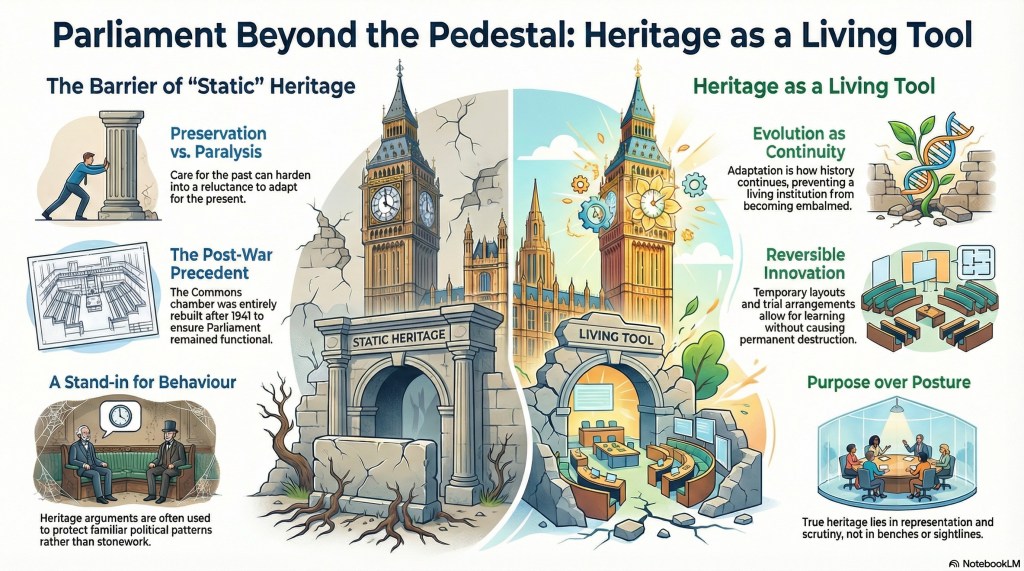
It’s also easy to forget that the Commons chamber as we know it isn’t ancient in the way people often imagine. The space was rebuilt after the war, under pressure, because the original had been destroyed. Decisions had to be made quickly about what to recreate, what to adapt, and what to leave behind.
At the time, those choices weren’t treated as acts of vandalism. They were treated as necessity. Parliament had to keep functioning.
Which is an awkward thing to hold alongside the idea that the chamber is now somehow beyond adjustment. If rebuilding it entirely wasn’t considered a betrayal of heritage then, it’s hard to argue that careful change is automatically one now.
When does preservation turn into paralysis?
There’s a quieter shift that can happen over time, and it doesn’t come from bad motives.
Preservation starts out as care — about not damaging something valuable. But slowly, almost without intent, it can harden into reluctance to touch anything at all. At that point, protecting the past begins to crowd out curiosity about whether the institution still fits the present.
That’s when a living place starts to feel a little embalmed.
Nothing dramatic breaks.
Nothing visibly fails.
Things just become harder to adapt than they need to be.
Does change always have to mean loss?
What often gets lost in these debates is the idea of reversibility.
Not every change needs to be permanent. Not every adjustment needs to be carved into stone. Temporary layouts, trial arrangements, small shifts during restoration work — these aren’t acts of destruction. They’re ways of learning how a space behaves when it’s used differently.
Parliament already accepts this logic more than it admits. Accessibility changes, broadcasting infrastructure, security adaptations — none of these were part of the original design, and all of them altered how the building works.
Yet we don’t usually talk about them as betrayals of history. They’re framed, quite reasonably, as adaptations to new realities.
Which raises a slightly uncomfortable question.
Why do some changes feel acceptable — and others don’t?
Often, it isn’t really about the stonework.
What tends to make people uneasy is the possibility that behaviour might shift — that confrontation could soften, that hierarchy might blur, that politics might look a little less theatrical.
Once you notice that, the heritage argument starts to look less like a fixed principle and more like a stand-in for something harder to name.
It’s not always about protecting the past.
Sometimes it’s about protecting familiar patterns.
Let’s pause and hear the obvious objections
This is probably the moment where a few reasonable concerns get voiced — and it’s worth letting them surface properly, rather than brushing past them.
“Isn’t this all just symbolism?”
Maybe — but symbolism is rarely neutral. Parliament already takes symbolism seriously when it comes to ritual, language, and hierarchy. Noticing that space sends signals isn’t introducing symbolism; it’s acknowledging the symbolism that’s already there.
“Politics is adversarial by nature — isn’t that the point?”
To a degree, yes. Disagreement is essential. But adversarial doesn’t have to mean performative, and challenge doesn’t have to be staged as combat. The question isn’t whether conflict exists — it’s whether the environment amplifies it unnecessarily.
“Wouldn’t this just make things vaguer or weaker?”
That worry usually rests on the idea that clarity only comes from confrontation. But in most other complex systems — courts, boards, even engineering teams — clarity comes from structure, time, and process, not from volume or posture.
“Isn’t this all a distraction from real reform?”
It could be, if it were treated as a silver bullet. But that isn’t what’s being suggested here. This is about removing friction that actively works against the behaviours we say we want, not pretending space alone can fix politics.
None of these objections are silly. They’re exactly the kinds of doubts you’d expect when something familiar is being gently questioned.
If heritage is about values, what does that imply?
If heritage means anything beyond aesthetics, it probably has more to do with purpose than posture.
Representation. Scrutiny. Legitimacy.
Those don’t live in benches or sightlines. They live in how Parliament actually operates. A chamber that quietly rewards performance over patience isn’t more authentic simply because it’s old; it’s just inherited a set of incentives that haven’t been revisited.
That doesn’t mean the past was wrong.
It just means the present asks different things of the same space.
So where does this leave us?
Not with a demand to rip anything out.
Not with a dismissal of history.
And not with the idea that architecture fixes politics on its own.
Just with a gentler reframing.
Heritage doesn’t have to end the conversation. It can slow it down, make it more careful, and force us to think about what we’re really trying to preserve.
If Parliament is meant to be a living institution, then adaptation isn’t a threat to its history. It’s how that history continues, rather than quietly hardening into ritual.
And once we allow ourselves to think that way, another question starts to surface.
If it’s not the building, what is it?
If space shapes behaviour, and heritage doesn’t actually forbid us from noticing that, then what else is shaping Parliament in ways we rarely stop to examine?
Because the strongest pressures on Parliament don’t come from stone or timber.
They come from incentives.
And that’s where this goes next.
This is the fourteenth post in a series — Let’s Rethink Parliament.
There isn’t a fixed destination yet. The aim is to notice patterns as we go: how time is used, how incentives shape behaviour, how habits become untouchable — and what that does to outcomes across health, housing, education and beyond.
The direction will emerge as we proceed.


Discover more from Hysnaps Politics, Gaming, Music and Mental Health
Subscribe to get the latest posts sent to your email.

