There’s a feeling many of us share, even if we struggle to pin it down.
That sense that politics has become more reactive. More fragile. More focused on the next moment than the next decade.
We often talk about it as impatience, or a lack of seriousness, or a failure of character. But before we go there, it’s probably worth asking a quieter question.
Did the environment politicians operate in actually change?
Because if it did, then the behaviour we’re seeing might not be a mystery at all.
What do we mean when we say “short-termism”?
Up to now, we’ve been talking about short-termism almost as a mood — a sense that everything feels compressed, urgent, and brittle.
Decisions feel rushed. Plans feel provisional. Nothing quite seems designed to last beyond the next cycle.
But moods are slippery things to examine on their own. So it helps to ask whether this shift leaves traces somewhere more concrete — places where incentives harden into patterns we can actually look at.
Not as proof.
Just as signals.
Have senior roles become more short-term — or does it just feel that way?
When we talk about long-term thinking, we usually talk about policy. But policy doesn’t think — people do, and people operate inside roles.
So a simple place to start is this:
are the most senior roles in government still held long enough for long-term thinking to make sense?
We could guess or we could check.
Rather than looking at all ministers — which quickly becomes messy — we narrowed this to Secretaries of State. The people running major departments. The roles where continuity should matter most.
And instead of treating history as one smooth line, we treated each election as a reset point, even when the same party won again. Because politically, that’s when the clock really restarts.
That gives us two ways of looking at the same underlying question.
How quickly do people cycle through these roles?
Chart 1: Senior Cabinet churn by election year — distinct appointees per year, normalised
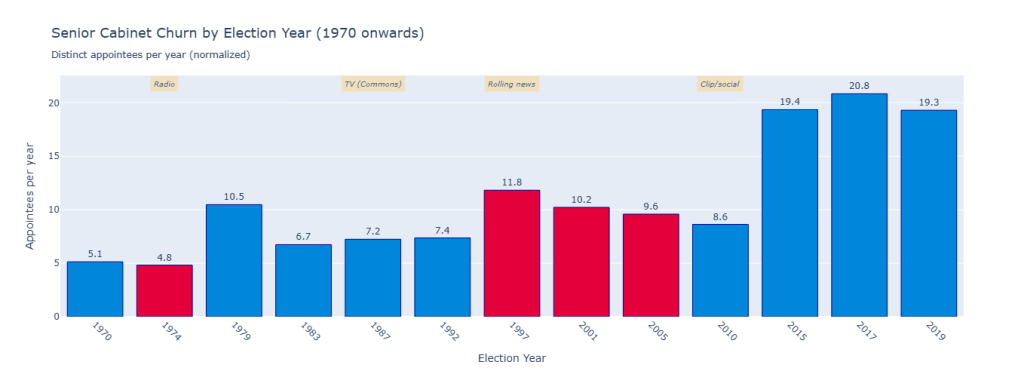
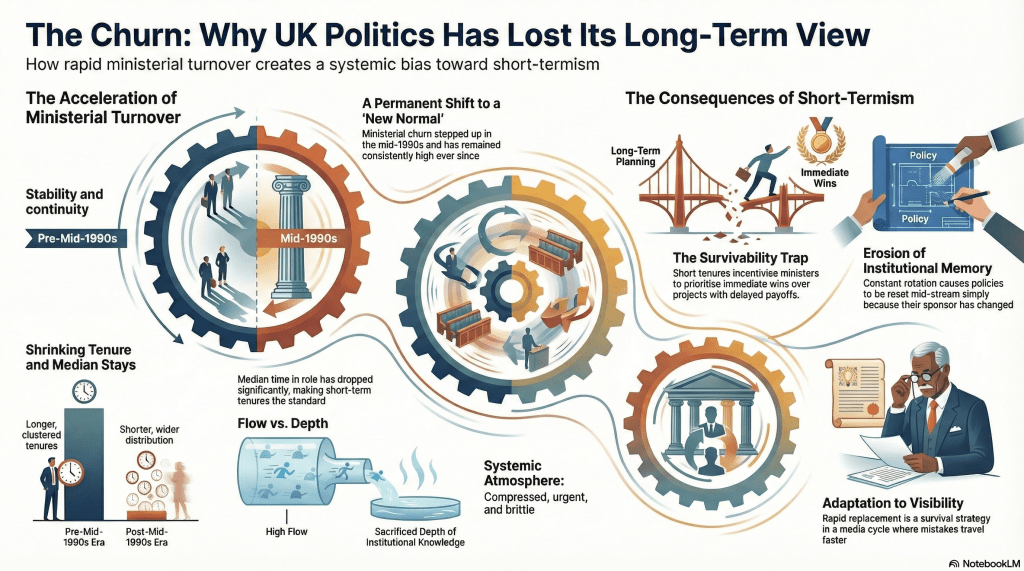
This first chart looks at churn.
Not how many Secretaries of State there are in total, but how many different people pass through these roles per year, adjusted for how long each Parliament lasted.
That distinction matters. We’re not asking “how busy was this government?” We’re asking something quieter.
How quickly did people rotate while Parliament was sitting?
Once we line the bars up by election year, a pattern starts to emerge.
Earlier periods show movement, but it’s relatively contained. Politics was never static, and we wouldn’t expect it to be. But from the mid-1990s onward, the baseline shifts.
The bars step up — and then stay up.
There isn’t a single spike that collapses back down. There’s a new normal.
We’ve marked major changes in media exposure on the chart — radio, then television in the Commons, then rolling news, then clip-driven social media — not as causes, but as context. Moments when the environment Parliament operates in visibly changed.
Nothing explodes overnight.
But the system starts cycling people through faster.
And how long do they actually stay?
Chart 2: Senior Cabinet tenure distribution by election year — box/whiske
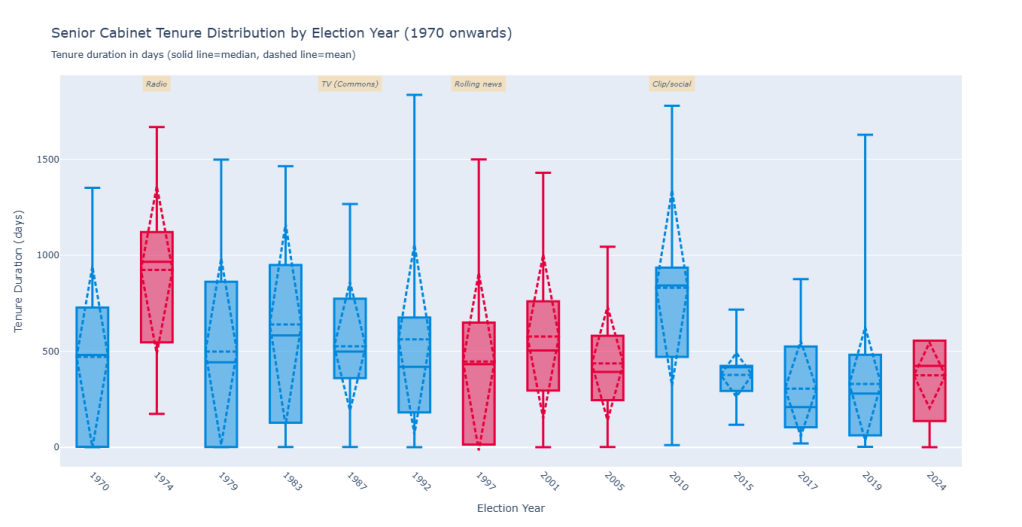
The second chart flips the question around.
Instead of asking how many people pass through, it asks how long they stay once they’re there.
Each box shows the distribution of tenure lengths for Secretaries of State elected at that point — the median, the spread, and the outliers.
Earlier elections tend to show longer tenures clustered closer together. There’s variation, but also a sense of stability.
Later elections look different.
The medians drop, the spread widens and short tenures become more common, even alongside the occasional long survivor.
Not everyone is churning — but more people are.
And that matters, because these two charts are telling the same story from opposite directions. One looks at flow, the other at depth, and they meet in the middle.
So what changed?
It’s tempting to jump straight to blame.
Media. Social platforms. The news cycle. Voters. Politicians themselves.
But we don’t actually need to decide why this happened to notice what it changes.
As parliamentary politics became more visible — first audibly, then visually, then fragment by fragment — the cost of staying in role seems to have increased.
Mistakes travel faster, pressure accumulates in public and moments are clipped, shared, reinterpreted.
In that environment, persistence carries risk.
Replacing someone feels safer than backing them. Refreshing the cast feels like action. Depth becomes harder to defend when attention moves on quickly.
None of that requires bad faith.
It’s adaptation.
And once adaptation becomes normal, it feeds back into the system.
What does this do to long-term thinking?
Long-term planning rests on something simple, and surprisingly fragile.
That the person making decisions today expects to still be there when those decisions land.
When tenure shortens, incentives shift quietly.
It becomes safer to focus on what can be delivered within a role, rather than what will mature after it. Risks with delayed payoffs start to look like traps. Continuity becomes someone else’s problem.
Again, this isn’t about intent. It’s about survivability.
And that matters not just for ministers, but for Parliament as a whole.
Scrutiny becomes harder when counterparts rotate frequently. Institutional memory thins. Policies are reset mid-stream, not because they failed, but because their sponsor changed.
Is this just crisis politics?
This is where the election-by-election framing helps.
We’re not looking at one government, or one party, or one extraordinary moment. The pattern persists across different administrations and different contexts.
Which suggests we’re not seeing a temporary breakdown.
We’re seeing a system that has quietly adjusted to a new environment — one where speed, visibility, and responsiveness are rewarded more reliably than patience.
What does this tell us — and what doesn’t it?
Ministerial churn isn’t the whole story.
But it is a useful signal — because it shows how a system under constant visibility and pressure adapts, even when nobody intends it to.
And once we start looking for that pattern, it’s hard not to notice it elsewhere too — in budgets, in policy cycles, in institutional memory, and in the kinds of people who decide whether stepping into this environment is worth it.
This doesn’t tell us who to blame. It doesn’t tell us what to fix yet.
It just helps us see the shape of the problem more clearly.
So where does this leave us?
We didn’t start this post to argue that politicians have become worse.
We started by wondering whether the system still makes long-term thinking a rational thing to do.
If senior roles now turn over faster — and visibly so — then it’s reasonable to ask what kind of behaviour that environment selects for.
That’s not a verdict. It’s a pressure point.
And it leads us toward the next question.
If this is the environment Parliament now operates in, who does it actually attract — and who quietly decides it isn’t worth stepping into at all?
That’s where we go next.
This is the fifteenth post in a series — Let’s Rethink Parliament.
There isn’t a fixed destination yet. The aim is to notice patterns as we go: how time is used, how incentives shape behaviour, how habits become untouchable — and what that does to outcomes across health, housing, education and beyond.
The direction will emerge as we proceed.
Discover more from Hysnaps Politics, Gaming, Music and Mental Health
Subscribe to get the latest posts sent to your email.

