

After the last post, it’s tempting to reach for a simple explanation.
Shorter ministerial tenures.
More visibility.
More pressure.
Case closed.
But that’s probably too neat.
Because plenty of countries operate in the same media environment. They face the same acceleration, the same scrutiny, the same clipped moments circulating online.
And yet, some of them seem better at holding onto long-term plans once they start.
So maybe the more useful question isn’t what broke.
Maybe it’s this:
What makes long-term thinking survivable in some systems, even when everything around them speeds up?
Are we just talking about “better politicians”?
It’s an easy trap to fall into.
We see stability elsewhere and assume it must come from temperament. From seriousness. From a different political culture.
But that explanation collapses pretty quickly once we look closer.
Politicians are politicians everywhere.
Media pressure exists everywhere.
Crises don’t respect borders.
So if outcomes differ, it’s probably not because one country found better people.
It’s more likely that some systems make patience less risky — and others quietly punish it.
What does “making long-term thinking safer” actually mean?
It doesn’t mean removing accountability.
It doesn’t mean insulating decisions from politics entirely.
And it definitely doesn’t mean pretending governments can plan perfectly decades ahead.
What it does mean is reducing the personal and political cost of staying the course.
Giving decisions time to mature.
Making reversal harder than continuation.
Ensuring that changing direction carries friction, not momentum.
That’s a very different design problem.
Let’s look sideways, not up
Rather than ranking countries, it’s more useful to look at mechanisms.
What are some places doing that changes the incentives — quietly, structurally — without demanding heroic restraint from individuals?
Take Germany.
Germany isn’t immune to churn or disagreement, but it does something subtle. Long-term policy planning — particularly around infrastructure, energy, and industrial strategy — is embedded in institutions that sit alongside day-to-day politics rather than inside it.
Coalition agreements matter. Federal-state coordination matters. Committees and working groups persist beyond individual ministers.
So when a minister changes, the policy doesn’t automatically reset.
Not because no one can change it — but because doing so requires effort, explanation, and buy-in.
Continuity becomes the path of least resistance.
What about smaller systems?
Size often gets used as a dismissal.
“Well, that works for them — they’re smaller.”
But scale cuts both ways.
Take New Zealand.
New Zealand operates in an intense media environment, with fast feedback and strong personalities. Yet it has deliberately strengthened institutions that slow certain kinds of decision-making down.
Independent fiscal oversight. Clear long-term reporting requirements. Explicit wellbeing and outcome frameworks that outlive individual governments.
None of these remove politics.
But they change what politics is about.
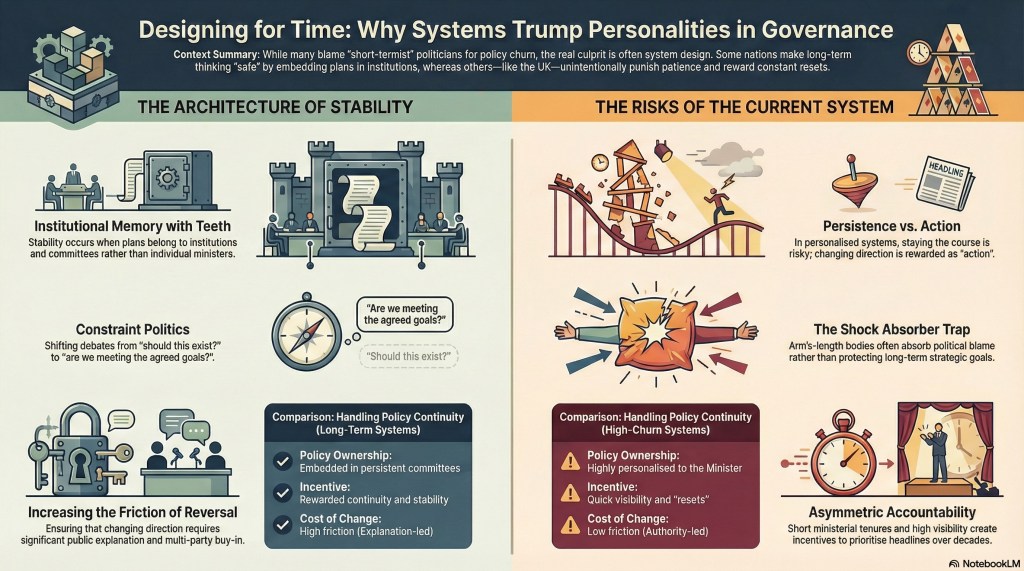
Arguments shift from “should this exist?” to “are we meeting the agreed goals?”
That’s not consensus politics.
It’s constraint politics.
And the Nordics?
Countries like Sweden often get described as “consensual,” which makes it sound cultural and unreachable.
But look closer and the pattern repeats.
Long-term funding settlements. Strong committee systems. Clear separation between strategic planning and day-to-day delivery.
Ministers still come and go. Debates still happen. Elections still matter.
What changes is the cost of tearing something up for short-term advantage.
It’s higher.
So what’s the common thread?
It isn’t electoral systems alone. It isn’t media restraint. It isn’t nicer politicians.
It’s institutional memory with teeth.
Places where:
plans don’t belong to a single person
progress is measured against time horizons longer than a term
reversal requires explanation, not just authority
In those systems, long-term thinking isn’t an act of courage.
It’s a defensible position.
Why this matters for Parliament
Coming back to the UK, the contrast starts to sharpen.
We’ve built a system where:
roles rotate quickly
visibility is constant
and responsibility is highly personalised
Which means persistence is risky.
If you stay the course and it falters, your name is on it.
If you change direction, it looks like action.
That asymmetry doesn’t just shape outcomes.
It shapes behaviour long before outcomes arrive.
Are arm’s-length bodies the answer?
This is probably the point where some of us start thinking:
“Isn’t this what arm’s-length bodies are for?”
It’s a fair instinct. But it’s also worth slowing down and unpacking what we mean — because “arm’s-length body” sounds technical, but the idea behind it is actually very human.
At its simplest, an arm’s-length body is meant to do something on behalf of government, without being pulled directly into day-to-day political weather.
Not independent in the sense of being unaccountable.
But not micromanaged either.
A bit of distance.
Some insulation.
Enough space to think past the next headline.
What were they originally meant to do?
Most arm’s-length bodies were created to solve a very specific problem.
Governments kept finding themselves stuck between two pressures:
On one side, the need for long-term planning — in health, housing, infrastructure, education.
On the other, the reality of short political cycles, media scrutiny, and constant responsiveness.
So the compromise was delegation.
We don’t remove democratic control.
We don’t hand everything to the market.
Instead, we set up a body with a clear remit, give it professional leadership, and say:
“You run this day to day. We’ll set the direction, and hold you to account — but we won’t rewrite the rules every time politics gets noisy.”
At least, that was the theory.
And sometimes, that theory worked
There are cases where this kind of separation genuinely helped.
Where long-term investment became easier.
Where planning survived ministerial changes.
Where expertise accumulated instead of resetting.
In those moments, arm’s-length bodies acted as continuity machines — carrying plans forward even when the people at the top changed.
That’s the version many of us have in mind when we reach for them.
So what went wrong?
Over time, something subtle happened.
The distance remained — but the protection weakened.
Bodies that were meant to reduce political churn started absorbing it instead.
When plans became controversial, responsibility drifted outward.
When delivery faltered, blame followed.
When things went well, credit flowed back inward.
And slowly, the relationship shifted.
Instead of Parliament being protected from short-term pressure by these bodies, the bodies themselves became buffers — taking the hits so Parliament didn’t have to.
That’s when delegation stops being a solution and starts becoming a coping mechanism.
Who strengthened them — and who didn’t?
This is where it gets uncomfortable, because the pattern doesn’t map neatly onto party labels.
At different times, different governments have:
strengthened mandates
shortened them
tightened control
or quietly bypassed them
Often in response to immediate pressure rather than long-term design.
One government delegates to buy stability.
The next pulls control back to regain visibility.
Another re-delegates after discovering how hard direct control actually is.
Over time, that push and pull waters down the original intent.
What started as a way to make long-term thinking safer becomes a way to park complexity somewhere else.
So are arm’s-length bodies fixing the problem — or hiding it?
This is the uncomfortable possibility we need to sit with.
If Parliament itself still operates on compressed timeframes — if attention, credit, and blame are all short-term — then no amount of delegation can fully solve that.
The pressure doesn’t disappear.
It just moves.
In that situation, arm’s-length bodies don’t become engines of long-term change.
They become shock absorbers.
They take the impact so the core system doesn’t have to slow down.
Which leaves us with a more awkward question
If we keep creating bodies because we don’t trust Parliament to plan long-term…
What does that say about the system we’re trying to protect?
And if those bodies are then steadily pulled back into short-term politics anyway…
Are we actually changing incentives — or just rearranging where the pressure shows up?
We’ll come back to this properly later in the series.
But for now, it’s enough to notice this:
Delegation can help.
But it can’t compensate for a Parliament that still struggles to treat time itself as something worth protecting.
So what are we really learning here?
Not that the UK should copy another country.
But that long-term thinking survives where systems make it safer than reversal.
Where continuity is rewarded. Where memory is preserved. Where change requires justification, not just opportunity.
That’s a design choice — not a moral one.
Which leaves us with the next uncomfortable question
If the system rewards speed, visibility, and reset…
Who does that attract?
And just as importantly:
Who quietly decides that this environment isn’t built for them — and never stands in the first place?
That’s where we go next.
This is the sixteenth post in a series — Let’s Rethink Parliament.
There isn’t a fixed destination yet. The aim is to notice patterns as we go: how time is used, how incentives shape behaviour, how habits become untouchable — and what that does to outcomes across health, housing, education and beyond.
The direction will emerge as we proceed.



Discover more from Hysnaps Politics, Gaming, Music and Mental Health
Subscribe to get the latest posts sent to your email.

