

By now, a familiar move keeps showing up.
When something feels too complex, too slow, or too politically risky to handle directly, we step sideways.
We delegate.
We create an arm’s-length body.
We give it a mandate.
We put a little distance between the problem and the people who keep getting blamed for it.
And at first, that often feels sensible.
Because delegation can work.
It can extend capacity.
It can protect long-term thinking from short-term noise.
But it doesn’t always do that.
And the difference between those two outcomes turns out to matter far more than we usually admit.
When does delegation actually help?
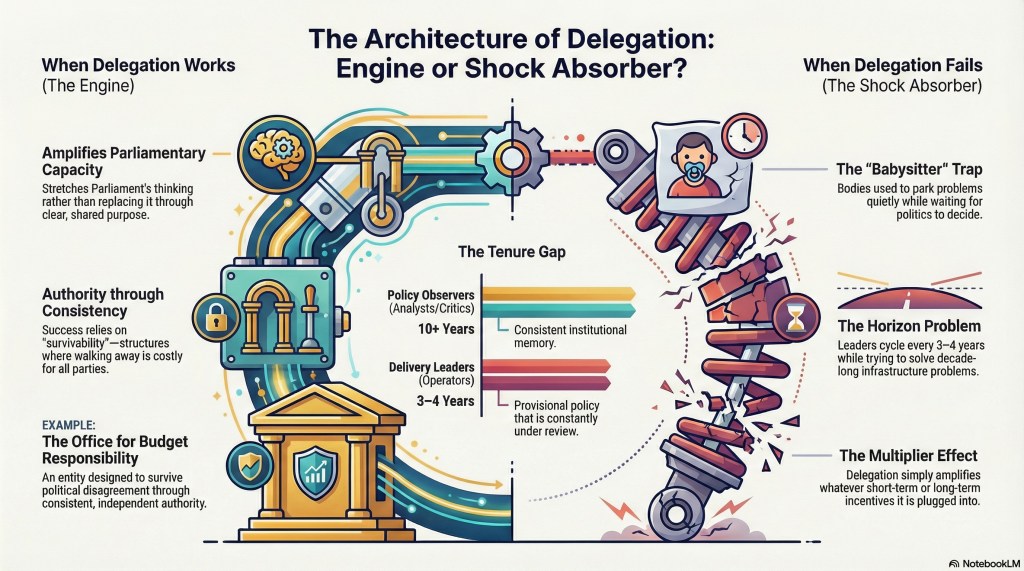
Delegation works best when it amplifies something Parliament is already capable of doing.
When there’s a clear sense of purpose.
When expectations are stable enough to survive more than one political moment.
When responsibility is genuinely shared rather than quietly passed along.
In those cases, an arm’s-length body doesn’t replace Parliament’s thinking — it stretches it. It gives long-term problems room to breathe without cutting them loose from democratic oversight.
That’s the theory, at least.
And sometimes, we do see it work.
The Office for Budget Responsibility is the obvious example. Not because everyone agrees with it, or even likes it — but because its design assumes disagreement. Its survival doesn’t depend on pleasing whoever happens to be in power. Its authority comes from consistency, not popularity.
The point isn’t trust.
It’s survivability.
So when does delegation start to fail?
This is where the line starts to blur.
Delegation begins to struggle when it’s used not to extend Parliament’s capacity, but to park problems somewhere quieter.
A body is created.
A remit is written.
And then the world around it keeps shifting.
The policy context changes.
Priorities reset.
Leadership turns over.
Not because anyone is acting in bad faith — but because upstream politics hasn’t settled on what it’s actually willing to sustain.
At that point, the arm’s-length body isn’t acting as a tool.
It’s acting as a babysitter — keeping things ticking over until politics decides what it really wants.
And babysitters, by design, don’t redesign the house.
What the tenure evidence quietly tells us
This is where the leadership tenure comparisons start to matter.
When we look across UK arm’s-length bodies, overseas equivalents, regulated corporate organisations, and even think tanks, a strange inversion appears.
The people observing policy — analysts, commentators, institutional critics — often remain in post for a decade or more. Meanwhile, the people meant to deliver long-term change are cycling through roles every three or four years.
Sometimes faster.
That creates a horizon problem.
We ask leaders of delivery bodies to reshape housing supply, stabilise health systems, manage environmental risk, and plan infrastructure that spans decades — while giving them windows of time that barely outlast a parliamentary cycle.
Compared to overseas peers, or even capital-intensive private firms, that level of churn isn’t a sign of accountability. It’s a sign of instability.
And it helps explain why so much long-term policy ends up feeling provisional, constantly “under review”, never quite allowed to settle.
Is this really about trust?
We often frame all of this as a question of trust.
Do we trust politicians to think long-term?
Do we trust technocrats to act wisely?
Do we trust independent institutions not to drift?
But trust turns out to be the wrong lens.
What matters more is whether the system makes trust survivable.
In real negotiation, no one leaves entirely happy. Outcomes hold not because everyone feels virtuous, but because the structure makes walking away costly and constant reopening unattractive.
The OBR works not because it is universally trusted, but because its design doesn’t require trust to function day-to-day. Its incentives align with consistency. Its authority doesn’t reset every time the political weather changes.
Where that alignment exists, delegation strengthens democracy.
Where it doesn’t, delegation simply relocates political fragility.
So what’s the real dividing line?
Looking across all of this — the tenure evidence, the international comparisons, the contrast between observers and operators — a pattern becomes hard to ignore.
Arm’s-length bodies tend to work best when Parliament has already done some of the hard work of fixing its own incentives, particularly around time, stability, and accountability.
They struggle when they’re asked to compensate for unresolved short-termism upstream.
That’s the uncomfortable bit.
If ministers rotate every couple of years, and the leaders of delivery bodies rotate only slightly more slowly, delegation isn’t insulating long-term policy from political cycles. It’s just stretching those cycles out and hoping the problem will behave.
And long-horizon problems rarely do.
Where does that leave delegation?
Delegation isn’t a substitute for institutional reform.
It’s a multiplier.
It amplifies whatever incentive structure it’s plugged into.
So if arm’s-length bodies end up acting as shock absorbers — quietly taking strain while nothing upstream really changes — that isn’t primarily a failure of those bodies.
It’s a signal.
We keep pushing long-term thinking outward, away from Parliament itself, as if distance might buy us time.
But time doesn’t live outside Parliament.
If anything, it’s the one thing Parliament has never quite decided where to put.
And until we answer that — until we work out where long-term thinking actually belongs — no amount of delegation will fully solve the problem.
That question sits slightly upstream of everything we’ve discussed so far.
We’ll come back to it.
This is the eighteenth post in a series — Let’s Rethink Parliament.
There isn’t a fixed destination yet. The aim is to notice patterns as we go: how time is used, how incentives shape behaviour, how habits become untouchable — and what that does to outcomes across health, housing, education and beyond.
The direction will emerge as we proceed.


Discover more from Hysnaps Politics, Gaming, Music and Mental Health
Subscribe to get the latest posts sent to your email.

