Let’s Rethink Parliament: Why Trust Is Never the Answer
There’s a story we keep coming back to when things go wrong.
That this was a lapse.
An exception.
A moment where the system briefly lost its way.
We tell ourselves that if the right people had been in the room, this wouldn’t have happened.
If standards had been upheld.
If someone had spoken up sooner.
And every time, the implied fix is the same: restore trust.
But that instinct deserves a pause.
Because trust sounds like a solution — yet it keeps leaving us in the same place.
What do we really mean when we say “trust”?
When we talk about trust in Parliament, we’re rarely talking about evidence or design.
We’re talking about belief.
That people will act in good faith.
That informal limits will be respected.
That power won’t be pushed too far simply because it can be.
For a long time, that belief carried a lot of weight in the UK.
The idea that the system worked because people played the game properly.
And when it did work, it felt almost self-policing.
The problem is what happens when it doesn’t.
What happens when trust is the thing being protected?
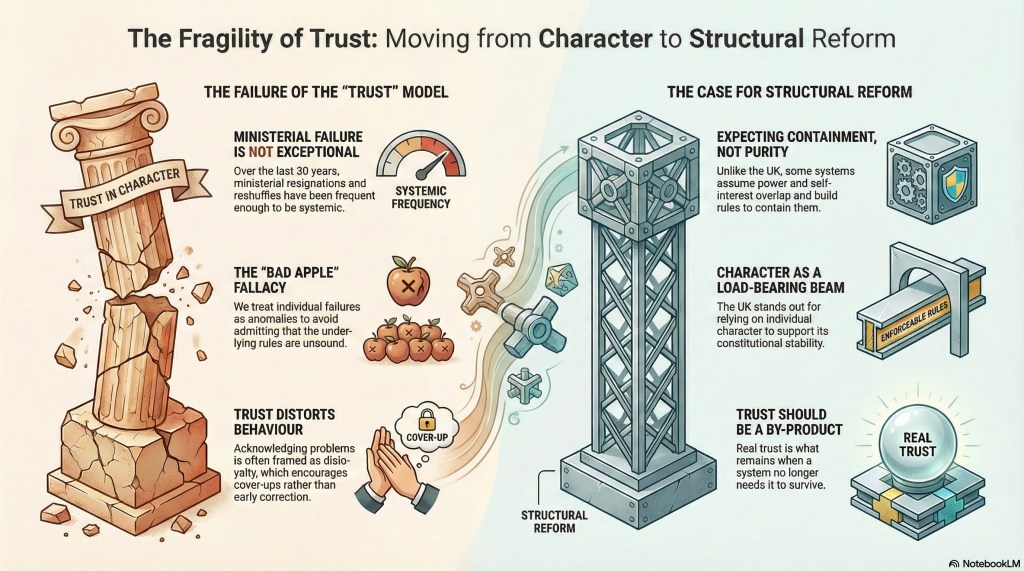
Once trust becomes the thing we’re trying to preserve, it starts to distort behaviour.
Because acknowledging problems begins to feel like disloyalty.
Tightening rules looks like accusation.
Enforcement starts to sound like a lack of faith.
So instead of redesigning the system, we look for reassurance.
We shuffle roles.
We accept apologies.
We draw a line and move on.
Not because anyone intends to hide problems — but because loss of reputation becomes a risk in its own right, encouraging cover-ups, complicity, and careful silence rather than early correction.
The irony is that this is usually framed as protecting trust.
In practice, it protects fragility.
Is failure really exceptional?
We often behave as though serious failure at senior levels is rare.
It isn’t.
Over the past 25–30 years, a significant proportion of senior ministers have been forced to resign, step aside, or be reshuffled under pressure — across governments of different parties, and often repeatedly. If we take a typical Cabinet size of around 21 posts per Parliament, the cumulative rate of disruption over that period is high enough that failure can’t honestly be described as unusual.
And yet each case is still treated as an anomaly.
A bad apple.
A regrettable episode.
Something that doesn’t quite reflect the system as a whole.
Which lets us believe that the rules are sound — and only the people were wanting.
“If only better people were in charge…”
This is where the conversation often drifts.
If only we could filter out the wrong sort.
If only standards could be restored.
If only politics could attract better people.
But better by whose definition?
Wrong according to which values?
And if standards were truly enforceable, would they need restoring at all?
We wouldn’t accept this logic anywhere else.
We wouldn’t tell ordinary people that rules don’t need enforcement because we trust them.
We wouldn’t design financial systems, safety systems, or legal systems that rely primarily on goodwill.
Yet in politics, we keep returning to the same hope — that character will compensate for structure.
Are we actually unusual in this?
This is where it helps to glance sideways, without idealising anyone else.
In places like France, there’s a far more explicit public assumption that power and self-interest overlap. Not always criminally. Not always corruptly. But inevitably.
The public expectation isn’t purity — it’s containment.
That doesn’t eliminate misconduct.
But it does mean the system isn’t emotionally dependent on believing everyone will behave well.
Exposure doesn’t feel like betrayal.
It feels like confirmation.
Contrast that with the UK, where trust has historically been part of the system’s self-image. When that trust is shaken, the response becomes moral rather than structural.
Other systems sit elsewhere on that spectrum.
Some rely on formal rules more heavily.
Some enforce resignation norms more cleanly.
Some accept cynicism and build around it.
None are perfect.
But the UK stands out for how much it still leans on character as a load-bearing beam.
Trust doesn’t fail — it gets overworked
The problem isn’t that trust is bad.
It’s that trust is brittle when it’s asked to do too much.
A system that depends on trust for its stability will always struggle to hear bad news early.
It will hesitate to tighten rules.
And it will tend to treat failure as a personal scandal rather than a design flaw.
Which is why trust keeps being invoked — and never quite restored.
Because trust isn’t something you can demand back into existence.
It’s what’s left over when the system doesn’t need it to survive.
That leaves us with a question worth carrying forward, rather than answering too quickly:
If repeated failure isn’t exceptional — and trust keeps being strained by design — are we really dealing with a problem of behaviour?
Or are we clinging to trust because redesigning the system feels harder?
That’s not something to resolve here.
But it’s something we’ll need to keep in mind as we move on to how Parliament responds when things go wrong — and why blame so often feels easier than repair.
This is the nineteenth post in a series — Let’s Rethink Parliament.
There isn’t a fixed destination yet. The aim is to notice patterns as we go: how time is used, how incentives shape behaviour, how habits become untouchable — and what that does to outcomes across health, housing, education and beyond.
The direction will emerge as we proceed.
Discover more from Hysnaps Politics, Gaming, Music and Mental Health
Subscribe to get the latest posts sent to your email.

