
There’s a moment that keeps repeating when something goes wrong.
Not the mistake itself — that usually happens earlier.
Not even the exposure — that tends to be inevitable.
It’s the moment after.
The pause, the glance around the room, the quiet sense that a story is about to settle into place.
Is this going to be about a bad decision, a flawed system, or a set of incentives quietly doing what they always do?
Or is it going to be about someone?
Because once it becomes about someone, everything else has a habit of slipping out of focus.
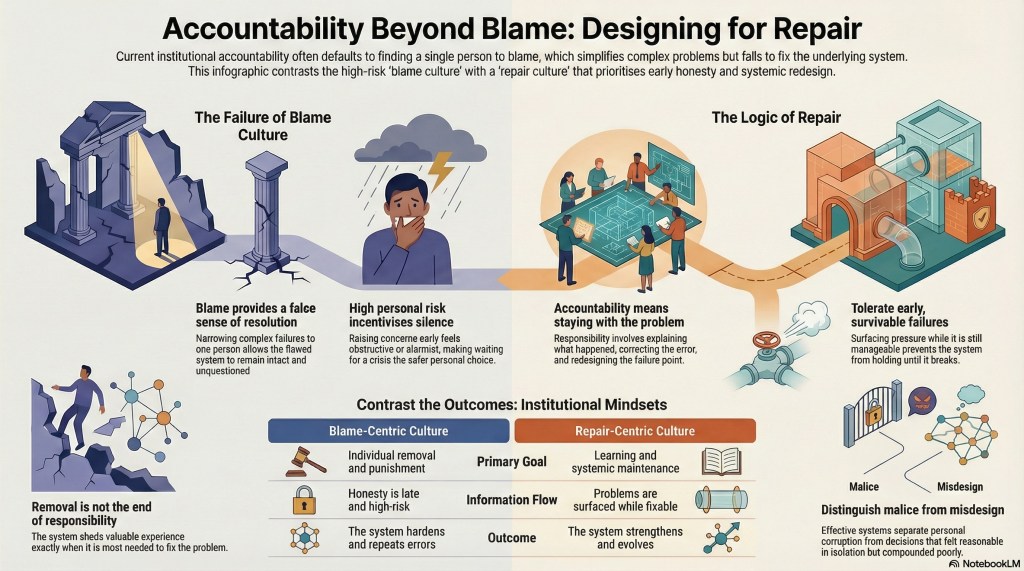
Why blame feels so satisfying
Blame has a strange pull, and part of that is how much it simplifies things.
A long chain of choices, constraints, and trade-offs suddenly narrows to a single figure we can point to. The story gains a centre, something recognisable and easy to explain, even if it no longer captures what actually happened.
Someone resigns. A statement is made. There’s a sense that a line has been drawn.
It can feel like resolution — even when very little has actually changed underneath.
And it’s not only about anger or punishment. Blame reassures us.
If the problem was them, then the system itself can remain intact. If they’re gone, we’re allowed to move on without asking too many further questions.
That’s a comforting story to tell ourselves.
What gets lost when we stop there
The difficulty is that most serious failures don’t come from one dramatic act.
They tend to emerge slowly, through a series of decisions that each felt reasonable in isolation. Assumptions go untested. Warnings feel awkward to press. Rules are followed exactly, even when they work badly in practice. Trade-offs make sense locally but compound into something fragile overall.
None of that fits neatly into a resignation letter.
And once the narrative centres on individual culpability, asking wider questions can start to feel uncomfortable — even disloyal.
Were the instructions actually clear?
Did the incentives point in the right direction?
Was anyone rewarded for slowing things down or raising doubts early?
Those questions usually arrive late, if they arrive at all.
Why early honesty is risky
Here’s the paradox we keep circling.
We say we want problems surfaced early. We praise “speaking truth to power”. We talk about learning cultures and institutional maturity.
But in practice, early honesty often carries the highest personal risk.
Raise a concern too soon and it can sound obstructive. Push back before a crisis and it may feel alarmist. Admit uncertainty and it can read as weakness or lack of grip.
Waiting is usually safer.
Seeing how things play out. Hoping the edge cases don’t materialise. Assuming someone else will intervene if it really matters.
And by the time it does matter, the cost of honesty has risen sharply.
What punishment crowds out
Once blame takes centre stage, something else quietly disappears: repair.
Repair is slower and far less visible. It doesn’t lend itself to clean headlines or clear endings. It means staying with the consequences of decisions rather than stepping away from them, and accepting that the system didn’t just allow the outcome but helped shape it.
That can feel uncomfortably close to collective responsibility.
So instead, the system resets.
New roles appear. Structures are rearranged. Language shifts just enough to signal action. There’s movement, but rarely interruption — enough change to look responsive, not quite enough to break the pattern.
What if fixing the problem was part of the consequence?
There’s a different way of thinking about responsibility.
One where admitting a problem doesn’t end your usefulness. Where being involved in a failure doesn’t automatically disqualify you from helping repair it. Where tightening rules after a breach isn’t treated as an admission of collapse, but as routine maintenance.
Alongside that sits a slightly more uncomfortable truth.
Sometimes nothing moves while everything appears to be working.
Concerns are noted. Risks are logged. Issues are “kept under review”. But as long as the system is technically holding together, momentum never quite arrives.
In practice, it’s often only once something fails — even in a small, contained way — that attention sharpens and authority aligns. Decisions that felt impossible suddenly become discussable. Trade-offs that were quietly avoided can finally be named.
Not because anyone wanted failure, but because failure creates traction in a way foresight rarely does.
That’s why systems that can tolerate early, survivable failure tend to be healthier than those that insist on uninterrupted success. They surface pressure while it’s still manageable, instead of forcing everything to hold until it breaks.
A system like that doesn’t rely on people being flawless. It relies on problems being surfaced while they’re still fixable.
And that changes the incentives.
Honesty becomes safer. Learning becomes visible. The system strengthens rather than hardens.
Accountability doesn’t have to mean expulsion
There’s a quiet assumption in political culture that accountability ends with removal.
Once someone steps aside, responsibility is seen as discharged.
But in most other domains, responsibility looks different.
When a bridge fails, the engineers don’t simply vanish. When a company misjudges risk, the board doesn’t all resign and walk away. When a hospital system struggles, the response isn’t to erase everyone involved and start again.
People are expected to stay with the problem — to explain what happened, to correct it, and to help redesign what failed.
Politics decided long ago that this would look unacceptable, that continued involvement would appear self-serving or illegitimate.
The result is a system that sheds experience precisely when it’s most needed.
Why this matters more than it sounds
A Parliament that defaults to blame will always hear the truth late.
Not because people are dishonest, but because they’re human.
If being early carries reputational risk, silence becomes rational. If the only acceptable response to failure is removal, repair quickly becomes someone else’s job.
So the same patterns re-emerge under new names.
And trust — the thing we keep trying to restore — grows thinner each time.
This isn’t an argument against accountability.
It’s an argument for a different shape of it.
One that distinguishes between malice and misdesign, between corruption and consequence, between punishment and learning.
Because if we want Parliament to deal better with long-term problems, it has to be able to acknowledge short-term ones without fear.
Which leaves us with a final question to carry forward:
If our system punishes people most harshly for admitting mistakes, what kind of behaviour are we quietly selecting for?
That’s the thread we pull next.
This is the twentieth post in a series — Let’s Rethink Parliament.
There isn’t a fixed destination yet. The aim is to notice patterns as we go: how time is used, how incentives shape behaviour, how habits become untouchable — and what that does to outcomes across health, housing, education and beyond.
The direction will emerge as we proceed.


Discover more from Hysnaps Politics, Gaming, Music and Mental Health
Subscribe to get the latest posts sent to your email.

