
“Accountability.”
It sounds firm. Reassuring. Final.
But the more we sit with it, the more slippery it becomes — because we rarely stop to ask what accountability is actually meant to do.
Is it about punishment?
Deterrence?
Reassurance for the public?
Or is it supposed to make the system work better next time?
Because those goals don’t always point in the same direction.
What usually happens after failure
In practice, political accountability tends to follow a familiar arc.
Something fails.
Pressure builds.
A resignation, reshuffle, or quiet removal follows.
There’s a sense that responsibility has been discharged.
But what’s striking is how often that moment also marks the end of learning.
The person who knows most about what went wrong leaves the room.
The incentives that shaped the decision remain untouched.
The system resets — lighter on experience, heavier on caution.
We call that accountability, but it often functions more like erasure.
Why this feels normal to us
Part of the reason this feels so natural is that we’ve come to expect politics to work this way.
We talk about “ministerial responsibility” as if it’s a moral category rather than a practical one. Once someone is “responsible”, the story feels complete. Staying involved can even look suspicious — as though repairing damage is somehow self-serving.
So removal becomes the clean ending.
But clean endings don’t necessarily make for better systems.
A comparison we don’t usually make
It’s worth pausing here and looking sideways for a moment.
Think about how we treat GPs.
Like MPs, GPs are generalists. They’re not cardiologists, oncologists, or neurologists. Their role isn’t to know everything — it’s to assess, triage, escalate, and coordinate.
They operate in high-stakes environments.
They make decisions with imperfect information.
And sometimes, things go wrong.
But when a GP makes a mistake, our first instinct isn’t to fire them and move on.
Instead, we ask different questions.
What happened?
Was this a systems issue?
A training gap?
A workload problem?
A process that made error more likely?
Most of the time, the response is review, supervision, learning, and adjustment. Only in cases of malice, gross negligence, or repeated refusal to improve does removal come into play.
Not because we’re being lenient — but because we’ve learned something important.
If you remove people at the first sign of failure, you lose competence faster than you gain safety.
Why politics treats error differently
Politics, oddly, has never absorbed that lesson.
Instead, it often treats error as contamination. Once something has gone wrong, continued involvement becomes uncomfortable. The safest move — for the individual and sometimes for the institution — is distance.
But that creates a strange inversion.
The people with the clearest view of what failed are the first to leave.
Those who remain inherit the consequences without the context.
And the same mistakes quietly become easier to repeat.
We don’t call this a learning loop. We call it “moving on”.
What if responsibility didn’t end with removal?
So here’s the question we keep circling.
What if responsibility didn’t mean stepping aside — but staying with the problem?
What if admitting a mistake wasn’t the end of usefulness, but the beginning of obligation?
In most professions, being involved in a failure doesn’t disqualify you from fixing it. It commits you to doing so. You’re expected to help redesign the process, update the guidance, and prevent recurrence.
Politics treats that instinct with suspicion.
But it’s worth asking why.
The incentive problem hiding underneath
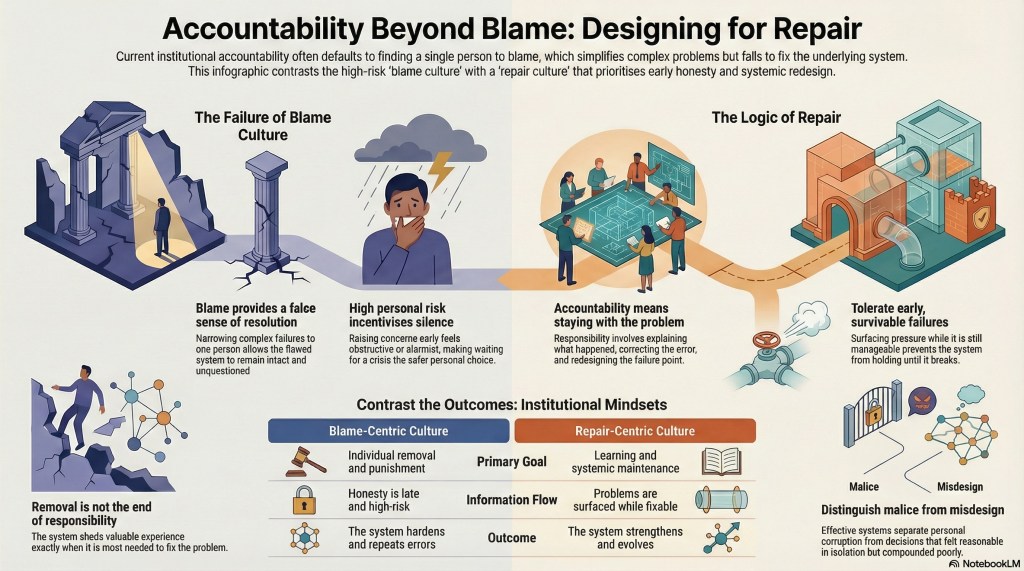
If the cost of failure is expulsion, then honesty becomes risky.
If staying involved looks like clinging on, then learning gets cut short.
If the safest response is silence until forced, then early warning dries up.
None of this requires bad faith.
It’s just how people behave when the incentives point that way.
And over time, the system selects for those who are good at surviving moments — not necessarily those who are good at fixing structures.
Making repair visible — and expected
A different model of accountability would look quieter, but more demanding.
It would expect people to explain what happened.
To stay involved in the correction.
To help tighten rules and redesign processes that failed.
Not indefinitely.
Not without limits.
And not where malice or corruption is involved.
But as a default — repair before removal, learning before erasure.
That doesn’t weaken accountability.
It deepens it.
Why this matters for everything that follows
Long-term problems don’t get solved by clean exits.
They get solved when institutions accumulate memory, adjust incentives, and make it safer to tell the truth early — even when that truth is uncomfortable.
We already know how to do this in other high-stakes systems.
The question isn’t whether it’s possible.
It’s why we’ve decided politics should be different.
And once we start asking that, another question follows naturally.
If we redesigned accountability around learning and repair rather than blame and exit…
what would that change upstream — in behaviour, honesty, and time horizons?
That’s where we go next
This is the twenty first post in a series — Let’s Rethink Parliament.
There isn’t a fixed destination yet. The aim is to notice patterns as we go: how time is used, how incentives shape behaviour, how habits become untouchable — and what that does to outcomes across health, housing, education and beyond.
The direction will emerge as we proceed.
Discover more from Hysnaps Politics, Gaming, Music and Mental Health
Subscribe to get the latest posts sent to your email.

