There’s a slightly uncomfortable feeling that creeps in once we’ve gone far enough into all of this.
Not a dramatic one. More the kind you get when you’re halfway through a conversation and realise you’re both circling the same point without quite saying it out loud.
We keep coming back to behaviour.
Not in the moral sense — not “good people” versus “bad people” — but in the quieter, more structural sense. What people are nudged toward doing. What feels safe. What feels risky. What gets rewarded without anyone having to say it explicitly.
And the awkward thing is this: none of the changes we’ve been talking about so far rely on a single big lever being pulled.
That’s probably why they’re unsatisfying if you’re looking for a clean fix.
So what’s actually been shifting?
If we look back across the ground we’ve covered — time pressure, visibility, working rhythms, churn, delegation — there’s a pattern that keeps resurfacing.
When things start to improve, it’s rarely because anyone’s had a sudden burst of wisdom. It’s usually because time is being used a little more evenly, people stay in post long enough to remember what came before, and questions get asked earlier rather than at the point where everything’s already locked in. The sense of constant emergency softens — not disappears, but stops dominating every decision.
None of that looks dramatic. And that’s sort of the point.
These changes alter how it feels to operate inside the system long before they change what the system produces.
Why big fixes keep disappointing us
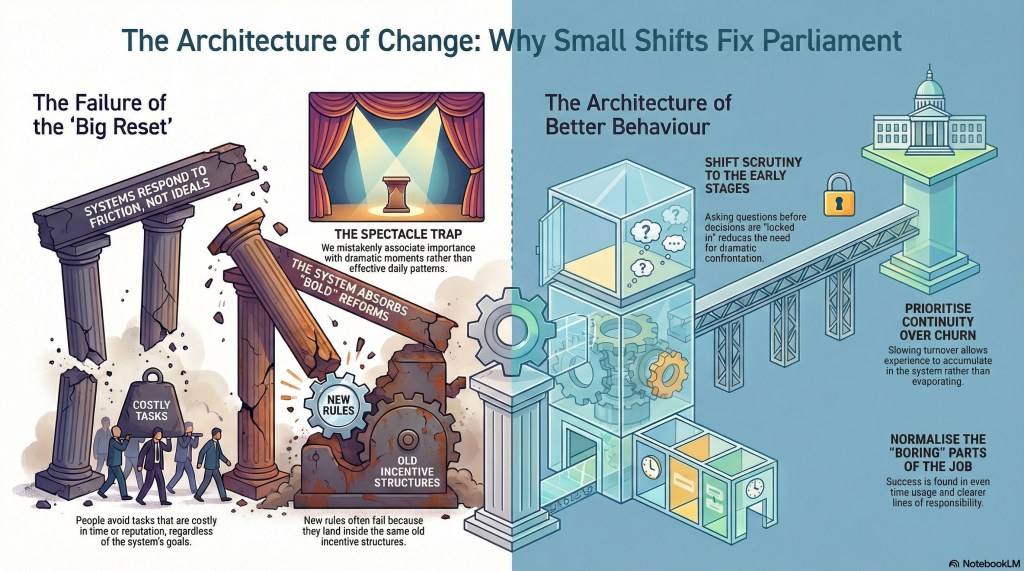
There’s always a temptation to imagine a clean reset — some reform that wipes the slate, a structural change after which politics finally starts behaving differently. A moment you can point to and say, that’s when it changed.
We’ve all seen versions of that story play out.
Something bold gets announced and, for a while, it genuinely feels like movement. There’s energy around it. Commentary shifts. Expectations rise.
And then, gradually, it starts to feel thinner. Not because anyone sabotaged it, and not because it was insincere, but because it’s landed inside the same incentive structure as everything else.
The system absorbs it, reshapes it, and carries on largely as before.
Which is usually the point where we start blaming motives instead of asking what the structure made likely.
What changes behaviour before it changes outcomes?
One of the things that’s easy to miss is that systems don’t usually respond to ideals. They respond to friction.
If something is costly in time, attention, or reputation, people quietly avoid it. If something is low-risk and visible, it gets repeated. Over time, those small choices harden into norms.
So when we talk about “fixing Parliament”, the question that keeps coming back isn’t “what should people want to do?”
It’s closer to: what does the system make easier than the alternatives?
That’s why things like working patterns and continuity keep cropping up in this conversation. Not because they’re exciting, but because they quietly shape what people feel able to do. When responsibility is clearer, and scrutiny happens earlier, there’s less need for the kind of dramatic confrontation that tends to arrive once options have already narrowed.
Is this just avoiding the hard questions?
It can sound that way at first.
Especially if we’re used to debates where the real dividing line is supposed to be ideological, or constitutional, or electoral.
Those questions aren’t irrelevant. They’re just not the first place the pressure shows up.
What we’ve been noticing instead is that a lot of dysfunction appears well before you get anywhere near voting systems or grand redesigns. It shows up in how time is allocated, how risk is distributed, and how failure is handled when it’s still small enough to learn from.
By the time people are arguing about fundamentals, the incentives have usually been misaligned for years.
So why does none of this feel dramatic?
Because it isn’t.
And that’s uncomfortable, because we’ve trained ourselves to associate importance with spectacle. Big moments. Clear winners and losers. Reforms you can point to.
What seems to make the biggest difference is when the system stops fighting the boring parts of the job. When it becomes a bit safer to say something isn’t working yet, and when turnover slows just enough for experience to accumulate rather than evaporate.
None of that looks impressive in isolation. But together, it changes what survives.
Where does that leave us?
Probably in a less satisfying place than a manifesto bullet point, but a more honest one.
If Parliament keeps producing short-term fixes, fragile institutions, and performative conflict, it’s unlikely to be because everyone involved suddenly forgot how to care about the long term.
It’s more likely that the system keeps quietly steering behaviour in that direction.
Which means the question worth sitting with isn’t “what’s the one thing we should change?”
It’s whether we’re willing to notice — and adjust — the small design choices that shape everything else downstream.
And that’s not a heroic task.
It’s a patient one.
Which is inconvenient, given how little patience the system currently makes room for.
That tension is probably where the rest of this series really lives.
This is the twenty second post in a series — Let’s Rethink Parliament.
There isn’t a fixed destination yet. The aim is to notice patterns as we go: how time is used, how incentives shape behaviour, how habits become untouchable — and what that does to outcomes across health, housing, education and beyond.
The direction will emerge as we proceed.
Discover more from Hysnaps Politics, Gaming, Music and Mental Health
Subscribe to get the latest posts sent to your email.

