There’s usually a moment in conversations like this where someone leans back and says something like:
“Right. We’ve talked about the problem long enough. What are we actually going to do?”
It’s a fair question. And if we’re honest, we’re probably thinking it too.
We’ve spent a long time circling pressures, incentives, habits, and unintended consequences. At some point, it starts to feel indulgent not to move on to solutions.
But there’s also a trap here.
Because the instinct to act can quietly drag us back into the same patterns we’ve been criticising.
Are we fixing things — or just reaching for something decisive?
There’s a particular kind of comfort in big fixes.
A reform you can name.
A change you can point at.
A moment you can draw a line under and say, “That’s when it changed.”
We’re used to that framing. Politics encourages it. Media loves it. Even critics of the system tend to reach for it, because it feels satisfying.
The trouble is, most of the problems we’ve been talking about didn’t come from a lack of bold ideas. They came from systems quietly reshaping those ideas once the excitement wore off.
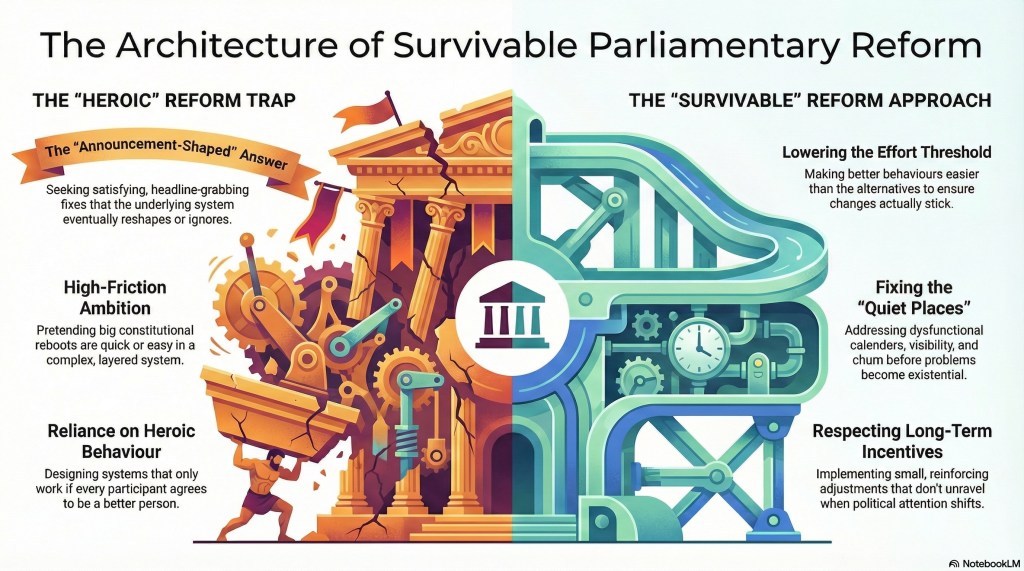
Which makes it worth pausing before we rush to the next announcement-shaped answer.
Why one-term fixes so often disappoint
There’s nothing wrong with ambition. But there is something dishonest about pretending that certain kinds of change are quick, frictionless, or easily contained within a single parliamentary term.
Especially in a system like the UK’s, which evolves by layering practice on top of practice rather than by tearing itself down and starting again.
We don’t have a single written constitution you can rewrite and reboot. What we have is a dense web of laws, conventions, habits, and expectations that only really reveal themselves once you try to move them.
That doesn’t mean big change is impossible. It just means pretending it’s easy is usually the first mistake.
So what kind of change actually survives?
This is where the conversation shifts slightly.
Instead of asking what should Parliament look like, we’ve been edging toward a different question:
What kinds of changes still work when people behave normally?
Not heroically. Not perfectly. Just… normally.
The things that seem to last aren’t the ones that rely on everyone agreeing to be better people. They’re the ones that quietly make certain behaviours easier than the alternatives.
When time is structured more evenly, fewer things have to be forced through at the end.
When roles last long enough to build memory, less energy goes into restarting conversations.
When scrutiny happens early, there’s less pressure for theatrical confrontation later.
None of that looks like reform in capital letters. But it changes how the system breathes.
Isn’t this just avoiding the hard stuff?
It can feel that way.
Especially if we’re used to thinking that seriousness means tackling the biggest questions first — voting systems, constitutional codification, wholesale institutional redesign.
Those debates matter. They’re just not where the system tends to break first.
Most dysfunction shows up much earlier, in quieter places: calendars, incentives, churn, visibility, and how risk is handled when it’s still small.
By the time the arguments become existential, a lot of the damage is already baked in.
Why small changes keep mattering more than we expect
One of the uncomfortable things we keep bumping into is that systems rarely change because someone finally makes a compelling argument.
They change because the day-to-day effort required to behave differently drops just enough to make it stick.
When careful work stops being punished by exhaustion.
When honesty doesn’t automatically trigger career risk.
When memory isn’t constantly wiped by turnover.
Those aren’t headline-grabbing achievements. But they’re the conditions under which better decisions stop being exceptional.
So what are we not doing here?
This might be the most important bit to say out loud.
We’re not pretending that everything can be fixed in one term.
We’re not claiming there’s a single lever that solves Parliament.
And we’re not acting as if redesigning the entire constitutional order is a low-friction starting point.
Not because those ideas are wrong — but because treating them as easy is part of how trust gets eroded.
Honesty about limits is doing some work here too.
Where does that leave the rest of the series?
Probably in a narrower space than we started in — but a more grounded one.
We’re not short of proposals.
We’re short of changes that respect how incentives actually behave over time.
So what comes next isn’t a list of answers.
It’s a closer look at a handful of changes that don’t try to be heroic, but do try to be survivable. The kinds of adjustments that reinforce each other quietly, rather than promising to transform everything at once.
That’s the direction from here.
Not toward a silver bullet — but toward changes that don’t unravel the moment the spotlight moves on.
This is the twenty third post in a series — Let’s Rethink Parliament.
There isn’t a fixed destination yet. The aim is to notice patterns as we go: how time is used, how incentives shape behaviour, how habits become untouchable — and what that does to outcomes across health, housing, education and beyond.
The direction will emerge as we proceed.

Discover more from Hysnaps Politics, Gaming, Music and Mental Health
Subscribe to get the latest posts sent to your email.

