

Once you stop looking for a big switch to flip, something slightly odd happens.
The conversation gets… smaller.
Not smaller in ambition — smaller in scale. You start noticing the bits of the system that don’t usually make speeches about themselves, but seem to decide how everything else behaves. Things like how the calendar is laid out, how long people stay in post, when questions are allowed to surface, and who actually has the time to read material before decisions are made.
None of those sound dramatic. But once you notice them, it becomes harder to ignore how much weight they’re carrying.
Where pressure actually shows up
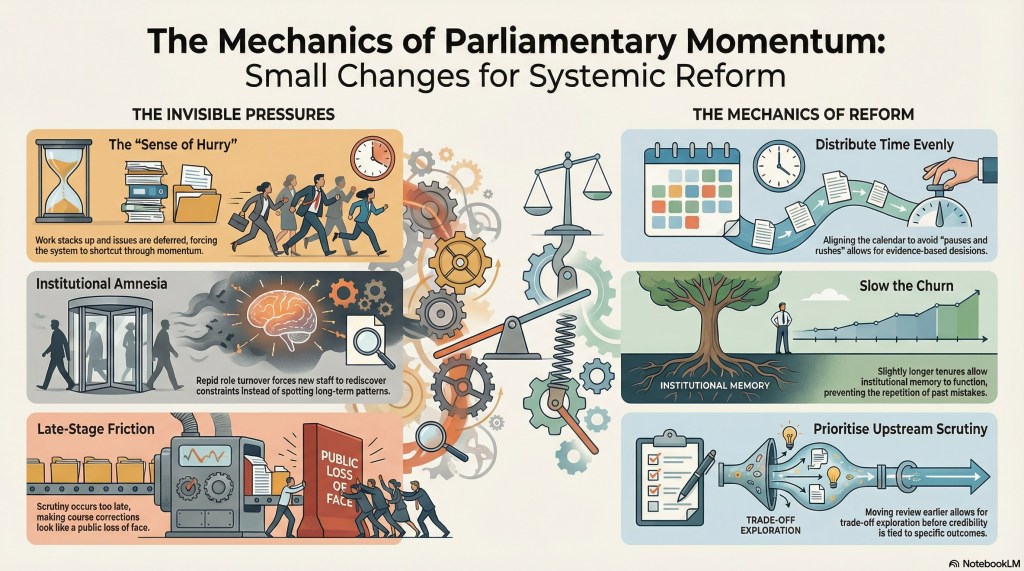
Most of the strain we’ve been talking about doesn’t arrive as a dramatic failure.
It tends to creep in as a sense of hurry. Work stacking up. Issues being pushed to later meetings, different forums, or dealt with just well enough to keep moving. Nothing breaks outright — it just never quite settles.
And when we trace that back, it usually lands in the same places.
Time gets compressed into bursts. Decisions appear late in the process. People rotate out just as they’re starting to understand the problem they were brought in to deal with.
So the system compensates. It shortcuts. It leans on momentum and visibility. Not because anyone thinks that’s ideal, but because it’s what fits the shape of the day.
That’s the pressure we’re really talking about.
Why time keeps reappearing in this conversation
Time sounds like a dull thing to focus on. But it’s where a lot of incentives hide.
If scrutiny only happens at the end, everything before it gets shaped by anticipation rather than evidence. If the calendar is built around pauses and rushes, behaviour adjusts to survive those rhythms.
When work is spread out even slightly differently, other options start to open up. Questions can be raised earlier, changes don’t automatically feel like admissions of failure, and fewer issues have to be treated as emergencies simply because they weren’t left until the last moment.
Nothing magical happens. The pressure just eases enough for different choices to be viable.
Continuity isn’t about comfort — it’s about memory
We often talk about turnover as if it’s automatically healthy. Fresh eyes. New energy. Avoiding stagnation.
And there’s truth in that — up to a point.
But when roles turn over too quickly, the system forgets faster than it learns. People spend their early months rediscovering why certain constraints exist, and their later months preparing to leave before they’re blamed for outcomes they didn’t fully shape.
Slow that churn down even slightly, and something else starts to happen. Decisions begin to refer back to earlier attempts. Patterns become easier to spot. Mistakes don’t need to be relearned from scratch every time someone new arrives.
That isn’t nostalgia. It’s institutional memory doing what it’s meant to do.
Why earlier scrutiny matters more than louder scrutiny
A lot of parliamentary drama happens late in the process.
By then, the range of options has narrowed, positions have hardened, and changing course looks less like learning and more like losing face.
Earlier scrutiny doesn’t remove disagreement — but it changes the texture of it. There’s more room to explore trade-offs without everything being framed as a win or a loss. It becomes easier to say “this might not work as intended” before anyone has publicly tied their credibility to it.
Again, this isn’t about better behaviour. It’s about timing.
None of this works on its own
This is the bit that’s easy to miss.
Taken individually, these changes don’t feel like reform. Adjust a calendar here. Extend a tenure there. Shift some scrutiny earlier in the process.
On their own, they barely register.
But together, they start reinforcing each other. More evenly distributed time makes early scrutiny usable. Continuity gives memory something to work with. Clearer responsibility reduces the personal risk of being honest when something isn’t going well.
The system stops quietly penalising its own better instincts.
Why this still isn’t a checklist
It’s tempting at this point to start writing lists. To say “do these five things and Parliament will improve.”
But that’s not quite how this works.
What we’re really talking about is alignment — making sure the small, unglamorous mechanics of the system aren’t quietly undermining the outcomes we say we want.
That kind of change rarely announces itself. It tends to arrive unevenly, and without a single moment you can point to and claim credit for. Which is probably why it’s so easy to overlook.
Where this takes us next
Once you start thinking this way, another question becomes hard to avoid.
What happens when responsibility is pushed outside Parliament itself — when work is delegated, arm’s-length bodies are created, or other institutions are asked to carry long-term thinking on Parliament’s behalf?
Do those moves reinforce stability, or do they simply absorb pressure for a while?
That’s the next thing worth turning over.
Because delegation can be a tool.
But under the wrong incentives, it can quietly become something else.
This is the twenty fouth post in a series — Let’s Rethink Parliament.
There isn’t a fixed destination yet. The aim is to notice patterns as we go: how time is used, how incentives shape behaviour, how habits become untouchable — and what that does to outcomes across health, housing, education and beyond.
The direction will emerge as we proceed.



Discover more from Hysnaps Politics, Gaming, Music and Mental Health
Subscribe to get the latest posts sent to your email.

