There’s a strange feeling that crops up again and again when you listen to political debate.
A sense that we’re always starting from scratch.
The same issues return — housing, health, education, infrastructure — but each time they’re talked about as if they’ve just appeared. As if there isn’t a long trail of previous attempts, partial fixes, abandoned reforms, and hard-won lessons sitting just behind us.
And that raises an uncomfortable question.
Is the problem really that we don’t know what to do?
Or is it that the system keeps forgetting what it already learned?
We don’t lack analysis — we lack carry-over
If we pause for a moment, it’s hard to say the UK is short on thinking about its problems.
Work gets done. Papers are produced. Reviews are commissioned. Inquiries come and go. There’s no shortage of effort being spent trying to understand what’s happening and why.
The issue isn’t that insight doesn’t exist.
It’s that it doesn’t travel very well.
What happens when memory becomes fragile
Understanding has a habit of thinning out as it moves through the system.
It often struggles to survive changes of role. It doesn’t always make it cleanly across elections. And it almost never stands up well against the pull of wanting to look like something genuinely new is happening.
So even when lessons are learned, they’re learned locally and temporarily.
They don’t embed.
Why problems keep coming back
That’s how we end up in a strange loop.
Problems don’t get avoided because of what went wrong last time. Instead, they tend to reappear slightly repackaged, often described as if they’ve just been discovered.
The system doesn’t remember failing — it remembers starting.
So we find ourselves circling familiar ground, not because no one noticed the earlier cracks, but because those cracks weren’t carried forward in a way that changed how the next attempt was made.
Why starting over feels easier than continuing
There’s also a human instinct wrapped up in this.
Beginning something new feels energetic. It signals momentum. It suggests agency.
Picking up something half-finished feels different. It means inheriting compromises, unresolved tensions, and decisions you didn’t make. It asks you to stand inside someone else’s logic before you can adjust it.
Starting again avoids all of that.
You get a simpler story to tell. A clearer sense of ownership. And a bit of emotional distance from choices that were already controversial before you arrived.
None of that requires cynicism. It’s just how people behave inside systems that quietly reward novelty more than continuity.
The cost of permanent reinvention
The awkward part is that restarting doesn’t just cost time in some vague, hand-wavy way.
It costs actual money, actual staff time, and actual years of national attention.
We can see it most clearly with public inquiries, because at least those are counted and costed.
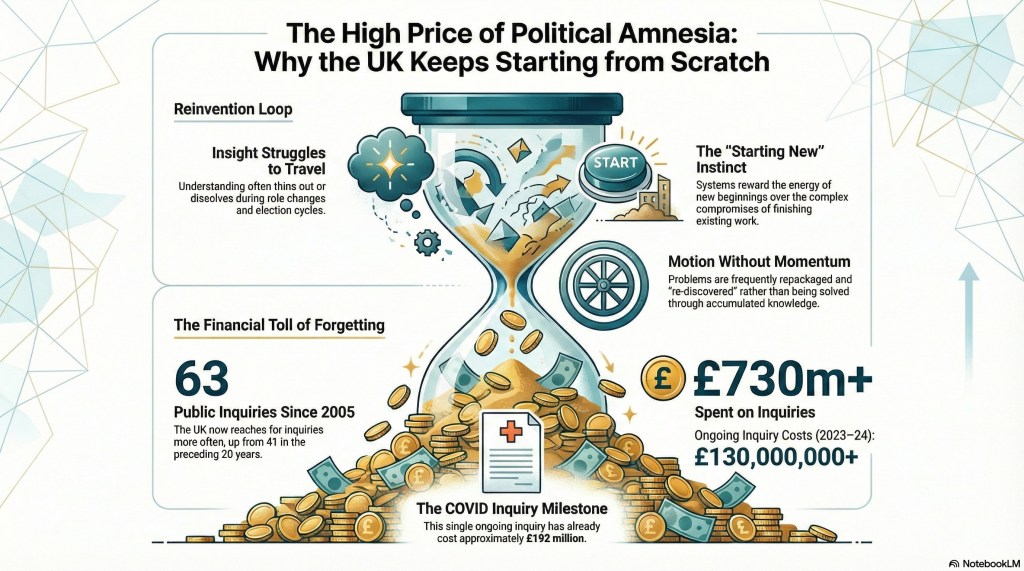
Since 2005, across the UK, 63 public inquiries have been launched. In the twenty years before that, it was 41. So even before we argue about whether they’re “good” or “bad”, we can see the direction of travel: we reach for them more often now than we used to.
And they aren’t cheap background admin.
The Institute for Government notes that completed inquiries since 2005 have cost over £730m, and that in 2023–24 the direct cost of ongoing inquiries exceeded £130m (before we even count the extra spend by departments and public bodies responding to them).
The Covid Inquiry alone has already spent around £192m, and it’s still running.
None of that is automatically wasted. Sometimes inquiries are exactly what a democracy should do.
But if we’re honest, this is also what “permanent reinvention” looks like in numbers: we keep paying to re-establish the facts, and then we act surprised when implementation takes years, arrives in fragments, or quietly dissolves once the headlines move on.
Which is why, from the outside — from the point of view of patients, tenants, teachers, councils — it can feel like we’re always in motion but rarely building momentum.
Why this matters before we talk about fixing anything
This is where all the earlier threads quietly meet.
The way parliamentary time is carved up. How quickly roles turn over. When scrutiny happens. And how often responsibility gets pushed outward into arm’s-length bodies rather than held centrally.
All of these affect whether learning sticks.
They don’t just shape decisions in the moment — they shape whether decisions can build on one another across time.
If memory keeps dissolving, even sensible reforms struggle to survive. Not because they’re flawed, but because the environment they land in doesn’t hold still long enough for them to take root.
A slightly awkward realisation
Once we notice this, another thought starts to surface.
We often talk about political failure as if it’s about ideology, competence, or intent. But a lot of what we’re seeing looks more like a problem of continuity — of whether the system is able to remember itself long enough to improve.
That’s not something you fix with sharper speeches or tougher standards.
It’s something you fix by deciding that learning matters more than novelty — and then shaping institutions so that learning has somewhere to live.
We’re not there yet.
But before we talk about how we might get there, there’s one more thing worth sitting with.
Because forgetting isn’t always accidental.
Sometimes, it’s quietly encouraged.
And that’s what we need to look at next.
This is the twenty fifth post in a series — Let’s Rethink Parliament.
There isn’t a fixed destination yet. The aim is to notice patterns as we go: how time is used, how incentives shape behaviour, how habits become untouchable — and what that does to outcomes across health, housing, education and beyond.
The direction will emerge as we proceed.


Discover more from Hysnaps Politics, Gaming, Music and Mental Health
Subscribe to get the latest posts sent to your email.

