
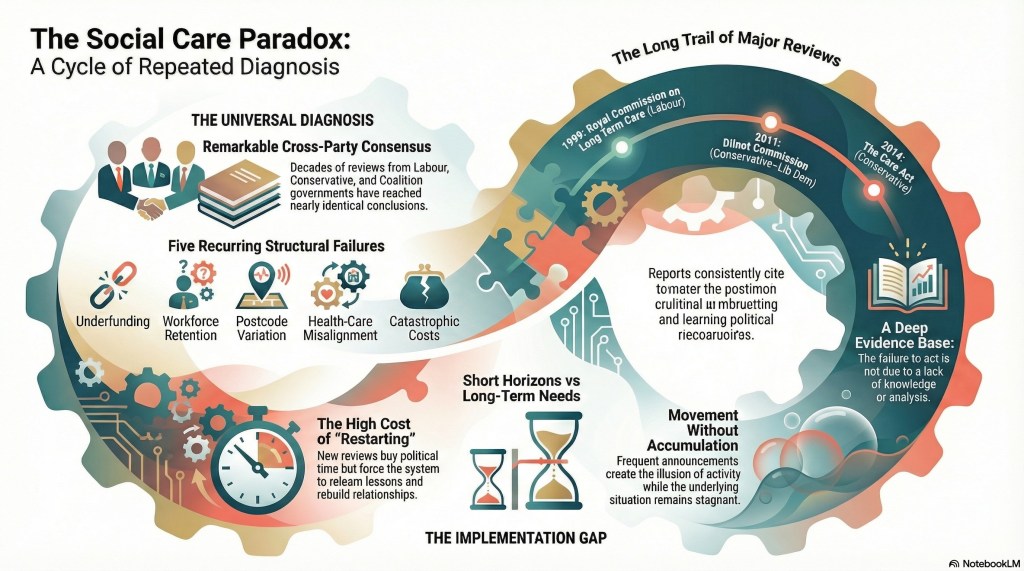
There’s a reason social care keeps resurfacing.
Not because it’s unusually controversial. And not because anyone believes it’s easy.
In fact, what’s striking is almost the opposite. There’s been broad agreement, for a long time, that the system isn’t working as it should — and that doing nothing simply shifts the cost elsewhere.
So the question isn’t really why does this keep coming up?
It’s why does it keep coming back in the same way?
Why social care is a useful case study
Social care doesn’t lend itself to big announcements or quick wins. It doesn’t sit neatly inside a single department, or a single budget line, or even a single political story.
It’s about older people, disabled adults, unpaid carers, local authorities, the NHS, housing, workforce pay, and long-term demographic change — all tangled together.
Which makes it an awkward problem for a system that prefers clarity, ownership, and pace.
And yet, attention hasn’t been sporadic. It hasn’t arrived in short bursts and disappeared again.
It’s come back again and again, almost continuously, over several decades.
Different governments. Different language. Same issue, circling.
The long trail of reviews
Since the late 1990s, social care has been examined by:
- Royal Commissions
- green and white papers
- independent reviews
- cross-party commissions
- parliamentary committees
- spending reviews with reform promises attached
These span Labour governments, Conservative governments, and coalitions. They reflect different priorities and political instincts. They use different language to describe the problem.
But when you step back, something slightly uncomfortable becomes hard to ignore.
The analysis is strong. The evidence base is deep. And the moral case has been rehearsed many times over.
Each review takes time to restate the problem, rebuild consensus, and re-explain why the current arrangements don’t quite work. A lot of effort goes into recreating shared understanding — partly because the last round never had enough time, stability, or follow-through to properly embed.
None of this is corrupt. And none of it is especially unusual.
What matters is the accumulation.
What restarting quietly costs
Restarting always looks active.
A new review signals seriousness. It creates space. It buys time. It allows a government to say, honestly, that it’s looking again.
But restarting carries a cost, even when it feels productive.
Time is spent re-explaining the issue. Relationships have to be rebuilt. Old ground is covered again before any real progress can begin.
From outside the system — from the point of view of people relying on care, carers trying to cope, councils juggling budgets — this doesn’t feel like renewal. It feels like drift.
Things are always being announced. Outcomes arrive later than promised, or in partial form, or not quite at all.
It looks like movement without much accumulation.
And because the system keeps restarting, memory never quite settles. Lessons have to be relearned. The same tensions resurface under slightly different names.
Over time, restarting starts to feel safer than finishing.
Did the reviews actually disagree?
This is the point where a fair question usually comes up.
Were these reviews fundamentally at odds with each other? Did they point in radically different directions?
And the honest answer is: not really.
Across decades of work, the core diagnosis has been remarkably consistent.
The details vary, the sequencing changes, and the political packaging shifts — but most reviews converge on familiar conclusions. Underfunding relative to demand. Postcode variation driven by local authority budgets. Workforce pay and retention problems. Poor alignment between health and social care. Fear of catastrophic costs delaying decisions. The need for more predictable, pooled funding.
If these reviews had reached wildly different answers, we could reasonably say the problem was unresolved disagreement.
But that isn’t what the record shows.
What we see instead is repeated agreement, followed by hesitation about committing to what that agreement implies.
Which makes it harder to avoid a more uncomfortable interpretation.
That the review process itself has gradually become a way of managing the problem — keeping it visible, but also safely in the future.
Not because anyone set out to kick it into the long grass.
But because restarting is often easier than finishing, especially in a system where time, tenure, and responsibility are constantly shifting.
Why this matters beyond social care
Social care isn’t unique here. It’s just unusually clear.
It shows us what happens when:
- long-term problems meet short political horizons
- responsibility is shared but accountability is thin
- learning exists, but memory doesn’t quite stick
The system keeps thinking. It keeps analysing. It keeps agreeing.
What it struggles to do is stay put long enough to carry those decisions through.
Which leaves us with a quiet, unsettling thought to carry forward.
If a problem can be understood this well, for this long, across this many governments — and still keep restarting — then the issue probably isn’t knowledge.
It’s whether the system is built to finish the things it already knows how to start.
And that’s something we’ll need to sit with as we turn to the next question.
Not about whether Parliament cares enough.
But about whether it has designed itself to remember, commit, and follow through.
That’s where we go next.
Further reading & evidence trail
For readers who want to follow the thread:
- Royal Commission on Long Term Care (1999) — Labour
- Wanless Review of Social Care (2006) — Labour
- Shaping the Future of Care Together (2009) — Labour
- Dilnot Commission (2011) — Conservative–Lib Dem
- Care Act 2014 — Conservative
- House of Lords Economic Affairs Committee: Social Care Funding (2019) — Conservative
- NAO reports on delayed social care reform (multiple years)
- Institute for Government explainer: Adult social care reform timelines
Taken together, these documents don’t show confusion.
They show repeated clarity — without durable follow-through.
This is a step sideways from the twenty fifth post in the series — Let’s Rethink Parliament, to look more deeply at a single topic, for context.
There isn’t a fixed destination yet. The aim is to notice patterns as we go: how time is used, how incentives shape behaviour, how habits become untouchable — and what that does to outcomes across health, housing, education and beyond.
The direction will emerge as we proceed.



Discover more from Hysnaps Politics, Gaming, Music and Mental Health
Subscribe to get the latest posts sent to your email.

