There’s a question that keeps hovering once you’ve noticed all of this.
Not “what’s the perfect system?”
Not “how would we redesign everything from scratch?”
But something much more awkward.
What if we only had one term?
Not to transform politics forever.
Not to solve every structural problem.
Just one Parliament, one stretch of time, with no guarantee of coming back.
What would we actually try to change?
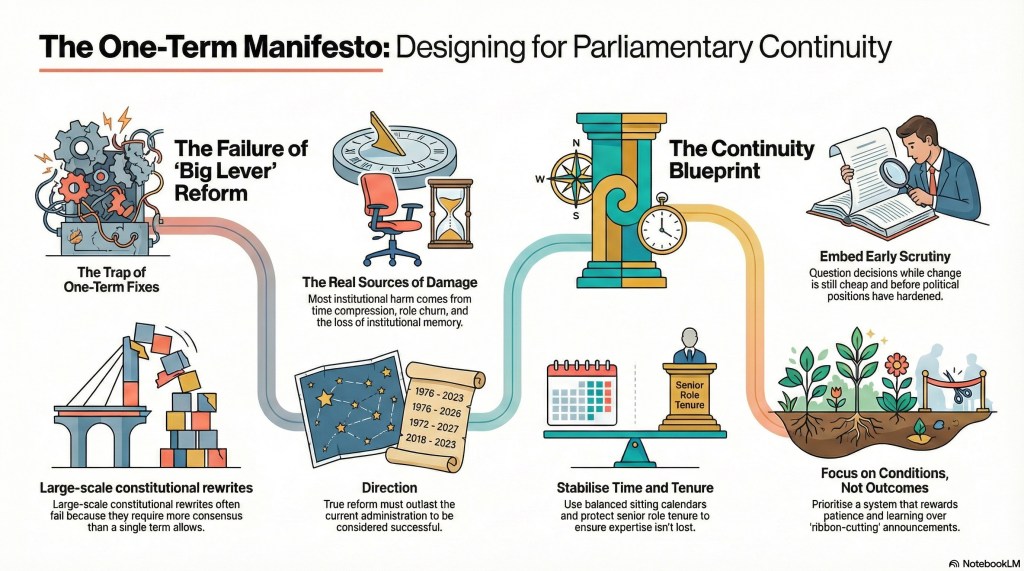
The temptation to go big
This is usually the point where people reach for the largest levers.
Rewrite the electoral system.
Replace the House of Lords.
Redesign the constitution.
And there’s a reason those ideas surface quickly. They feel decisive. They sound structural. They promise a clean break.
But there’s also something slightly dishonest about pretending those are one-term fixes.
Not because they’re wrong ideas — many of them are serious, defensible proposals — but because they demand levels of consensus, sequencing, and follow-through that no single Parliament can realistically secure on its own.
So rather than asking “what would fix everything?”, it’s probably more honest to ask something narrower.
What could we change that would still be there if we lost the next election?
What survives a change of government
If we look back over the series so far, a pattern keeps reappearing.
The things that cause the most damage aren’t usually ideological swings. They’re churn, compression, and forgetfulness.
Time gets squeezed.
Roles turn over before understanding settles.
Scrutiny arrives late, when positions have already hardened.
So the most useful one-term changes probably aren’t about outcomes at all.
They’re about conditions.
Things like how time is structured, how continuity is protected, and how early it’s safe to ask difficult questions.
Not glamorous changes. But resilient ones.
What this kind of manifesto wouldn’t promise
It wouldn’t promise to “fix” housing, health, or social care within five years.
Anyone who’s looked closely at those systems knows that’s not how they work.
It wouldn’t promise a total rewrite of constitutional arrangements, or a wholesale replacement of institutions that have grown over centuries.
Not because those conversations aren’t worth having — but because pretending they can be finished neatly inside a single term just creates another cycle of overreach and disappointment.
Honesty matters here.
Part of rebuilding trust is being clear about what can’t be delivered quickly, even with good intentions.
What it might actually commit to
Instead, it might focus on changes that alter how decisions are made rather than what decisions are reached.
Things that make it easier to do careful work, and harder to rely on last-minute urgency.
A sitting calendar that smooths time out across the year, rather than piling it up and releasing it in bursts.
More predictable tenure in senior roles, so people aren’t leaving just as they start to understand the systems they’re responsible for.
Earlier scrutiny built into the process, when change is still cheap and disagreement isn’t yet existential.
Clearer responsibility, so admitting something isn’t working feels less like personal failure and more like maintenance.
None of that guarantees better outcomes.
But it does make better outcomes more plausible.
Why this isn’t as modest as it sounds
On paper, this kind of programme can look underwhelming.
There are no ribbon-cutting moments. No single announcement you can point to and say “that’s when it changed.”
But that’s also why it might stick.
Because it doesn’t depend on one government being uniquely wise or virtuous. It depends on leaving behind a system that rewards patience a little more than performance.
A system where memory has somewhere to live.
Where learning doesn’t reset every few years.
Where delegation amplifies thinking rather than buffering instability.
Those aren’t headline reforms. But they’re the kind that quietly shape everything else.
So is this really all we’d do?
Probably not.
Any government would still have its priorities, its legislation, its arguments, its failures.
But if we were honest with ourselves about what a single Parliament can realistically leave behind, this might be the most ambitious thing it could aim for.
Not a solved system.
Just one that’s slightly easier to think in, slightly harder to rush, and a little more capable of remembering what it already knows.
And that brings us to the last, unavoidable question.
If we don’t design for that kind of continuity on purpose…
what are we implicitly choosing instead?
That’s where we end this series.
This is the twenty sixth and final post in the series — Let’s Rethink Parliament.
There isn’t a fixed destination yet. The aim is to notice patterns as we go: how time is used, how incentives shape behaviour, how habits become untouchable — and what that does to outcomes across health, housing, education and beyond.
The direction will emerge as we proceed.
Discover more from Hysnaps Politics, Gaming, Music and Mental Health
Subscribe to get the latest posts sent to your email.

