So we’ve got about 800-ish people — mostly older, mostly unelected — being paid to sit in the Upper House.
Do we actually understand what they do, or why they’re there at all?
That’s not meant to be rude. It’s just… an odd arrangement. And if you listen to how the House of Lords gets talked about in real life, it usually comes out as a handful of familiar one-liners:
- “It’s where politicians go to retire.”
- “They’re unelected, so they shouldn’t exist.”
- “They just slow everything down.”
- “It’s bishops, donors, and old judges.”
- “No one voted for them — why do they get a say?”
Some of that’s wrong, some of it’s half-right, and some of it is just what you say when something feels strange but you’ve never quite stopped to unpick why.
Because if you actually pressed most of us — myself included, until I sat down and looked — we’d struggle to give a clean answer to a very simple question:
What is the House of Lords actually for?
Not constitutionally or in theory, but in practice.
So before we discuss reform, abolition, elections, or anything else, it’s probably worth doing the boring but necessary bit first and just understanding what this thing actually does.
The easiest way to think about it
Here’s the least bad analogy I’ve found.
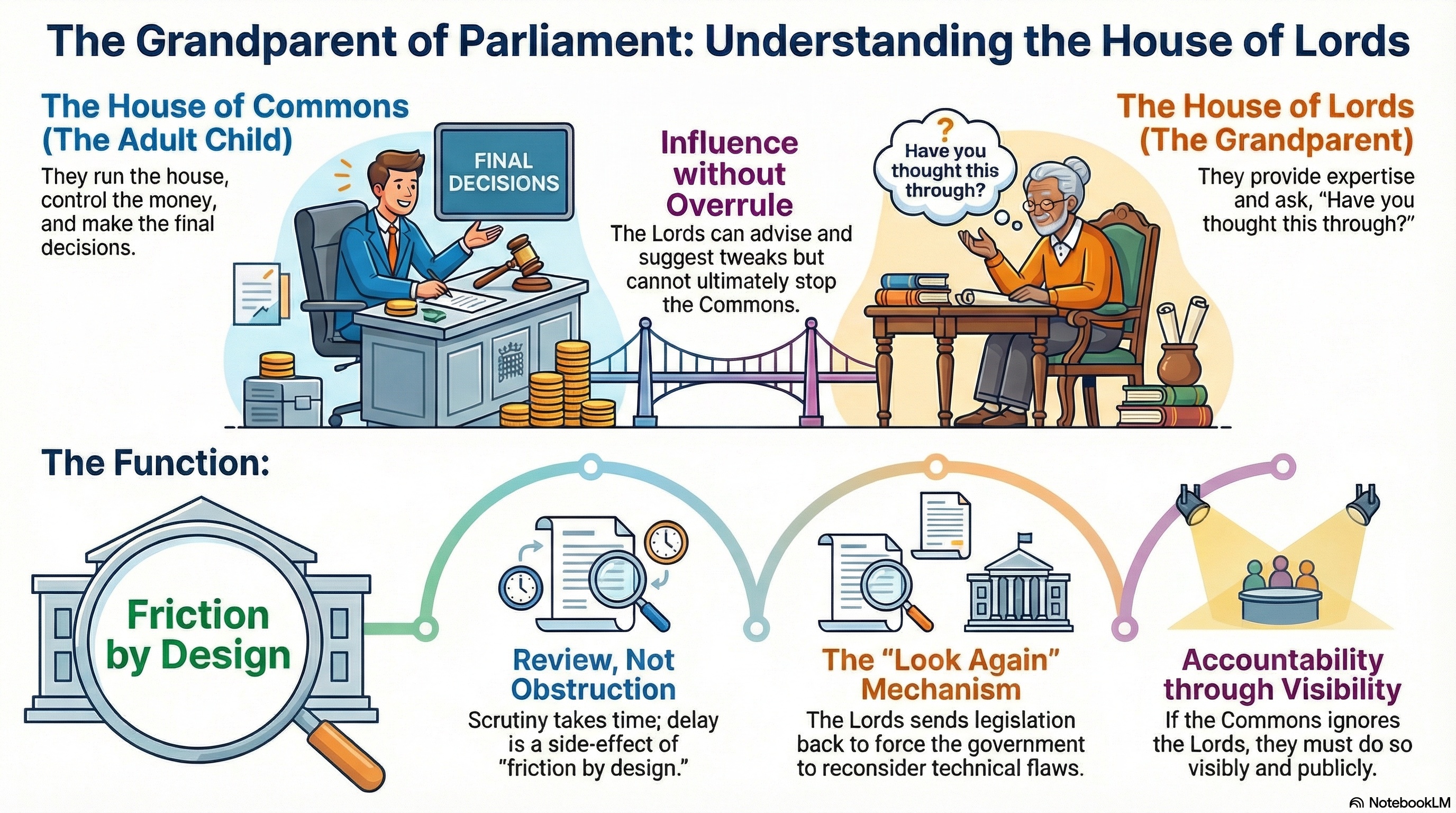
Think of the House of Commons as the adult child.
They’ve got the job, they make the decisions, they control the money, and they run the house.
The House of Lords is more like the grandparent.
They don’t get to tell the adult child what to do, they can’t overrule them, and they don’t get the final say. But what they can do is say things like:
- “Have you thought this through?”
- “You know this didn’t work last time.”
- “I’m not saying you’re wrong — just slow down a second.”
- “This bit here might cause trouble later.”
Most of the time, the adult child still does what they were going to do anyway. But sometimes — not always, but often enough to matter — they pause, rethink, tweak something, or realise they’ve missed a consequence.
That, in real terms, is what the Lords is for.
So what does it actually do?
Day to day, the Lords reviews legislation line by line, proposes amendments, asks technical and awkward questions, draws on subject-matter expertise, and forces the government to explain itself properly.
It’s worth clearing up one common misunderstanding early on.
The aim isn’t to delay. Delay is a side-effect. The aim is review.
If you review something properly, it takes time. That’s not obstruction; it’s friction by design.
And crucially, the Lords doesn’t usually block legislation outright. It sends things back. It says “look again”. It says “this bit doesn’t quite work”.
Sometimes the Commons agrees and changes course, and sometimes it doesn’t.
Which brings us to the question that always comes up next.
“Hold on — can’t Parliament just ignore them?”
Yes… and no.
There is a way for Parliament to override the Lords, but it’s not a shrug-and-move-on situation. There’s no big red button marked Ignore the Lords.
To override them, the government has to bring the legislation back again, wait, do it visibly, and effectively say out loud:
“We’ve listened, we still disagree, and we’re prepared to own that.”
That’s not a technicality — that’s the point.
The Lords can’t force the Commons to change its mind, but it can make ignoring scrutiny a deliberate, public choice. That’s very different from being powerless.
Why this all feels so odd
The House of Lords isn’t elected, it isn’t sovereign, and it isn’t accountable in the same way MPs are.
And yet it shapes laws, alters legislation, influences outcomes, and occasionally forces governments into uncomfortable positions.
That contradiction is what makes people uneasy — and it’s also the clue.
The Lords wasn’t designed in one go. It accumulated. Bits were added, bits were removed, compromises were made, and nothing ever got fully reset.
Which means we’ve ended up with an institution that does something genuinely useful, but does it in a way that’s hard to explain, using a structure most of us would never design from scratch.
That doesn’t make it bad.
But it does mean it’s worth understanding properly before we decide what to do with it next.
Where this leaves us
So at this point, all we’ve really established is that the House of Lords isn’t there to run the country, it isn’t there to block democracy, and it isn’t just a retirement home either.
It exists to review, to slow things down just enough, and to make sure legislation survives contact with reality.
Whether it does that well — and whether it’s the best way to do it now — is a separate question.
And that’s the one we’ll come to next.
So why do we have it in the first place?
And what was it actually meant to do?


This is post 1 of a series – Let’s Rethink The Lords, looking at the Upper House in the English system of politics. It will cover what it is, why it is, how it has changed, how other countries do it and potentially what could be done to improve ours.
There will be podcasts over at hysnaps-political-investigations providing explainers and summary videos at youtube @hysnapmmh, these are usually released a week or two after the Blog Post.
Discover more from Hysnaps Politics, Gaming, Music and Mental Health
Subscribe to get the latest posts sent to your email.

