In the last post we landed somewhere fairly modest.
The House of Lords isn’t there to run the country, it isn’t there to block democracy, and it isn’t just a retirement home. It reviews legislation, asks awkward questions, and sometimes makes the government pause and rethink.
That naturally leads to the next question.
Why do we have it at all?
Not “why hasn’t it been abolished yet”, but why it existed in the first place, and what problem it was originally trying to solve. Because once you look at that, a lot of the current oddness starts to make more sense.
Start with the boring answer
The House of Lords exists because Parliament didn’t begin life as a single, neatly designed institution.
For most of its history, England — and later Britain — was governed through a system where power was shared between the Crown, the nobility, and eventually representatives of towns and counties. Those groups didn’t sit together by accident; they reflected where power already sat in society.
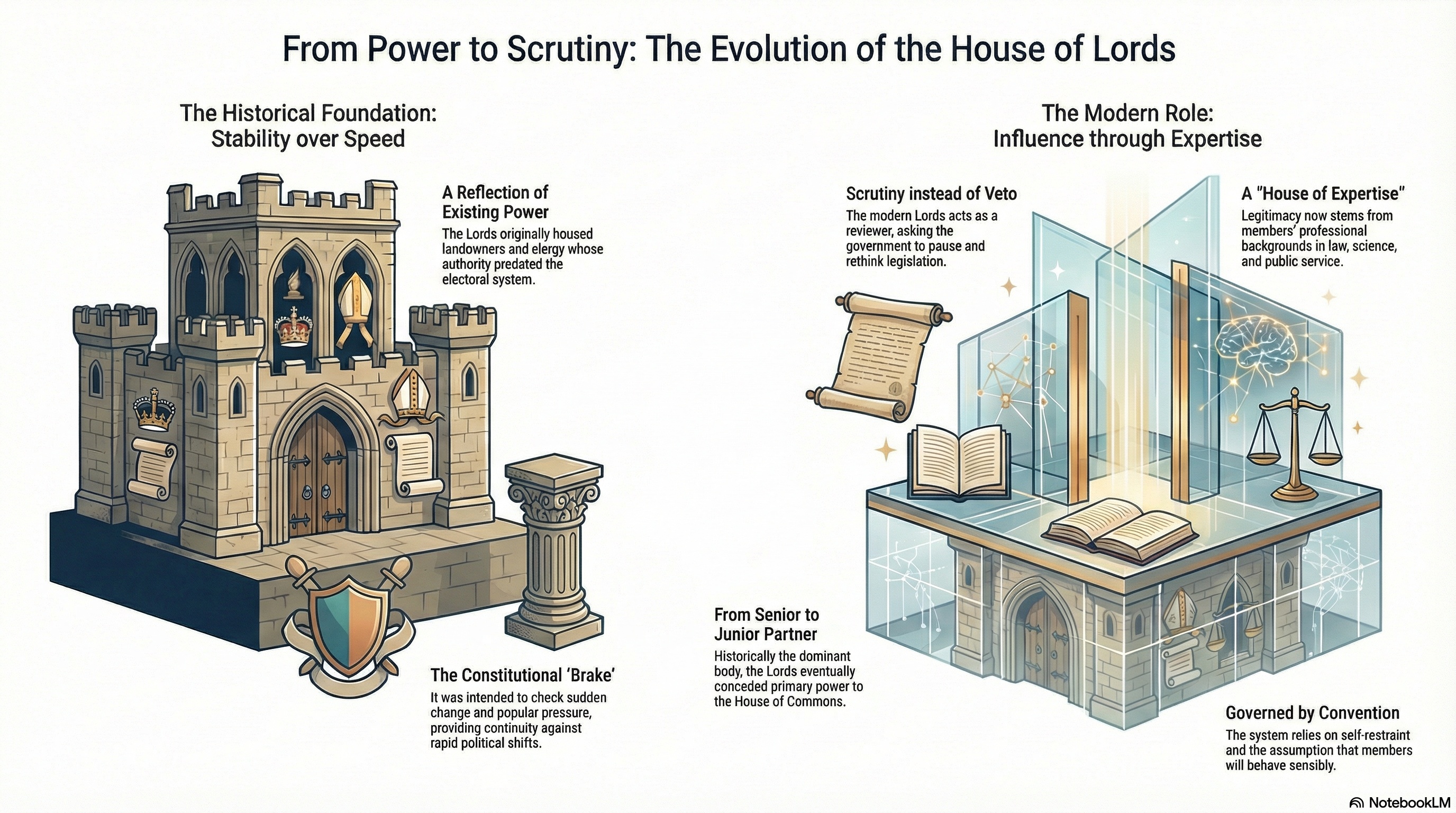
The Lords was simply where the powerful already were: landowners, clergy, and senior figures whose authority came from position rather than election.
The Commons arrived later, and for a long time it was the junior partner. So the original question wasn’t really “why does the Lords get a say?” It was closer to “why should ordinary people get one as well?”
That’s uncomfortable to say now, but it matters, because it explains the shape of what followed.
What the Lords was originally for
In its early form, the Lords wasn’t designed as a revising chamber in the modern sense.
It was meant to act as a check — not on democracy, because democracy wasn’t really the point yet, but on sudden change, popular pressure, and decisions made too quickly.
The rough idea was that the House of Commons reflected the mood of the country in the moment, while the Lords embodied continuity, stability, and a sense of inherited responsibility. That isn’t a particularly modern argument, but it is a coherent one.
If you like, it’s the same instinct that sits behind having judges who aren’t elected, civil servants who don’t change with governments, or central banks insulated from day-to-day politics. The language we use has changed, but the underlying logic hasn’t entirely gone away.
How power slipped away, but influence stayed
Over time, the Lords lost something important: power.
As democratic norms strengthened, it became harder to justify an unelected body having the final say over law and taxation. That authority moved — sometimes smoothly, sometimes after bitter arguments — to the Commons.
But the Lords didn’t disappear. What changed was its role.
What it retained was the ability to scrutinise legislation, revise it, and ask the Commons to think again. In other words, it shifted from being a co-equal holder of power to acting as a constitutional brake.
Not a veto, and not a rival government — more like a brake.
That shift wasn’t planned in one neat reform. It happened gradually, because it was the compromise people could live with.
Where expertise crept in
Once the Lords stopped being about direct power, a new justification started to take shape.
If this chamber isn’t elected, then what is it actually for?
Increasingly, the answer became experience. Over time, more and more emphasis was placed on bringing in people who had run departments, written laws, led major institutions, or worked at the top of their professions.
This is where the modern idea of the Lords as a “house of expertise” comes from.
But it’s worth noticing that this wasn’t something the system was rebuilt to do. It wasn’t redesigned from scratch to be a technical chamber, a place for long-term thinking, or a neutral reviewer. It simply grew into those roles over time.
Why this feels awkward now
That history explains a lot of the tension we feel today.
We’re asking the Lords to do a job that makes sense in a modern democracy — review, restraint, scrutiny — but we’re doing it using a structure that was never consciously designed for that purpose.
As a result, the system relies heavily on convention, self-restraint, and good faith — essentially on the assumption that most people involved will behave sensibly most of the time.
Most of the time, that works.
But it also explains why the Lords can feel fragile as an institution. Its membership looks odd to modern eyes, and its role is surprisingly hard to explain clearly without a fair bit of hand-waving.
What we’re looking at now is the result of a long, gradual shift: away from holding power directly and towards exercising restraint, away from authority and towards review, and away from status as such and towards experience.
Where that leaves us
So when people ask, “Why do we even have the House of Lords?” or “What was it meant to do?”, the honest answer is this:
It wasn’t meant to do exactly what it does now — but what it does now isn’t accidental either.
It’s the outcome of a slow evolution from power to restraint, from authority to scrutiny, and from inherited status to accumulated experience.
Whether that arrangement still works well — and whether it’s the best way to organise things now — is an open question.
Before we get there, though, there’s one more misunderstanding that needs clearing up, because it comes up every single time this topic is discussed.
“Hang on — can’t the Commons just ignore the Lords anyway?”
That’s what we’ll look at next.


This is post 2 of a series – Let’s Rethink The Lords, looking at the Upper House in the English system of politics. It will cover what it is, why it is, how it has changed, how other countries do it and potentially what could be done to improve ours.
There will be podcasts over at hysnaps-political-investigations providing explainers and summary videos at youtube @hysnapmmh, these are usually released a week or two after the Blog Post.
Discover more from Hysnaps Politics, Gaming, Music and Mental Health
Subscribe to get the latest posts sent to your email.

