If you’ve ever talked about the House of Lords for more than about five minutes, someone will usually say something like:
“But none of this really matters, does it?
If the Lords get awkward, the Commons can just ignore them.”
It sounds plausible, and it’s not completely wrong. But it’s also not quite how it works, and a lot of confusion comes from that gap between what people half-remember and what actually happens.
So this feels like the right moment to slow down and look at that assumption properly.
The short answer
Yes, the House of Commons can ultimately get legislation through even if the House of Lords objects.
But it can’t do that casually, quietly, or instantly. And that difference matters more than people often realise.
The longer answer (without the legal lecture)
There is a mechanism that allows the Commons to bypass the Lords. It exists because, in the end, an elected chamber has to be able to govern.
But it’s deliberately awkward to use.
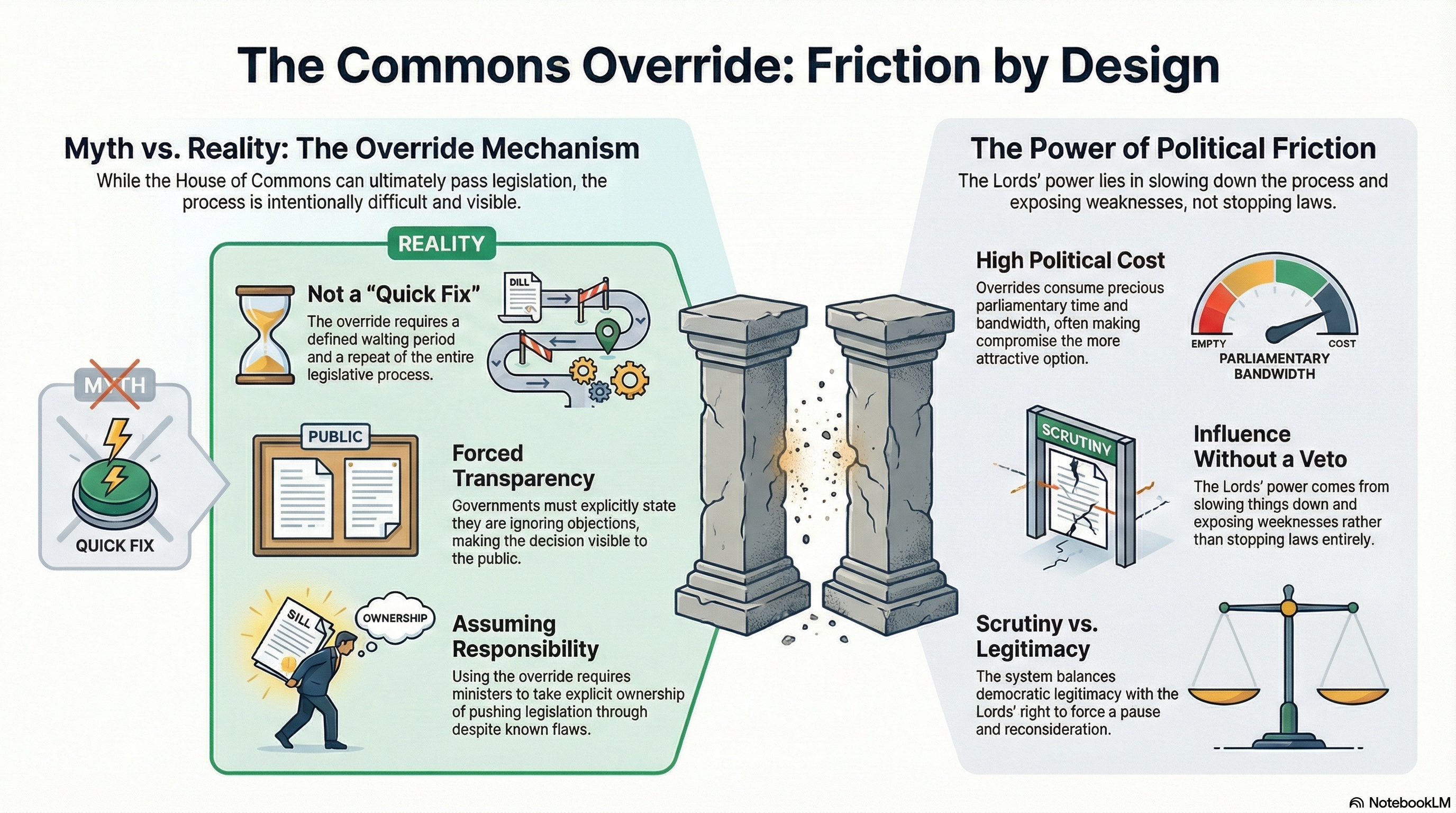
In practice, it means the government has to bring the legislation back again, wait for a defined period, go through another round of the process, and do all of this in full view of Parliament and the public. It’s not a quick workaround; it’s a slow, visible route that makes everyone pay attention.
Effectively, the government has to say something like:
“We’ve heard the objections, we still disagree, and we’re prepared to take responsibility for pushing this through anyway.”
That’s not a technical quirk. That’s the point of the design.
Why this isn’t the same as being ignored
If the Lords could simply be brushed aside, it wouldn’t be worth much attention. What makes the arrangement interesting is that overriding scrutiny carries a cost.
Using this mechanism takes time, consumes parliamentary bandwidth, attracts attention, and leaves a very clear paper trail. It forces ministers to be explicit about disagreement rather than letting awkward points quietly fade away.
That doesn’t stop governments acting. But it does stop them pretending the challenge never happened.
And that’s why the House of Lords is harder to ignore than it first appears.
Why this power exists at all
It’s worth reminding ourselves why this compromise emerged.
Over time, it became clear that an unelected chamber couldn’t be allowed to permanently block legislation supported by the elected one. That would undermine democratic legitimacy in a fairly obvious way.
So the system settled into a balance. The Commons gets the final say, while the Lords gets the right to push back, delay, revise, and force reconsideration. Neither side gets everything it wants, and neither side is supposed to.
That tension is baked in.
Does the Lords still matter if it can be overridden?
This is where the pub argument usually goes off track.
People often assume that if a body doesn’t have a veto, it doesn’t really have power. But political influence doesn’t only come from the ability to stop something outright. It also comes from slowing things down, exposing weaknesses, forcing explanations, and shaping the final form of a law.
A lot of legislation ends up changing not because the Lords “won”, but because the government decided the fight wasn’t worth it, or realised a flaw once it had been spelled out clearly and publicly.
That’s a quieter form of influence, but it’s still real.
So why isn’t the override used all the time?
Because it’s politically expensive.
Every time a government uses this route, it’s effectively saying, “We’re confident enough to override scrutiny and accept the consequences.” Sometimes that’s justified, and sometimes it isn’t. Either way, it’s not something ministers tend to do lightly, routinely, or without thinking carefully about the fallout.
That’s why, in practice, most disagreements between the two Houses are resolved through amendment and compromise rather than outright override.
Where this leaves us
So yes, the Commons can ultimately push legislation through without the Lords’ consent. But doing so takes time, draws attention, and requires the government to visibly own the decision.
The Lords can’t block democracy, but it can make democracy pause, explain itself, and be explicit when it chooses not to listen. Whether that balance still works well, and whether it’s the right one for the world we live in now, is the question we’re circling.
Before we get there, though, there’s one last thing worth asking.
When this override power is actually used, how does it tend to age? Does it usually look like a necessary decision in hindsight, or something we later regret?
That’s what we’ll look at next.


This is post 3 of a series – Let’s Rethink The Lords, looking at the Upper House in the English system of politics. It will cover what it is, why it is, how it has changed, how other countries do it and potentially what could be done to improve ours.
There will be podcasts over at hysnaps-political-investigations providing explainers and summary videos at youtube @hysnapmmh, these are usually released a week or two after the Blog Post.
Discover more from Hysnaps Politics, Gaming, Music and Mental Health
Subscribe to get the latest posts sent to your email.

