By this point, we’ve established a few things.
The House of Lords didn’t start out doing the job it does now. Over time, it shifted away from holding power directly and towards exercising restraint. And although the House of Commons can ultimately override it, doing so isn’t casual or cost-free.
That naturally raises the next question.
If the Lords changed this much once already, why did that happen — and what actually forced the change?
Because this wasn’t gentle evolution. It was conflict.
The point where things stopped muddling along
For a long time, the system relied on convention. The Lords had power because it always had power, and the Commons was gradually gaining confidence as democratic legitimacy grew.
Eventually, that balance stopped working.
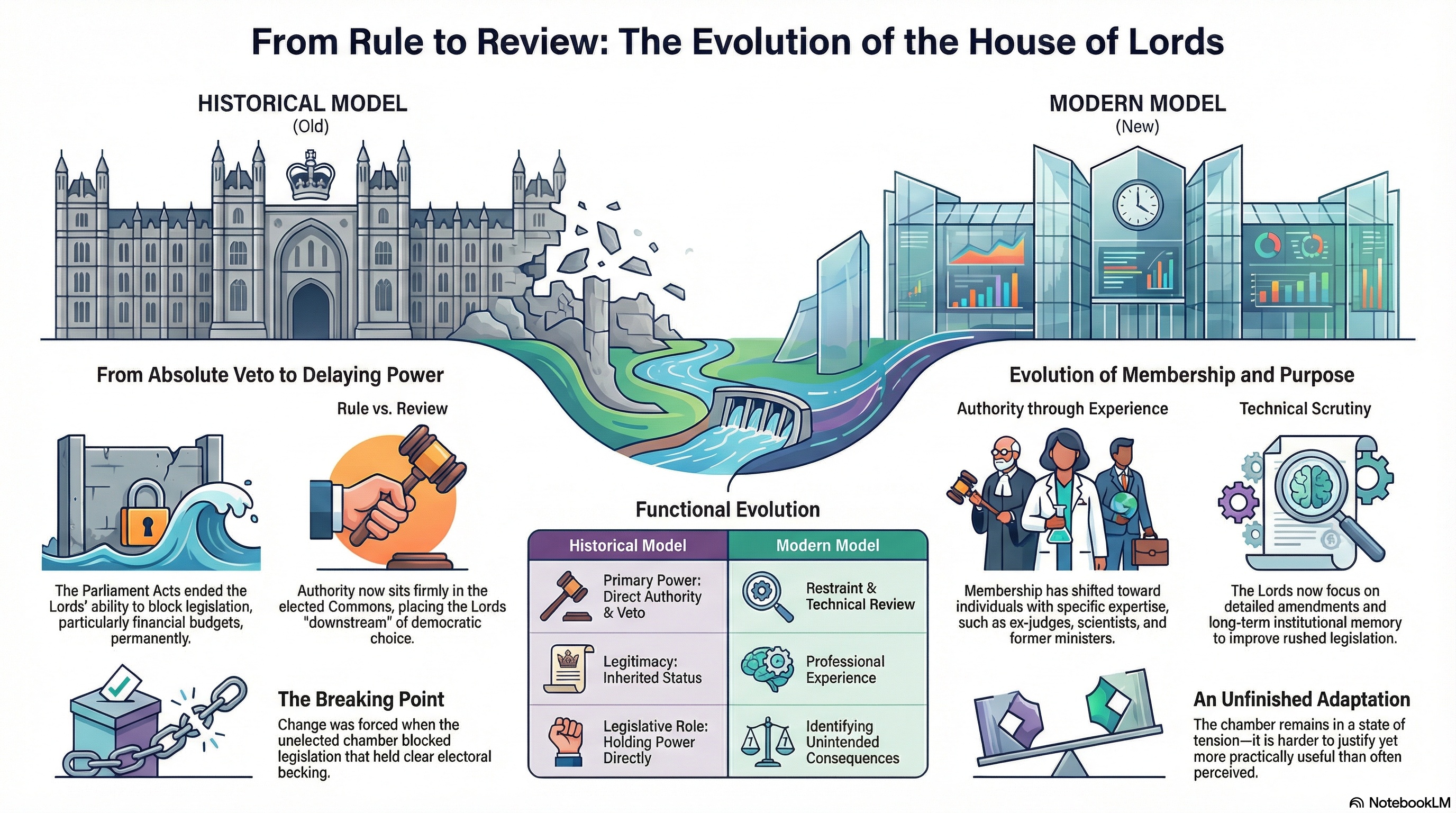
The breaking point came in the early twentieth century, when the Lords began using its authority to block legislation that had clear electoral backing, particularly around budgets and taxation. At that point, the issue stopped being theoretical and became very practical.
What happens if an unelected chamber can veto the core programme of an elected one?
That question didn’t have a sustainable answer, and everyone involved knew it.
What the system decided — explicitly
The response wasn’t to abolish the Lords. Instead, the system made a very clear choice about where legitimacy and authority should live.
Democratic legitimacy was anchored firmly in the Commons. Ultimate authority was placed with the elected House. The role of the Lords was recast as one of review rather than rule.
That wasn’t a rejection of scrutiny. It was an acknowledgement that scrutiny had to sit downstream of democratic choice, not above it.
This shift was written into law through measures like the Parliament Acts, which sharply limited the Lords’ ability to block legislation outright, particularly on financial matters. Over time, its veto became a delaying power rather than a permanent one.
The direction of travel mattered more than the legal detail.
What didn’t disappear
What’s interesting is what survived that change.
The Lords didn’t fade away. It didn’t stop amending legislation, and it didn’t retreat into irrelevance. Instead, it leaned more heavily into the parts of its role that still made sense in the new balance.
It focused on detailed examination of legislation, on technical amendment, on long institutional memory, and on having the confidence to push back when something looked rushed or poorly thought through. In other words, it leaned into review.
That’s why, despite losing formal power, it continued to shape outcomes in quieter ways.
How the membership shifted alongside the role
As the role changed, the composition of the House changed with it — not through a single redesign, but through gradual adjustment.
Once the Lords was no longer there to represent inherited power, the obvious question became who ought to sit there instead. Over time, more space opened up for people whose authority came from experience rather than status.
That’s how you end up with a chamber where former health ministers argue about NHS legislation, ex-judges pick apart legal wording, scientists question the evidence behind policy claims, and long-serving policy figures point out unintended consequences that only show up after a few years in the real world.
None of this was planned as a coherent redesign. It was an adaptation to the role the Lords had gradually found itself playing.
The unresolved tension we’re left with
Here’s where things start to feel awkward.
The House of Lords changed because it had to. The old model couldn’t coexist with a democratic Commons. But the process never really finished.
We stripped away its power without fully re-specifying its purpose. We let its membership evolve without deciding what it was evolving towards. The result is a chamber that is weaker than it once was, more useful than it often looks, and harder to justify than it probably should be.
That’s not because it’s failing. It’s because it’s carrying the weight of history as well as the demands of a modern state.
Where that takes us next
So when people say the House of Lords has changed before, they’re right.
But it didn’t change because someone sat down with a neat theory of governance. It changed because the old balance stopped working and something had to give.
Which brings us to the next, slightly awkward question.
If the Lords was never meant to be the nation’s ethical conscience, why do we keep ending up arguing about bishops, judges, and moral authority inside it?
That’s where we’ll go next.

This is post 4 of a series – Let’s Rethink The Lords, looking at the Upper House in the English system of politics. It will cover what it is, why it is, how it has changed, how other countries do it and potentially what could be done to improve ours.
There will be podcasts over at hysnaps-political-investigations providing explainers and summary videos at youtube @hysnapmmh, these are usually released a week or two after the Blog Post.
Discover more from Hysnaps Politics, Gaming, Music and Mental Health
Subscribe to get the latest posts sent to your email.

