If you talk about the House of Lords for long enough, there’s a point where someone inevitably stops and says:
“Hang on — why are there bishops in there?”
“And weren’t judges involved at some point too?”
It’s a fair reaction. Both things feel odd if you come to them fresh. And they’re usually treated either as obvious nonsense or as something too traditional to question.
In reality, they’re neither. They’re both leftovers from earlier versions of the system that never quite got cleaned up.
Start with the bishops
Bishops sit in the Lords because, historically, the Church didn’t just sit alongside the state — it was woven into it.
For centuries, senior clergy weren’t simply religious figures. They were administrators, educators, record-keepers, and moral authorities at a time when those roles weren’t clearly separated. When Parliament took shape, bishops were already part of the governing class, so they came with it.
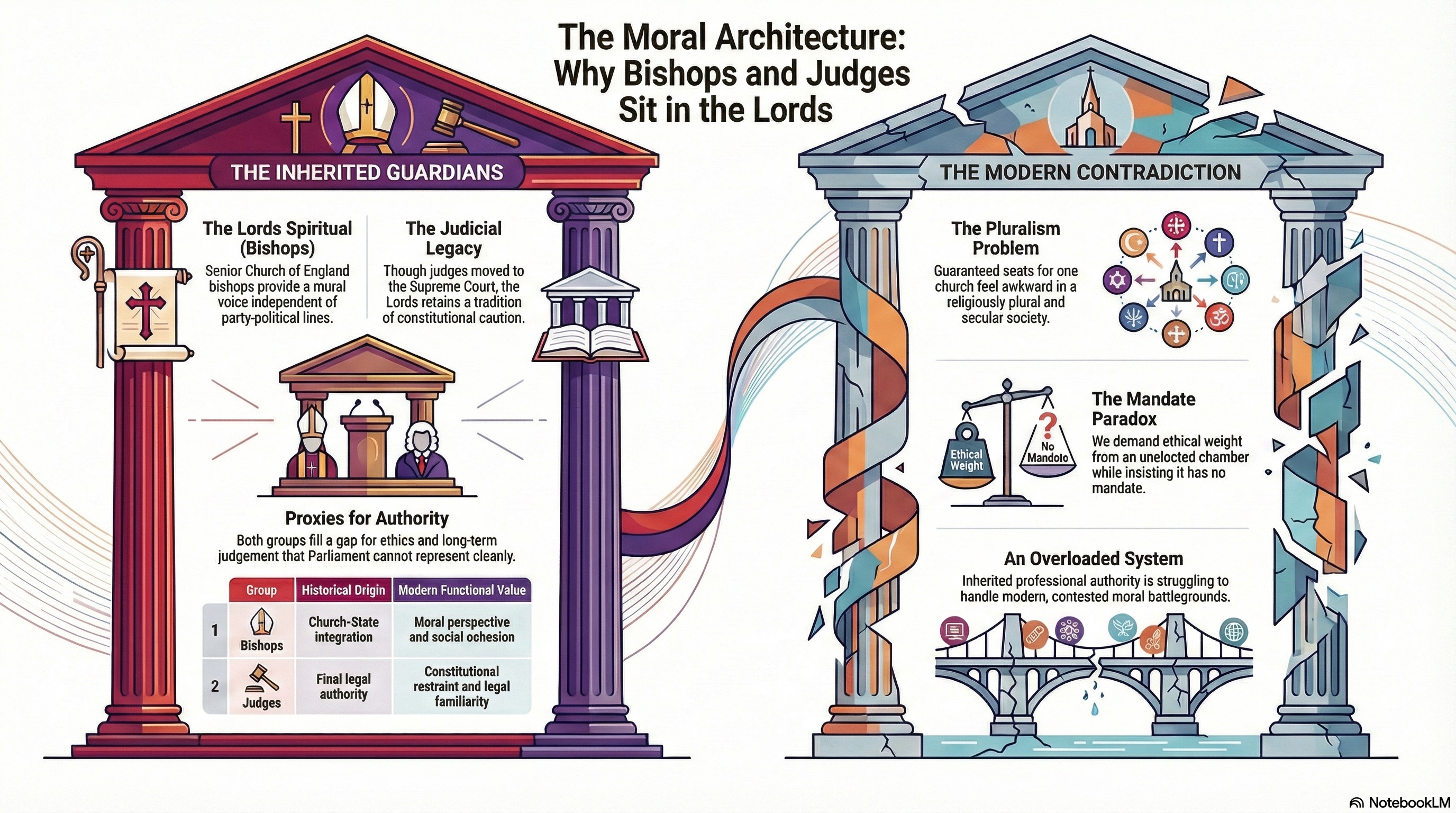
Today, that survives as the Lords Spiritual: senior bishops of the Church of England who sit in the Lords because of the positions they hold.
What they’re supposed to bring isn’t party loyalty or electoral representation, but a moral perspective, a sense of social consequence, and a voice that isn’t directly tied to party politics. And to be fair, many of them do exactly that. They often speak about poverty, care, social cohesion, and long-term responsibility in ways that don’t map neatly onto party lines.
The awkward part is obvious, though. They represent one established church in a country that is now religiously plural, increasingly secular, and legally committed to freedom of belief. So even if you like what many bishops say, it’s still reasonable to ask why this particular church gets a guaranteed place — and not others, or none at all.
Now the judges
Judges ended up in the Lords for a different reason.
For a long time, the highest court in the land wasn’t separate from Parliament. Final legal authority sat inside the House of Lords, and senior judges — the so-called Law Lords — were there to hear appeals and interpret the law, not to debate politics.
That arrangement made sense in its time, but it gradually became uncomfortable. As ideas about the separation of powers hardened, the notion that judges should also be legislators, or even appear to be, stopped sitting well.
So that function was deliberately peeled away, and the UK Supreme Court was created. Judicial authority was formally separated from Parliament.
That part of the system was redesigned properly.
What lingered was the sense that legal authority, constitutional caution, and deep familiarity with how the law actually works still somehow “belonged” in the Lords.
What bishops and judges were really doing there
If you strip away the robes and titles, bishops and judges were both filling the same gap.
They weren’t there because they were elected, and they weren’t there because they represented voters. They were there because they were seen as morally authoritative, professionally authoritative, and at least somewhat insulated from day-to-day political pressure.
In other words, they were being used as a proxy for something Parliament didn’t have a clean way of representing: ethics, long-term judgement, and constitutional restraint.
For a long time, that arrangement worked tolerably well. Society was more homogeneous, fewer issues were framed as explicit moral battlegrounds, and there was more shared ground about what “the right thing” might look like.
Why that justification is creaking now
The problem isn’t that bishops or judges are doing a bad job.
The problem is that the job they’re quietly being asked to do has expanded.
We now expect Parliament to grapple openly with plural values, contested moral questions, long-term harms and trade-offs, and issues where there isn’t a single shared moral framework. Those debates are unavoidable in a modern, diverse society.
In that context, relying on one church, inherited professional authority, or personal gravitas starts to look less like settled wisdom and more like improvisation.
That doesn’t mean moral reasoning doesn’t belong in the system. It clearly does. It just means we’ve been hosting it in a place that was never designed to carry that weight.
The quiet contradiction at the centre of it all
This is the contradiction that sits at the heart of the Lords.
We’ve stripped away much of its power because it isn’t elected, but we still lean on it for ethical judgement, constitutional caution, and those moments where someone needs to say something uncomfortable out loud.
We do that partly by keeping bishops in the room, and partly by inheriting the legacy of judicial authority that once lived there. The result isn’t malicious or conspiratorial — it’s just inherited.
But it leaves us in a strange position. We ask an unelected chamber to carry moral weight, while insisting it has no mandate to do so.
What this is really about
When arguments flare up about bishops in the Lords or about judges having influence, they’re usually framed as disputes about religion or law.
But underneath, it’s something simpler.
It’s about the fact that we don’t have a clear, deliberate place in our system for ethical reflection, long-term moral reasoning, or values-based challenge that isn’t party-political. So we keep loading that responsibility onto the House of Lords, and then arguing about the people we’ve put there to carry it.
Which brings us neatly to the next step in the conversation.
If the Lords was never meant to deal with ethics in this way, what problems has that caused — and how might we deal with ethics more deliberately instead?
That’s where we’ll go next.
This is post 5 of a series – Let’s Rethink The Lords, looking at the Upper House in the English system of politics. It will cover what it is, why it is, how it has changed, how other countries do it and potentially what could be done to improve ours.
There will be podcasts over at hysnaps-political-investigations providing explainers and summary videos at youtube @hysnapmmh, these are usually released a week or two after the Blog Post.
Discover more from Hysnaps Politics, Gaming, Music and Mental Health
Subscribe to get the latest posts sent to your email.

