
So this is a follow on from my Let’s Rethink series on Parliament. During the time I was writing it and then publishing it, there was a petition which was raised through the UK Parliament Petition system regarding new elections being required when a MP changes party during a parliament.
By-elections to be called automatically when MPs defect to another party
It quickly hit 10,000 and the first response was –
It is an established constitutional principle that at UK General Elections, voters cast their vote for individual candidates, and not the political party they represent.
When a Member of Parliament (MP) decides to change their party affiliation, it is for the MP to decide whether to continue to sit in the House of Commons (as a representative of their new political party or as an independent MP) or to stand down from their seat to trigger a by-election and, if they wish, seek re-election.
There are no plans to make changes to the current arrangements.
Cabinet Office
According to the research collated in preparation of the debate the “Established constitutional principle” is –
The convention that the MP changing parties does not resign to fight a by-election accords with the arguments of Edmund Burke, an MP and political theorist in the late 18th century. Burke was himself a rebel in a number of policy areas and considered that an MP was a representative rather than a delegate.
Ok so assuming that the research is accurate that means in the late 1700’s, so that is back when rotten boroughs were removed, back when less than 10% of the population had the vote, and back before Parties campaigned using their manifestos and requested donations to the party. So very relevant – err nope. To be precise this is a justification based off a quote from someone who died in 1797 .
If you remember the posts I did first looking at Government debt and changes since the 1800’s, it is worth remembering that prior to 1832 and the first reform act, less than 4% of the adult population could vote, even after this first act a maximum of 5% could vote. So the quote being used is truly out of date and from a completely different era and situation.
Again from the research done by parliament. This exact question was previously asked in 2010, nearly a whole generation ago, and the response was exactly the same.
So this is not new, lets go on a little walk through recent history – welcome to –
The big parliamentary trail since 1960
1968 — Representation of the People Bill / “Description of Candidate in Nomination Paper and on Ballot Paper”
This is one of the clearest early post-1960 moments. Parliament changed the rules so that a candidate’s description on the nomination paper and ballot paper became optional and could be up to six words long, replacing the earlier rule that descriptions must not refer to political activities. In plain English: Parliament was making more room for party-style identifiers on the ballot paper, which matters because it pushes the voter experience away from a pure “person only” choice.
1985 — Representation of the People Bill / “Addresses of Parliamentary Candidates Not To Be Required”
This debate went straight at the question of whether electors should be able to see where a candidate comes from. Supporters of the change argued that publishing a full private address on the ballot paper was a security problem, while also acknowledging that voters may care about a candidate’s town or place of residence as part of judging who they are. That is basically Parliament debating how much “local personhood” should appear in the formal voting process.
1998 — Registration of Political Parties Bill
This is a major turning point. The Government said the Bill would let party names be registered and party emblems appear on ballot papers, and that it was designed to stop misleading candidate descriptions. In other words, Parliament explicitly strengthened the party cue on the ballot paper. The Commons said the Bill would “protect the identity of political parties,” and the Lords framed it as making party names and emblems formally visible to voters.
1998 — Registration of Political Parties Bill: “Emblems”
Later in the same legislative process, Parliament debated allowing parties to register up to three emblems. The stated purpose was again to address misleading descriptions and help identify party candidates more clearly on the ballot paper. That matters because it reinforces the idea that the formal election machinery increasingly assumes voters use party branding as shorthand.
2010–11 — Parliamentary Voting System and Constituencies Bill
This is where the “constituency link” gets discussed very directly. In Commons debate, the Government said constituency reforms would still allow boundary commissions to consider “local geography, local authority boundaries and local ties.” In the same debate, ministers also described the current electoral system as being defended partly because of its “strong constituency link,” while supporters of AV argued it would retain that link. So this bill is central if you want parliamentary discussion of MPs as territorial representatives rather than just party list figures.
2011 — Members of Parliament (Change of Political Party Affiliation) Bill
This Ten Minute Rule Bill proposed that any MP who voluntarily changed the political party affiliation shown on the ballot paper should be treated as having vacated the seat. The mover’s argument was blunt: if an MP defects, constituents should have “the final say.” This is one of the clearest parliamentary expressions of the view that voters did not just choose a person — they also chose the party label attached to that person.
2014–15 — Recall of MPs Bill
The enacted recall framework was focused on misconduct, not party switching. But the parliamentary argument was still about the constituency relationship: the core idea was that local constituents should have a route to remove an MP before the next general election in serious cases. It is more about accountability than party identity, but it still sits squarely in the “who owns the seat — the member, the party, or the constituency?” family of arguments.
2020 — Recall of MPs (Change of Party Affiliation) Bill
This returned explicitly to the person-versus-party question. The Bill proposed a new recall trigger where an MP who voluntarily left the party they represented at election would face a recall petition in their constituency. Again, that only makes sense if Parliament accepts that party affiliation is part of the mandate voters thought they were endorsing.
2020 — Parliamentary Constituencies Bill
This is another key one on the constituency side. Commons debate on amendments explicitly referred to preserving “local and community ties,” and Lords debate said MPs “represent communities, not just individuals,” stressing that MPs are embedded in local schools, councils, charities, culture and history. That is one of the stronger parliamentary statements of the older territorial model of representation.
2022 — Elections Bill
This debate is especially interesting because it states the tension out loud. The Government said candidates are required to disclose address information because MPs are elected on an individual basis and need to be identifiable, “even if many electors may make choices by party affiliation.” That is almost the exact contradiction we’ve been circling: legally individual, politically often party-first.
2024 — Speaker’s Statement on constituency representation
This was not a bill, but it matters. The Speaker reminded the House about the rules and conventions around MPs involving themselves in other Members’ constituencies. That shows the territorial norm is still taken seriously inside Parliament: constituencies are not just electoral units, they are treated as the defined representational space of a particular MP.
2025 — Proportional Representation: General Elections
This Westminster Hall debate put the issue in plain terms. One speaker directly said that defenders of first past the post argue people are “not really voting for a Government, but just for a local MP,” and then challenged that claim using election outcomes. So by 2025 the question had become explicit enough to be debated head-on: is the UK system really about local person-centred representation, or is that mostly constitutional folklore?
This was “debated” on the 16th of March 2026, as is promised for a petition that reaches 100,000 signatures. By my personal count, from watching the youtube video of the debate, 11 that is eleven MP’s out of 650, turned up to debate this petition, only 8 MP’s are included as talking in the transcript and it was done as part of a committee rather than in the main house.
I find it interesting that the published research – https://commonslibrary.parliament.uk/research-briefings/cbp-10527/ did not include any reference to independent research and questionaires on this topic.
The British Election Study (BES), based on 2015-2019 results (quoting these as they are easily available) – 60-70% of participants could correctly identify the party of their MP whilst 20-40% could correctly name their MP. So that means for most people and nearly twice the share of the population, the party is more important than the person.
This is supported by work done by Ipsos and YouGov, where roughly 2 out 3 can name the party and less than 1 in 3 can name the person.
This ratio has expanded, i.e. more know the party and less know the person since the 1960’s, this suggests that there must be a reason that the main parties keep defending the status quo – so what is it.
Well when you look at the research by constituency you discover an interesting thing.
- In “Safe seats”, i.e. seats where the elected person majority is more than 30% higher than the next party – unsurprisingly – the party recognition is significantly higher and the MP name recognition is lower, unless the MP is a core party member. It is for this reason that often political technocrats get put in these seats. The party knows that they will not win on personality but can rely on the relevant seat to elect by party. It is worth pointing out that at least 50% of Uk seats are defined as safe seats, so more than 50% of MP’s are potentially elected due to party.
- In Marginal seats the whole equation reverses, the MP name recognition becomes higher, and it is because of this that the establishment doesn’t want change. In these seats where loyalty can change, the MP’s ability to be personable and effective in the local campaign has a large effect, and it is these seats that in FPTP parliamentary power is decided. It is these seats where the parties almost wish to take a back seat, especially if they have low popularity, and they push the MP constituency relationship, in an attempt to win. But lets be honest they are doing this to win for the PARTY not the person.
So over the last 65-70 years both public and parliamentary attitudes have been shifting towards acceptance that the party is more important that the person. It is this background that really angered me about the way this petition has been treated.
So lets get back on track – if this was discussed only in committee – what was discussed in the main chamber? Luckily modern tech makes finding this out easy –
Topics and Debates in the UK parliament 2026-03-16
Yes there are quite a few important topics included in that list, some I thought and potentially most of us thought had been completed and laid to bed, and others that were a bit of an eye opener. However, nearly 130k voters made the effort to sign the petition, that is 3 in every 1000 voters.
Now this got me thinking, how many of these petitions are raised, how many get an official response, how many get a debate etc. (More on this possibly in a later post) For this one, the responses so far, personally to me, feel like the minimum that they believed was going to be acceptable.
If you read the research there is a comment in it about MP’s who change party in history frequently did not stand in their original constituency at the next election, but rather stood in a safer “party” seat, so if the Person is important why would this happen?
If it is accepted that there are safe and unsafe seats based on party, that invalidates the majority of the reasoning given for maintaining the current practices. If people truly elect the “person” and not the “party” then there would be no safe seats.
Yes I understand that the opportunity for recall elections to be forced by a constituency is available, and I’ll also be honest that I was not fully sure how this was achieved, and perhaps we need to encourage the greater use of them, but actually in this case they are not relevant.
To this end – here is a link to more information on them. Recall Elections – how to replace your MP mid parliament
But for those of you who don’t want to read all that here is a quick summary. The ability to use these was introduced in 2015 – via a Private members bills.
Under the rules of the Recall of MPs Act 2015 MPs can be recalled under three circumstances:
- If they are convicted in the UK of any offence and have been sentenced or ordered to be imprisoned or detained, after all appeals have been exhausted. Note – a sentence over 12 months in jail automatically disqualifies someone from being an MP.
- If they are suspended from the House following a report and recommended sanction from the Committee on Standards for a specified period (at least 10 sitting days, or at least 14 days if sitting days are not specified).
- If they are convicted of an offence under section 10 of the Parliamentary Standards Act 2009 (making false or misleading parliamentary allowances claims). Note – the sentence does not have to be custodial for this condition.
So if your MP has not been convicted of a crime or “suspended” from the house as a sanction, and even if they have, but were only involved in minor crimes, a Recall election cannot be called.
So if an MP changes party – nope.
Right lets’ get back to the actual debate – it lasted 1hr 5 minutes and 8 MP’s were recorded as contributing – so I took the transcript and asked NotebookLM to run some analysis on it for me, to generate the for and against arguments and provide a conclusion.
Below is verbatim its response.
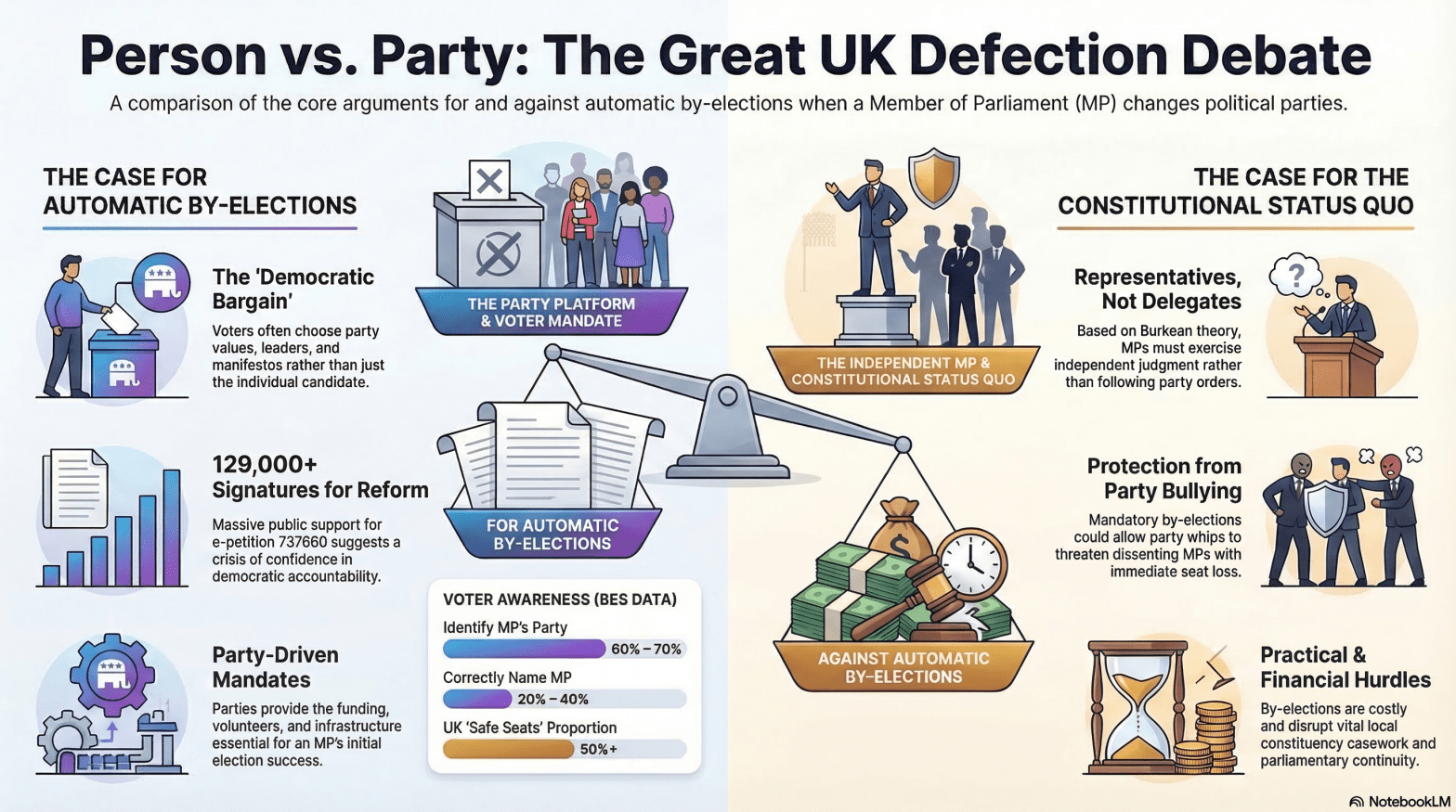
The Tension Between Party and Person The parliamentary debate, prompted by a petition with over 129,000 signatures, highlighted a key tension in the electoral system: whether voters elect an individual or a political party. While the constitutional stance is that voters elect an individual, MPs openly acknowledged that a voter’s choice is actually a complex calculation involving party values, manifestos, national leaders, and tactical voting. Data collected by political parties demonstrates that the vast majority of people cast their ballots based on the party rather than the individual candidate.
Arguments for Automatic By-Elections MPs advocating for the change argued that defections fundamentally break the trust between voters and their representatives. The core arguments included:
- The Party Mandate: Political parties provide the vital funding, campaign infrastructure, and volunteers that get candidates elected. Because most voters cast their ballots based on the national party offering, a candidate switching sides alters the platform they were elected on.
- Restoring Voter Choice: When an MP defects to a party with different values, constituents can rightfully feel betrayed. Triggering an automatic by-election is seen as a necessary mechanism to give the electorate the right to reassert their trust in the individual or choose a new representative aligned with their original party vote.
Arguments Against Automatic By-Elections Those opposing the petition argued that mandating by-elections would severely undermine parliamentary democracy and cause practical issues. Their main points included:
- The Principle of Independence: Drawing on Edmund Burke’s long-standing constitutional principle, MPs argued that they are elected to use their independent judgment and reason, not simply to act as delegates bound to a party line.
- Empowering Party Whips: There is significant concern that automatic by-elections would give party leadership too much power. It could discourage MPs from following their conscience or standing up to their party when they feel it is moving in the wrong direction.
- Practical Difficulties: Legislating this change would be incredibly complex. MPs pointed out the difficulty in legally defining “independence,” or figuring out how to handle situations where an MP loses the whip, or when political parties merge or restructure.
- Constituency Disruption: By-elections are costly to the public purse and disrupt vital local representation. During a campaign, constituency casework stalls for weeks or months, whereas under the current system, an MP who changes affiliation can continue helping residents without interruption.
- Misuse of Recall: While mechanisms like the Recall of MPs Act 2015 exist to remove MPs, they are strictly for ethical misconduct or criminality. MPs argued that conflating a change in political values or ambition with ethical misconduct would set a dangerous precedent.
Alternative Solutions and Conclusion During the debate, it was also suggested that the disillusionment driving the petition points to a deeper need for systemic reform, such as introducing Proportional Representation (PR) so that seats better reflect votes cast. Ultimately, while the debate acknowledged the primacy of party labels in modern elections, the Government and several MPs concluded that the current arrangements strike the right balance. The prevailing view remains that it is up to an individual MP’s integrity and conscience to decide if defecting requires them to resign and seek a fresh mandate from the public.
Now I maybe wrong – but my interpretation of the whole debate and outcome is – err, they may have a point, but it will require us to admit that the system has to change and that will involve a lot of messy and uncomfortable discussions.
In reality we are suffering from the fact that the people making the decisions are the people the decisions are about, i.e. it will mean they have to do extra work and will potentially destabilise the status quo. This is a common issue when we ask organisations to reform themselves, there is always a disincentive for change. This is common human reaction and behaviour and is why as a rule we design systems where we don’t ask or allow an organisation to oversee themselves or changes to how they operate without external oversight.
Right I have resisted getting my AI editor to streamline this, as I wished this to be truely from the heart. It may also explain why I generally do use AI the help streamline my arguements and present them more clearly.
All of my previous political posts started off like this and then got cleaned up and made more readable thanks to AI. I would be be interested in people’s preferences.
Ok below is an infographic summary of the debate
Discover more from Hysnaps Politics, Gaming, Music and Mental Health
Subscribe to get the latest posts sent to your email.

