

Up to now, we’ve talked about the override power mostly in theory.
We’ve said that the House of Commons can push legislation through even if the House of Lords objects — but only by doing so openly, slowly, and at a political cost.
That can sound procedural and a bit abstract.
So it’s worth asking the obvious follow-up question: when this power has actually been used, what tends to happen next?
Because if ignoring the Lords reliably led to disaster — or reliably led to success — that would tell us something important.
In practice, it’s messier than that.
Why the override exists at all
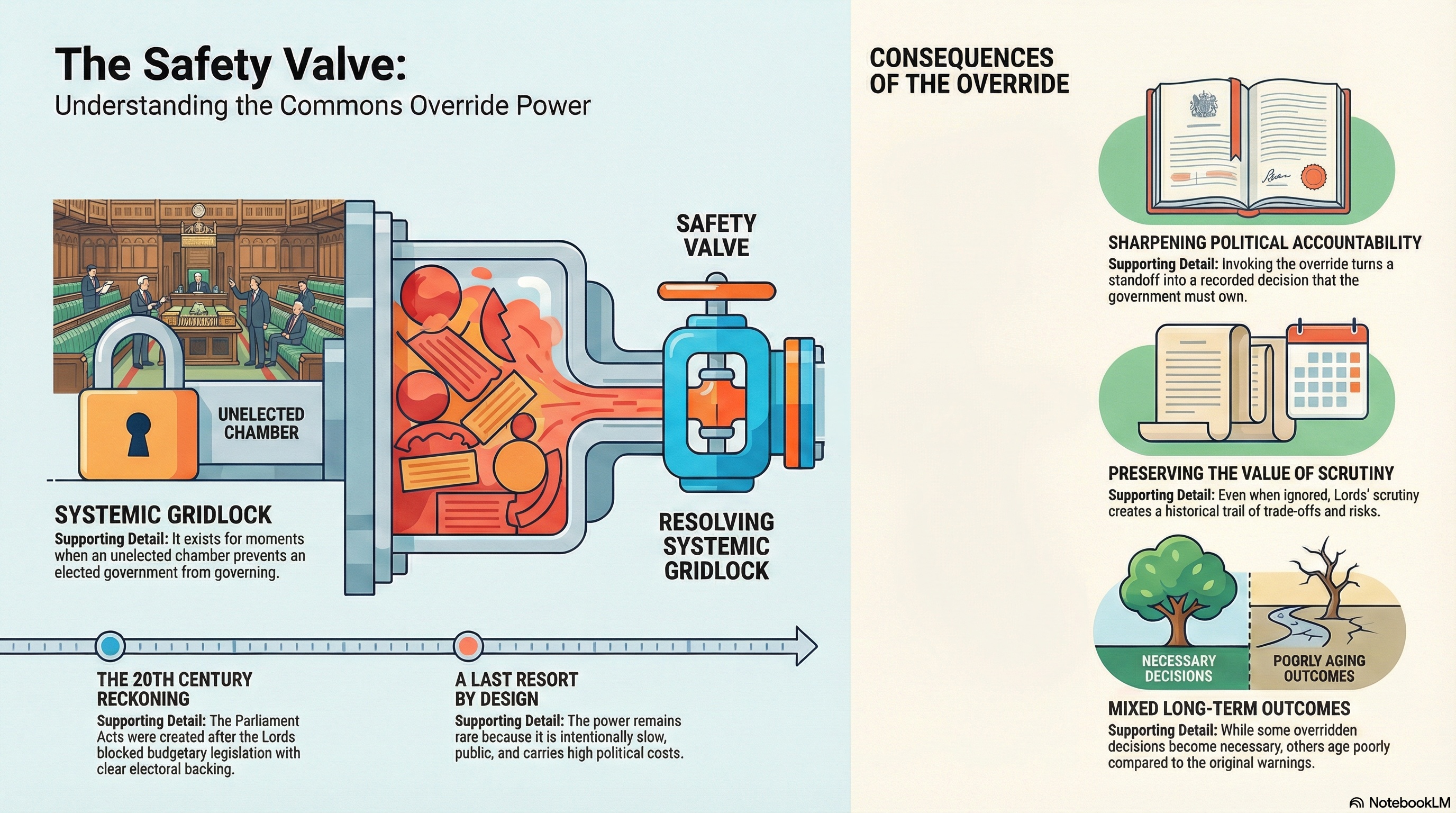
The override power wasn’t invented because the Lords was being irritating. It exists because, at certain moments, the system genuinely locked up.
The clearest early example came in the early twentieth century, when the Lords blocked budgetary legislation that had clear electoral backing. That confrontation didn’t drift to a compromise. It forced a reckoning, and the result was the Parliament Acts, which permanently shifted the balance between the two Houses.
That episode matters because it explains the purpose of the override. It’s a safety valve. It exists for moments when an unelected chamber is preventing an elected one from governing at all.
What tends to happen when it’s actually used
Once you move beyond the big, dramatic moments people tend to remember, a pattern starts to emerge.
When governments decide to invoke the override, it’s usually because they’ve concluded that the policy matters enough to push through, that the political cost is worth paying, and that delay itself has started to become part of the problem. That doesn’t automatically mean the policy is good, or wise, or well-designed. But it does mean the government is making a conscious choice to own the consequences.
And that’s the key point.
Using the override doesn’t make disagreement disappear. It crystallises it. It turns an ongoing argument into a recorded decision rather than leaving it hanging as an unresolved standoff.
Does it usually turn out well or badly?
This is the point where people often want a clean verdict.
When Parliament ignores the Lords, does it generally work out for the good of the country, or does it tend to end badly?
The honest answer is that it’s mixed — and that’s probably the most revealing thing about it.
Some decisions that were pushed through despite Lords opposition later came to be seen as necessary or inevitable. Others aged badly, with the warnings raised during scrutiny looking increasingly reasonable in hindsight.
What’s striking isn’t that the Lords was always right, or that the Commons always was. It’s that the debates themselves often age better than the outcomes. When things go wrong later, it’s common to find that someone in the Lords flagged the risk early on, even if that warning didn’t ultimately change the result.
Why scrutiny still matters even when it “loses”
This is the bit that often gets missed.
The value of scrutiny isn’t only measured by whether it stops something. It’s also measured by whether it forces arguments into the open, clarifies trade-offs, and creates a clear record of what was known at the time.
When a government overrides the Lords, it’s effectively saying: we’ve heard this, we understand the objections, and we’re choosing to proceed anyway.
That doesn’t make responsibility vanish. It sharpens it.
Years later, when outcomes are judged, there’s usually a visible trail showing what concerns were raised, who raised them, and who chose to set them aside. That record matters, even if it didn’t change the immediate outcome.
Why the override stays rare
Given that the Commons can use this power, it’s worth noticing how rarely it actually does.
Most disagreements between the two Houses are resolved through amendment, compromise, or quiet adjustment. The override is generally a last resort, not a routine tool. That rarity isn’t accidental. It’s part of the design.
If overriding the Lords were easy or consequence-free, it would be used all the time, and the Lords really would become irrelevant. Instead, the possibility of override shapes behaviour long before it’s ever invoked.
Where this leaves us
So yes, the Commons can ultimately push legislation through without the Lords’ consent.
But when it does, the decision tends to carry weight precisely because it had to be taken consciously, publicly, and against explicit warning.
That doesn’t make the Lords infallible. It does make it consequential.
Which brings us back to the question that’s been quietly building across these posts.
If the Lords’ role is to surface ethical concerns, long-term risks, and uncomfortable trade-offs — but it can ultimately be brushed aside — is this really the best place in the system for that kind of work to live?
Or are we asking one institution to carry too many responsibilities, and then criticising it for not carrying them perfectly?
That’s where we’ll go next.


This is post 6 of a series – Let’s Rethink The Lords, looking at the Upper House in the English system of politics. It will cover what it is, why it is, how it has changed, how other countries do it and potentially what could be done to improve ours.
There will be podcasts over at hysnaps-political-investigations providing explainers and summary videos at youtube @hysnapmmh, these are usually released a week or two after the Blog Post.
Discover more from Hysnaps Politics, Gaming, Music and Mental Health
Subscribe to get the latest posts sent to your email.

