Up to now, we’ve been circling something without quite naming it.
We’ve seen that the House of Lords wasn’t designed to be the nation’s ethical conscience. It evolved into a revising chamber — a brake — a place where legislation is slowed down and stress-tested.
And yet, again and again, ethical arguments end up happening there.
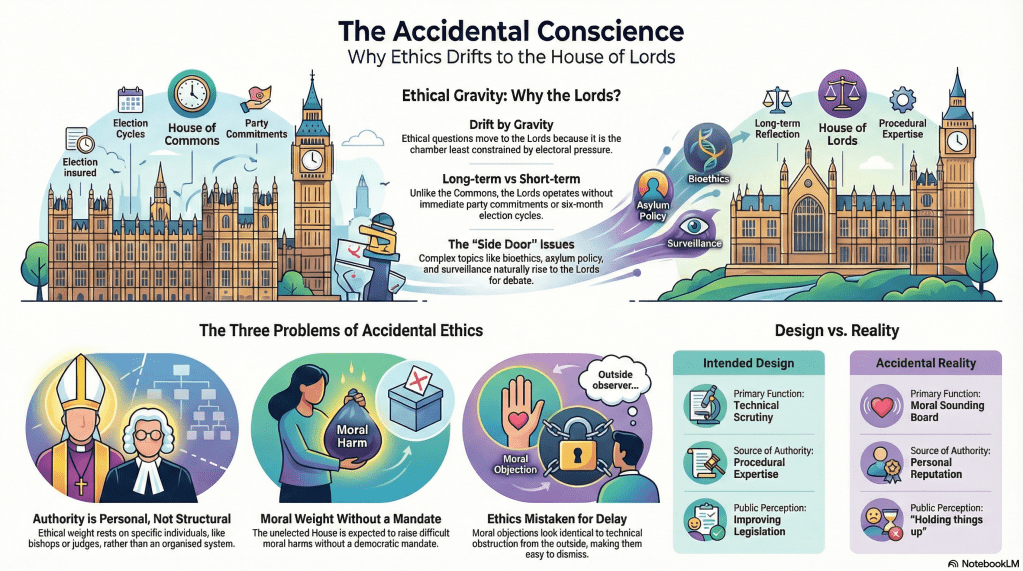
Not because anyone formally decided that ethics should live in the Lords, but because when ethical questions don’t have an obvious home, they tend to drift to the place that feels least constrained by electoral pressure.
Not by design. By gravity.
How ethics ends up in the Lords at all
Most big political decisions now have an ethical dimension baked into them.
Sometimes that’s obvious: end-of-life care, asylum policy, surveillance powers, bioethics, policing. Other times it’s quieter but just as real: housing rules, welfare design, climate trade-offs, the use of data.
When those questions hit the House of Commons, they’re usually framed through party commitments, electoral pressure, and short time horizons. That isn’t a criticism — it’s just how elected politics works.
The Lords, by contrast, isn’t fighting an election in six months’ time. It contains people with long experience and fewer immediate incentives. So when ethical concerns don’t sit comfortably inside party debate, they tend to rise upwards.
That’s how ethics creeps in through the side door.
The first problem: ethics becomes personal
Because there’s no clear ethical role in the system, ethical authority ends up being carried by people rather than by structures.
Debates start to hinge on who said what. Which bishop spoke up. Which former judge intervened. Which respected figure admitted they felt uneasy about where something was heading.
That can be powerful. A trusted voice can cut through in a way no process ever will.
But it’s also fragile. When the argument depends on who is speaking rather than how the reasoning is organised, it quickly turns into a fight about legitimacy instead of substance. People stop engaging with the ethical concern itself and start arguing about whether the person raising it “should” be there at all.
The second problem: moral weight without a mandate
There’s a deeper tension sitting underneath all of this.
We’ve deliberately stripped the Lords of power because it isn’t elected. We’re clear that it shouldn’t overrule democratic choice.
And yet we still lean on it to say the difficult moral things. To raise long-term harms. To flag when something feels wrong even if it’s popular or politically convenient.
That puts the Lords in an odd position.
It’s expected to carry moral weight, but without a clear mandate to do so. When it speaks carefully, it’s easy to ignore. When it speaks forcefully, it’s accused of overreach. Either way, it’s operating in a grey zone where the boundaries are never quite agreed.
The third problem: ethics gets mixed up with delay
There’s also a practical issue.
Ethical objections usually arrive via the same route as everything else the Lords does: amendments, scrutiny, requests for reconsideration. Procedurally, a pause to think about moral consequences looks exactly the same as a pause to fix unclear wording or technical drafting.
From the outside, it all collapses into the same complaint: “the Lords holding things up again”.
That blurs an important distinction. Are we slowing down because the text is sloppy, or because the consequences are ethically troubling? Right now, the system doesn’t really tell us — which makes it easier to dismiss both.
The fourth problem: ethics comes in bursts
Without a dedicated place to sit, ethical reasoning tends to appear in short, intense bursts. A bill arrives, attention focuses, concerns are raised, arguments are had — and then the moment passes and everyone moves on to the next thing.
There’s very little continuity. No accumulation of reasoning. No visible sense that we’re learning from previous decisions or carrying ethical lessons forward in a structured way. Each debate has to rebuild the ground from scratch.
That’s exhausting, and it’s not especially effective.
What all of this adds up to
None of this means the House of Lords is doing a bad job.
In many cases, it’s doing the best job it can with the role it’s been handed — a role it inherited by default rather than by design. But it does mean we’ve ended up with a mismatch.
We’re asking one institution to review legislation, spot technical flaws, slow things down when necessary, provide long-term caution, and quietly act as a moral sounding board as well. That’s a lot to carry, especially when some of those roles pull in different directions.
When tensions surface, we don’t usually say “the system hasn’t given ethics a proper home”. We argue about bishops, judges, or whether the Lords is being “political”.
Which misses what’s actually going on.
Where this pushes the conversation next
So if the House of Lords was never meant to deal with ethics in this way — and if relying on personal authority and inherited roles is starting to creak — the obvious question is what dealing with ethics deliberately would actually look like.
Not louder, and not more moralistic. Just clearer.
A place where ethical questions are expected rather than improvised, where reasoning is structured rather than episodic, and where different values can be examined openly instead of being smuggled into technical debates.
That’s the question we’ll take on next.
This is post 7 of a series – Let’s Rethink The Lords, looking at the Upper House in the English system of politics. It will cover what it is, why it is, how it has changed, how other countries do it and potentially what could be done to improve ours.
There will be podcasts over at hysnaps-political-investigations providing explainers and summary videos at youtube @hysnapmmh, these are usually released a week or two after the Blog Post.
Discover more from Hysnaps Politics, Gaming, Music and Mental Health
Subscribe to get the latest posts sent to your email.

