By this point, a pattern should be fairly obvious.
We keep finding ourselves having ethical arguments inside the House of Lords, not because anyone deliberately put them there, but because there hasn’t really been anywhere else for them to go.
That’s left us with a system that wants ethical questions to be taken seriously, but hasn’t quite decided where they belong.
What’s actually missing
If you strip away all the institutional history and constitutional baggage, what’s missing is surprisingly simple.
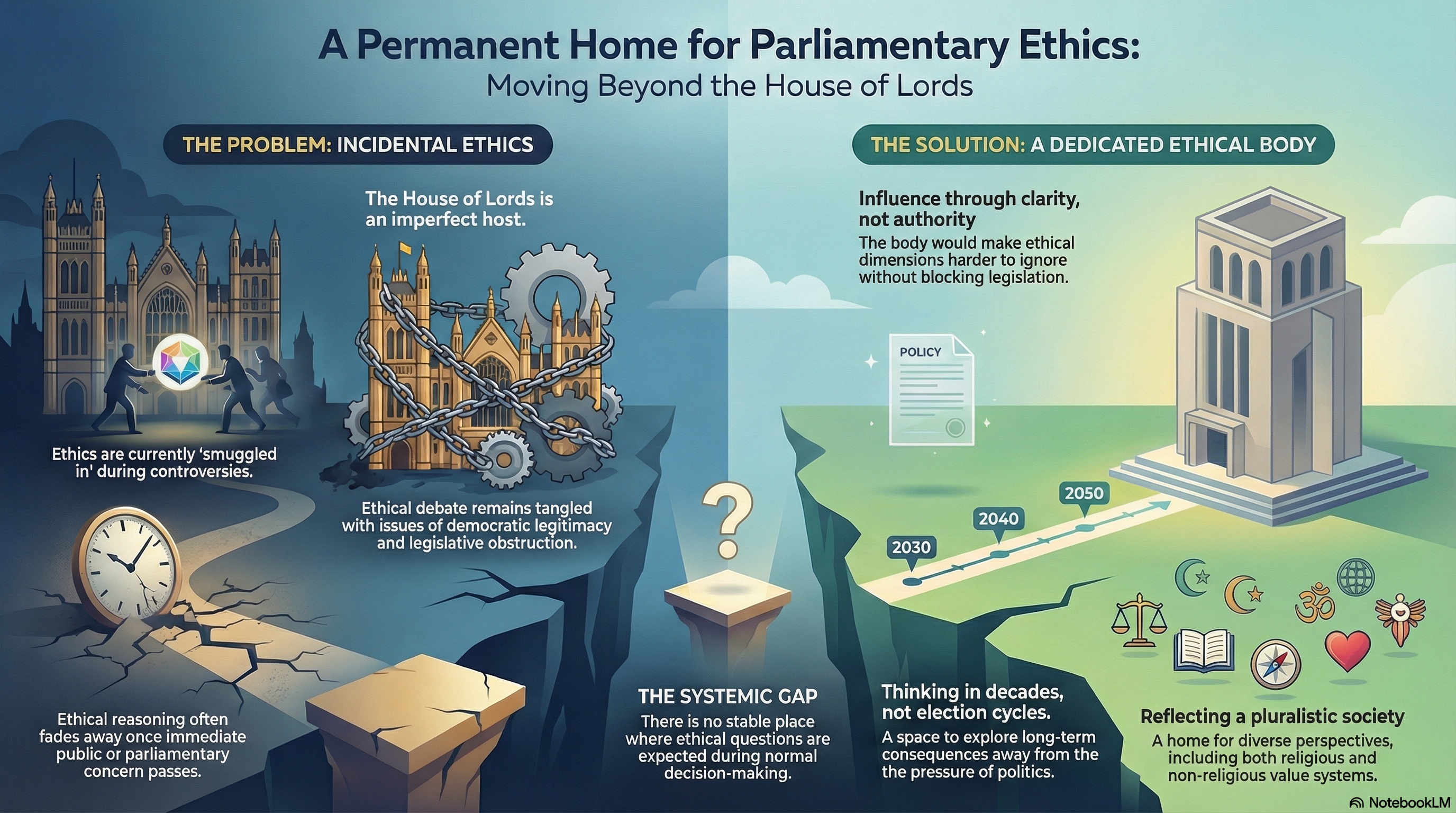
We don’t have a stable place in the system where ethical questions are expected to show up as part of normal decision-making, where they can be discussed openly rather than smuggled in through amendments or personal interventions, and where the reasoning can be carried forward instead of being rediscovered from scratch every time a new controversy erupts.
At the moment, ethics tends to appear when something feels uncomfortable, when a bill triggers public concern, or when a respected figure decides to speak up. Then, once the immediate moment has passed, it fades again.
That isn’t because politicians don’t care about ethics. It’s because the system doesn’t give ethical reasoning a permanent home.
What this isn’t about
Before going any further, it’s probably worth being clear about what this isn’t.
This isn’t about creating a new moral authority that hands down verdicts from on high. It isn’t about telling elected representatives what they must believe. And it definitely isn’t about turning ethical debate into something preachy, symbolic, or performative.
The last thing anyone needs is a body that claims to have the final moral answer. That would make things worse, not better.
What “doing ethics better” might actually mean
At a minimum, dealing with ethics better would mean having a place where ethical questions can be raised deliberately, rather than incidentally.
A place where long-term consequences can be explored without everything being filtered through the next election cycle. A place where different value systems can be heard — including religious and non-religious perspectives — without any one of them being treated as the default. A place where disagreement is expected and surfaced, rather than smoothed over for the sake of speed. And a place where the reasoning is visible, even when people come to different conclusions.
Crucially, such a body wouldn’t need the power to block legislation. Its influence wouldn’t come from authority or vetoes, but from clarity — from making the ethical dimensions of decisions harder to ignore.
Why this probably shouldn’t live inside the Lords
At this point, it’s tempting to say: couldn’t we just formalise this role inside the House of Lords?
The problem is that doing so would pull us straight back into the issues we’ve already identified. If ethics stays inside the Lords, it remains tangled up with questions of democratic legitimacy. It keeps getting mixed up with delay and obstruction. And it continues to rely heavily on who happens to be in the room at the time.
Pulling ethics out into its own space isn’t about sidelining it or downgrading its importance. It’s about giving it a clearer shape and a clearer purpose.
What this starts to point towards
Once you start thinking in these terms, a different kind of institution begins to come into view.
Not a second House of Lords. Not a rival to Parliament. And not a moral court.
Something more modest, and more focused.
You might imagine a standing body whose role is to examine the ethical dimensions of major policy choices, reflect the reality of a plural society that includes people of faith and people of no faith, think in decades rather than parliamentary terms, and feed its reasoning back into the democratic process without trying to override it.
At this stage, that’s just a direction of travel rather than a concrete proposal.
But it’s enough to set up the next step in the conversation: if we were to explore this idea seriously, what might it actually look like in practice?
This is post 7 of a series – Let’s Rethink The Lords, looking at the Upper House in the English system of politics. It will cover what it is, why it is, how it has changed, how other countries do it and potentially what could be done to improve ours.
There will be podcasts over at hysnaps-political-investigations providing explainers and summary videos at youtube @hysnapmmh, these are usually released a week or two after the Blog Post.
Discover more from Hysnaps Politics, Gaming, Music and Mental Health
Subscribe to get the latest posts sent to your email.

