Up to now, we’ve been careful not to jump too quickly to solutions.
We’ve looked at what the House of Lords actually does, how it changed over time, why ethics drifted into it by accident, and what problems that’s quietly created. All of that was groundwork.
At some point, though, you do have to ask a practical question: if we were trying to tidy this up rather than defend the inherited shape of things, what might we actually do?
So think of this less as a proposal and more as something to put on the table and walk around.
Start with a simple separation
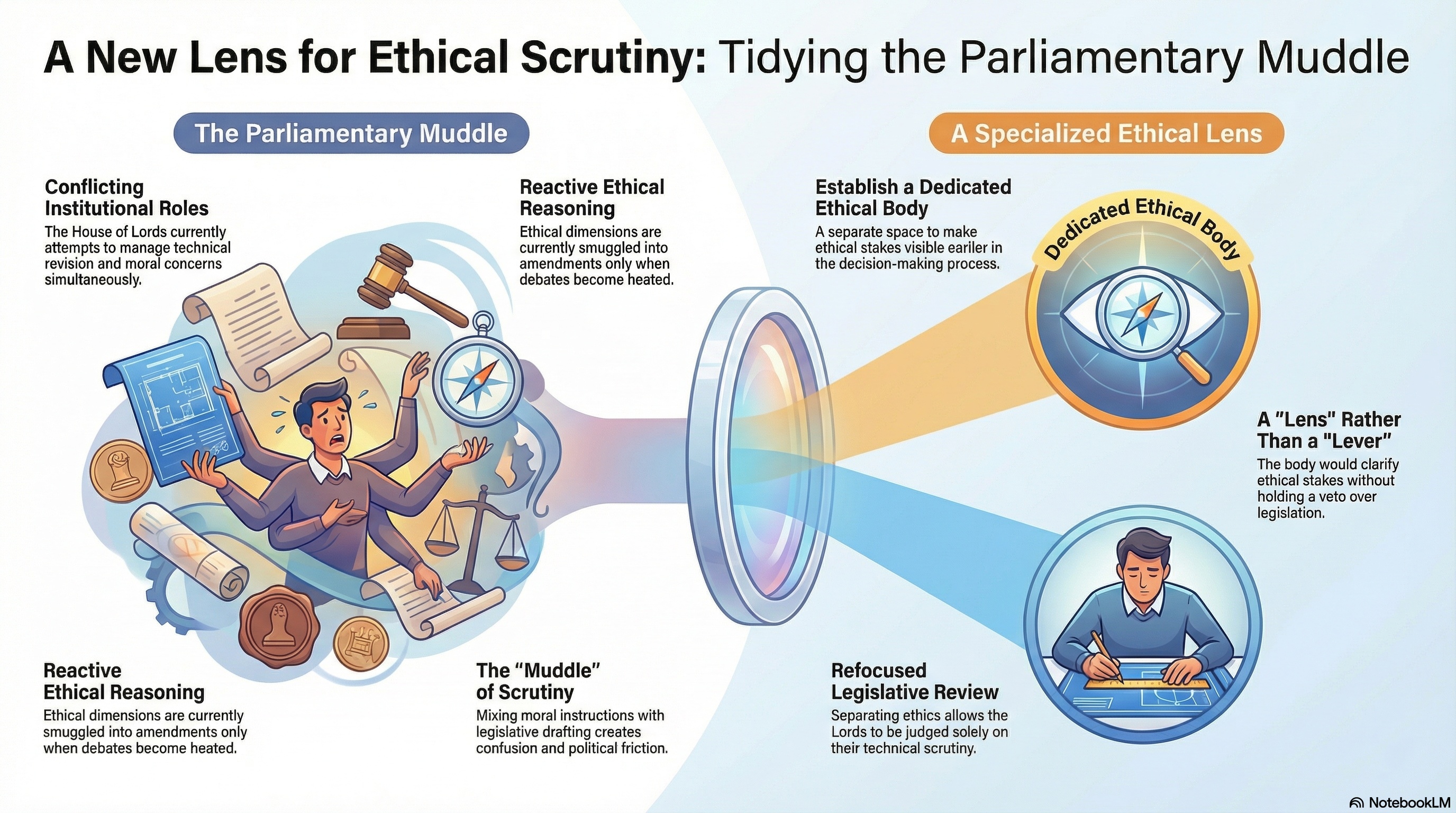
One way of making sense of the current muddle is to notice that we’ve been asking one institution to do two quite different things at the same time.
On the one hand, we want a chamber that revises legislation, spots technical flaws, and slows things down when bills are rushed or poorly drafted. On the other, we keep leaning on that same chamber to carry ethical weight — to raise moral concerns, long-term risks, and uncomfortable questions that don’t sit neatly inside party debate.
Those roles overlap, but they aren’t identical. And forcing them to live together has created a lot of the confusion we’ve been circling.
A different way of handling ethics
So imagine doing something fairly straightforward.
Instead of relying on bishops, judges, or particularly respected individuals inside the Lords to carry ethical arguments by default, imagine creating a separate body whose purpose was openly and explicitly ethical. Not in the sense of issuing moral instructions, but in the sense of expecting ethical questions to be examined as a normal part of political decision-making.
This wouldn’t be a moral authority handing down verdicts. It wouldn’t have a veto over legislation. And it wouldn’t be a rival Parliament trying to outvote the Commons.
It would simply be a place where ethical questions are expected to be raised, worked through, and made visible.
What that would actually change
At the moment, ethical reasoning tends to appear when something goes wrong or when a debate becomes heated. With a dedicated space, it would show up earlier and more consistently.
When major policies with long-term consequences were proposed, the ethical dimensions wouldn’t need to be smuggled into amendments or carried by individual voices. They’d already be part of the conversation.
Sometimes that reasoning would be ignored. Sometimes it would reshape a bill. Sometimes it would just sit there as a clear record of what was understood at the time.
That alone would be a shift.
Who this would be for
Crucially, this kind of body wouldn’t sit above Parliament. It would sit alongside it.
Its audience would be MPs, peers, committees, journalists, and the wider public — anyone trying to understand the ethical stakes of a decision without everything being filtered through party positioning.
In that sense, it would act less like a lever and more like a lens.
Why this helps the Lords too
If ethical reasoning had its own clear home, the House of Lords could be judged more fairly on the job it already does.
Instead of being criticised for overstepping when it raises moral concerns, or dismissed as irrelevant when it doesn’t, it could focus more cleanly on legislative review and revision.
That doesn’t weaken scrutiny. It clarifies it.
Where this leaves us
So that’s the option on the table: separating ethical reasoning from legislative revision, and giving each a clearer place in the system.
It doesn’t pretend disagreement will vanish, or that politics will suddenly become tidy. But it does make the argument more honest.
Instead of saying “the Lords are being awkward again”, the conversation becomes: we were warned, the trade-offs were set out, and we chose this path anyway.
The obvious next question is the practical one.
If you were even half-serious about something like this, how would it actually work in practice?
Who would sit in it?
How long would they serve?
And how do you stop it becoming either toothless or overbearing?
That’s what we’ll tackle next.

This is post 9 of a series – Let’s Rethink The Lords, looking at the Upper House in the English system of politics. It will cover what it is, why it is, how it has changed, how other countries do it and potentially what could be done to improve ours.
There will be podcasts over at hysnaps-political-investigations providing explainers and summary videos at youtube @hysnapmmh, these are usually released a week or two after the Blog Post.
Discover more from Hysnaps Politics, Gaming, Music and Mental Health
Subscribe to get the latest posts sent to your email.

