Up to now, this has all been quite deliberately sketchy.
We’ve talked about why ethical reasoning keeps getting pushed into the House of Lords by default, and what might change if we gave it a clearer home. At some point, though, the obvious question arrives: how would something like this actually work in practice?
So let’s try to answer that without building a constitutional castle in the air.
Start by keeping it smaller than you think
The easiest way to get this wrong would be to overbuild it.
This doesn’t need to turn into another elected chamber that starts competing with the Commons, or a kind of mini–Supreme Court issuing quasi-legal judgements, or a body that can stall legislation on its own authority. As soon as it starts to resemble any of those, it runs straight into legitimacy problems and political resistance — and rightly so.
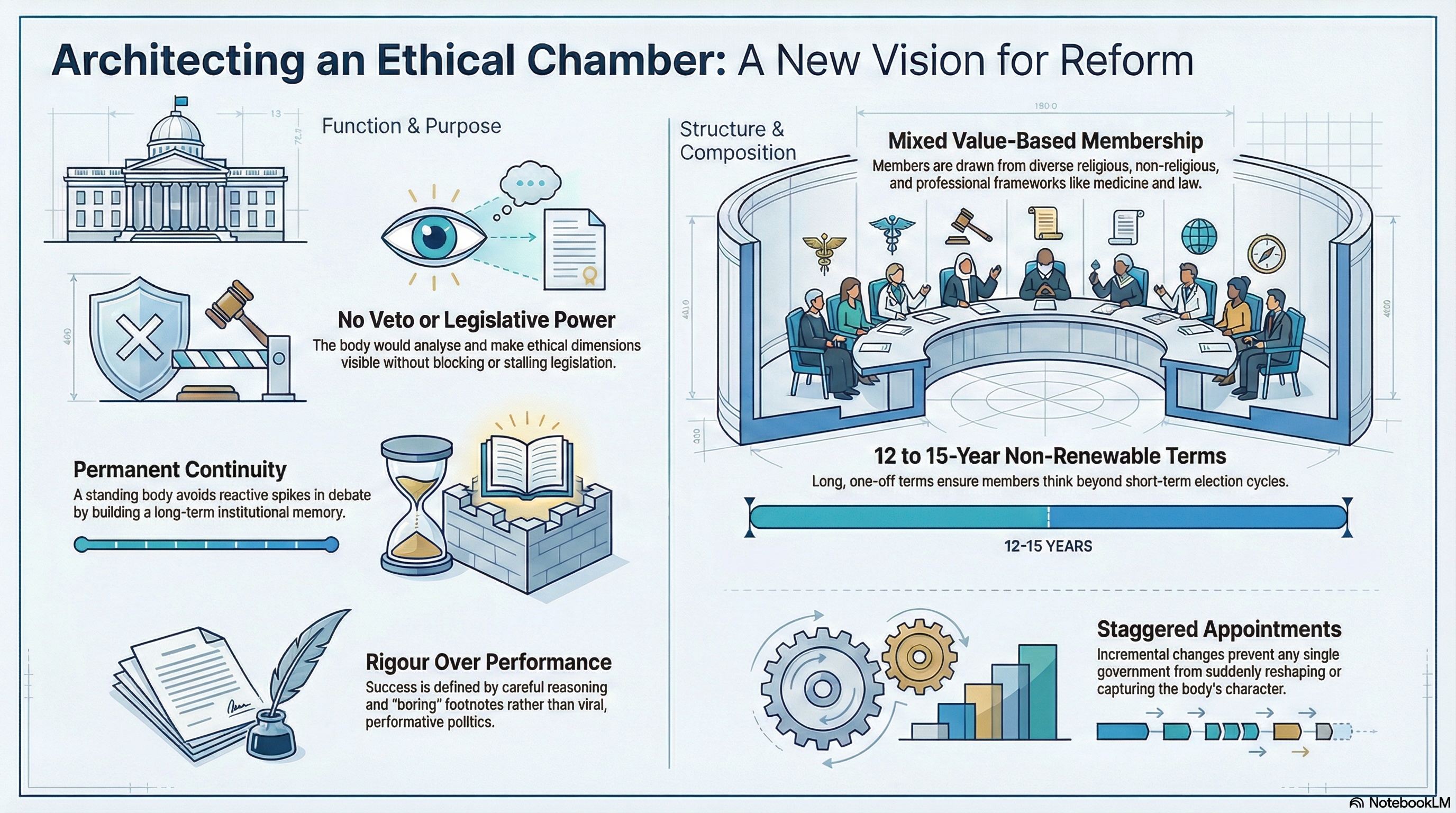
The constraint here is simple. It wouldn’t have a veto. It wouldn’t be able to block legislation. And it wouldn’t exercise direct control over anything. Its job would be to think, to analyse, and to make ethical dimensions visible — not to rule.
Make it permanent, not reactive
One of the problems we’ve seen already is that ethical debate currently arrives in flashes. Something lands, attention spikes, arguments happen, and then the system moves on.
If you want something better than that, you need continuity.
That points towards a standing body rather than ad-hoc panels or one-off commissions. Something that exists year after year, builds memory, and can recognise when the same ethical patterns are repeating.
Not because it has the answer, but because it remembers the question.
Who would sit in it?
This is usually the point where people get uneasy — and that’s fair.
If you make it elected, it starts to look like a rival to the House of Commons. If you make it purely appointed, people worry about capture or quiet cronyism. If you lean too hard on technical expertise, it can drift into technocracy and lose touch with lived values.
So the safest approach is probably a mix.
You’d want people drawn from different value traditions, including religious and non-religious perspectives, alongside people who’ve spent time working in areas where ethical trade-offs are unavoidable — medicine, law, science, social care, data, defence, climate policy. The aim wouldn’t be to find the “right” moral answer, but to make sure different moral frameworks are present and can be heard.
Long terms, slow change
If this body is meant to think beyond election cycles, its structure needs to reflect that.
That suggests long, non-renewable terms — perhaps something in the region of twelve to fifteen years — with staggered appointments. That way, no single government can reshape it quickly, and any attempt to influence it would be slow and visible rather than sudden and decisive.
You’d always be able to see who appointed whom, and when.
How it would relate to Parliament
This body wouldn’t sit above Parliament, and it wouldn’t sit inside it either.
Instead, it would sit alongside. Its work would feed into select committees, inform scrutiny in the Lords, and give MPs something concrete to respond to when ethical issues arise.
That distinction matters.
The aim isn’t to take responsibility away from elected politicians. It’s to make it harder for anyone to pretend the ethical dimension of a decision was never raised or explored.
Why being boring is a feature, not a bug
One of the best safeguards here is dullness.
If this body became glamorous, combative, or performative, it would have failed. Its strength would come from being predictable, steady, and difficult to dismiss, not from dominating headlines or producing viral moments.
You’d expect fewer speeches and more footnotes. Less drama, more careful reasoning.
That may not sound exciting, but it’s often how institutions that quietly last are built.
Where this leaves us
So yes, something like this could be built without tearing up the constitution or inventing a new moral elite.
It would be modest in power, slow to change, and deliberately constrained. It wouldn’t settle arguments, but it would make them clearer and harder to ignore.
Which brings us neatly to the next question.
If we did something like this for ethics, what does that mean for the House of Lords itself?
Does it change its role, its shape, or the case for reform more broadly?
That’s where we’ll go next.
This is post 10 of a series – Let’s Rethink The Lords, looking at the Upper House in the English system of politics. It will cover what it is, why it is, how it has changed, how other countries do it and potentially what could be done to improve ours.
There will be podcasts over at hysnaps-political-investigations providing explainers and summary videos at youtube @hysnapmmh, these are usually released a week or two after the Blog Post.
Discover more from Hysnaps Politics, Gaming, Music and Mental Health
Subscribe to get the latest posts sent to your email.

