Up to now, we’ve mostly been talking around the House of Lords rather than straight at it.
We’ve looked at how ethical questions drifted into it, why that happened without anyone really planning it, and what might change if ethical reasoning had a clearer home of its own. Which brings us to the point in the conversation where someone inevitably leans back and says:
“So… if you do all that, what’s left for the Lords?”
It’s a reasonable question. And the answer turns out to be much less dramatic than it might sound.
This isn’t about abolishing the Lords
The first thing to be clear about is that none of this implies scrapping the House of Lords.
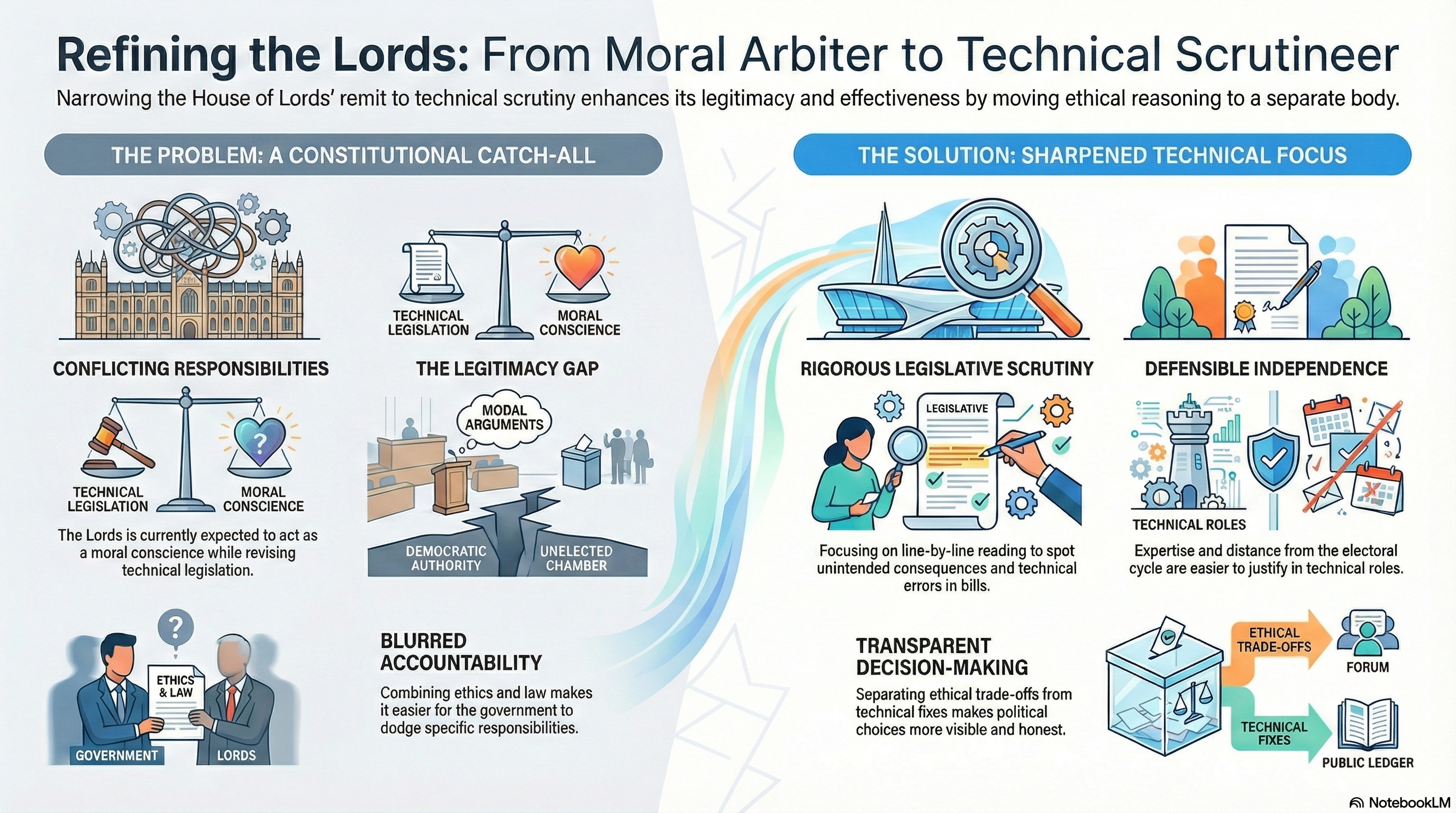
If anything, separating ethics out makes the Lords easier to explain and easier to defend. At the moment, it’s doing several jobs at once, some of which sit slightly awkwardly together. It revises legislation, catches technical problems, slows things down when bills are rushed — and at the same time it’s often expected, informally, to act as a kind of moral backstop.
Taking that last expectation away doesn’t weaken the Lords. It sharpens what it’s actually there for.
Back to the job it already does quietly well
Once the pressure to act as the nation’s ethical conscience is lifted, the Lords can focus more clearly on legislative scrutiny.
That means the unglamorous but important work people rarely notice until it’s missing. Reading bills line by line. Spotting where wording doesn’t quite do what ministers think it does. Flagging unintended consequences that only become obvious once you’ve lived inside a system for a long time. Forcing explanations when policy sounds tidy in principle but messy in practice.
Those things don’t trend on social media, but they’re exactly the sort of work that benefits from experience, independence, and a bit of distance from the electoral cycle. And they’re far easier to justify in an unelected chamber.
Fewer arguments about legitimacy, fewer crossed wires
One of the constant sources of tension around the Lords is what happens when it raises moral concerns.
The conversation very quickly shifts away from the substance of the issue and towards the people raising it. Why should bishops have a say? Why should former judges carry weight? Who asked these people to decide what’s right or wrong?
If ethical reasoning had a clearer home elsewhere, a lot of that noise would fall away. The Lords would still scrutinise legislation, still raise concerns, and still ask awkward questions — but it would be doing so on technical, constitutional, and practical grounds, rather than being cast as an unelected moral authority.
That’s a much more stable place for it to sit.
It also changes how override decisions feel
There’s another, subtler effect.
If ethical concerns are being examined openly in a dedicated space, then when the House of Commons decides to push ahead anyway, the story changes slightly.
Instead of the familiar refrain that “the government ignored the Lords again”, the picture becomes clearer and more honest. The ethical risks were set out. The trade-offs were visible. Parliament debated them. And a choice was made.
That doesn’t stop hard decisions. But it does make responsibility harder to dodge.
What this still leaves unresolved
Of course, none of this magically settles every question about the Lords.
It doesn’t answer how members should be appointed, whether terms should be time-limited, whether there should be an elected element, or how large the chamber ought to be. Those debates don’t disappear.
What changes is that we’re no longer trying to force one institution to carry every unresolved tension in the system. Once ethics has a clearer place, reforming the Lords becomes a more focused conversation about scrutiny, expertise, independence, and long-term thinking — rather than a proxy argument about morality, religion, and democratic legitimacy all rolled into one.
Where this takes us next
So by this point in the series, something important has shifted.
We’ve stopped treating the House of Lords as a kind of constitutional catch-all and started asking what each part of the system is actually for. That makes reform feel less like an ideological fight and more like a design problem.
Which sets us up for the next, slightly uncomfortable step.
If we’re serious about reform rather than just rearranging the furniture, we need to ask how all of this could go wrong. How a new body might be captured, sidelined, ignored, or quietly hollowed out.
That’s the stress-test — and that’s where we’ll go next.

This is post 11 of a series – Let’s Rethink The Lords, looking at the Upper House in the English system of politics. It will cover what it is, why it is, how it has changed, how other countries do it and potentially what could be done to improve ours.
There will be podcasts over at hysnaps-political-investigations providing explainers and summary videos at youtube @hysnapmmh, these are usually released a week or two after the Blog Post.
Discover more from Hysnaps Politics, Gaming, Music and Mental Health
Subscribe to get the latest posts sent to your email.

